searchkeywordcontent
From Keywords to Conversations: Why Keyword Density and Backlinks Don't Work for Generative Engines
What if the SEO playbook that built your organic traffic over the last decade is now actively irrelevant—not broken, not diminished, but architecturally invisible to the engines your audience is increasingly using to find answers?
10 min read

# From Keywords to Conversations: Why Keyword Density and Backlinks Don't Work for Generative Engines

*What if the SEO playbook that built your organic traffic over the last decade is now actively irrelevant—not broken, not diminished, but architecturally invisible to the engines your audience is increasingly using to find answers?*

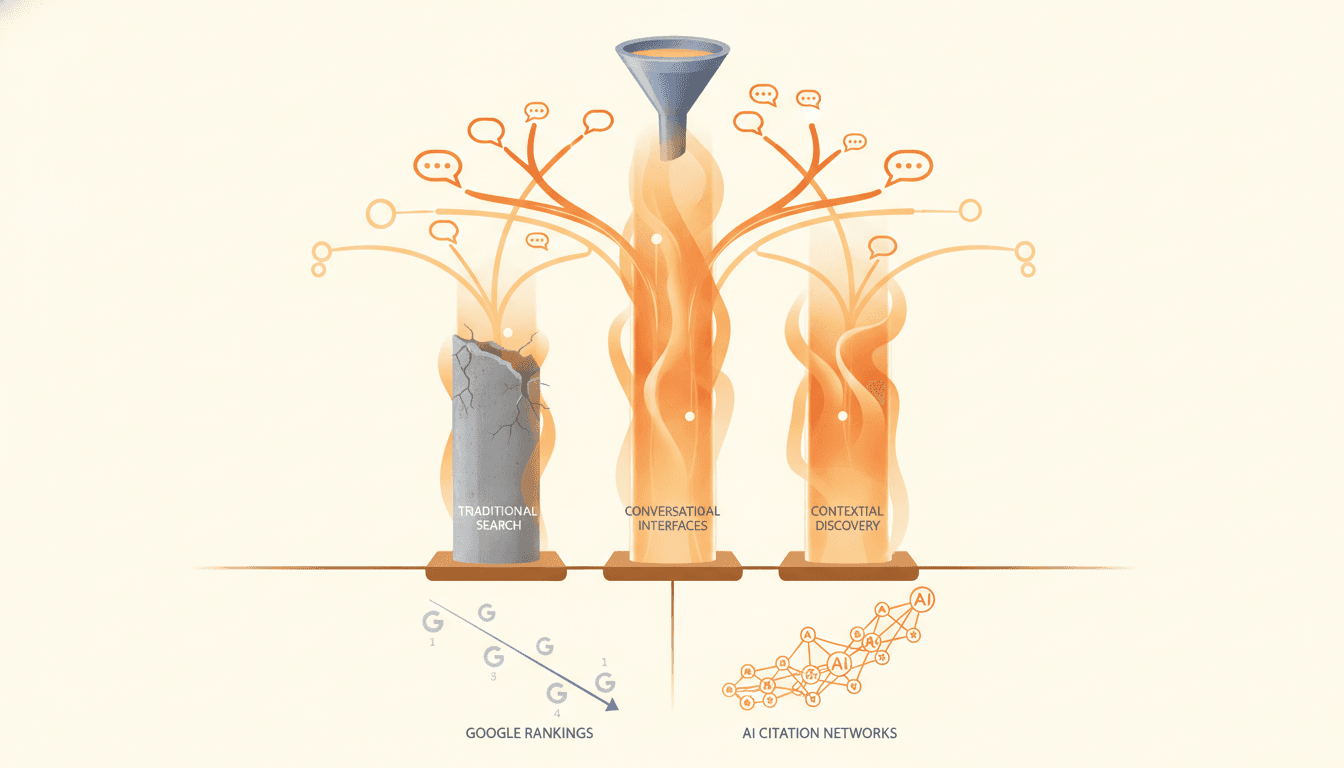
[IMG: Split-screen visual showing a traditional search results page on the left versus an AI-generated conversational answer panel on the right, with visual contrast between link-based ranking and semantic answer selection]


---


## The Rules Changed. Most Marketers Haven't.

For two decades, search engine optimization operated on a relatively stable set of assumptions: earn backlinks from authoritative domains, optimize keyword density, claim the top organic position. The entire discipline was engineered around measurable signals—acquirable, and to some degree, gameable.

Generative AI search engines work on fundamentally different principles. **Large language models process language semantically through vector representations**, not lexically through keyword counts. This distinction matters profoundly: a page stuffed with a target keyword does not score higher in an LLM's internal representations than a page discussing the topic with depth and terminological variety. As [Vaswani et al.'s foundational transformer architecture research](https://arxiv.org/abs/1706.03762) established, keyword density is a meaningless signal that AI engines never incorporated and cannot use during inference or retrieval.

The implications for backlinks are equally stark. Backlinks operate on the web's hyperlink graph—a structure that is, as [Stanford's NLP course notes on LLM architecture](https://web.stanford.edu/class/cs224n/) explain, **architecturally invisible to large language models**. LLMs do not ingest or process web graphs during inference. They operate on tokenized text. The entire link-based authority system is simply irrelevant at the model level.

Here's where the shift becomes concrete: [Retrieval-Augmented Generation (RAG)](https://arxiv.org/abs/2005.11401) systems—used by Perplexity, Bing Copilot, and Google AI Overviews—select chunks of text based on vector similarity to the user's query, not on the number of inbound links the source page has accumulated. The optimization target shifts from "ranking signals" to **semantic relevance and answer completeness** at the passage level.

This structural decoupling between traditional SEO and AI citation is already visible in the data. [BrightEdge's Generative AI Search Research Report](https://www.brightedge.com/resources/research-reports/generative-ai-search) found that **41% of URLs cited in Google AI Overview responses did not appear in the top 10 traditional organic search results** for the same query. Organic ranking and AI citation are not the same race. They are not even the same sport.

What AI engines actually evaluate is substantively different: text content quality, source reputation, factual density, and whether other credible sources reference the brand or claim. Keyword density is not part of the equation. Neither is PageRank. Understanding why—and what replaces them—is the central challenge for marketers navigating the generative search era.

[IMG: Diagram illustrating how RAG systems work—showing a user query being converted to a vector, matched against a content database by semantic similarity, and returned as a cited AI answer—contrasted with a traditional PageRank link graph]


---


## What the Research Actually Shows About AI Citation

The shift from keyword optimization to generative engine optimization (GEO) is not speculative. It is increasingly well-documented in peer-reviewed research, industry studies, and direct analysis of AI engine outputs. Three findings stand out as particularly actionable for marketing teams.

### Factual Density and Authoritative Attribution Drive Citation Rates

The most empirically rigorous work on this question comes from Princeton University. The [GEO research paper by Aggarwal et al.](https://arxiv.org/abs/2311.09735) established that adding statistics, expert citations, and authoritative attributions to content **increases AI citation rates by up to 5.4 times** compared to identical content without those elements. This dwarfs the impact of any keyword-level optimization and represents the first empirically validated optimization framework specifically designed for generative engines.

Lead researcher Pranjal Aggarwal was direct about the mechanism: "Our research shows that the single biggest predictor of whether a source gets cited by an AI is whether it contains a citable, self-contained fact—a statistic with attribution, a definition, a named expert claim. Keyword optimization is essentially orthogonal to that goal."

The practical implication is significant. Content that contains original data, named statistics, expert attributions, and structured definitions—elements that make a passage quotable and self-contained—is disproportionately surfaced as an answer snippet. The [Semrush State of Search 2024 Generative AI Citation Analysis](https://www.semrush.com/state-of-search/) confirmed this pattern, finding that AI models exhibit a strong preference for exactly these content characteristics across both Perplexity and ChatGPT Browse outputs.

GEO as a formal discipline was first defined in academic literature in 2023, with researchers at Princeton, Georgia Tech, and The Allen Institute for AI identifying "authoritative citation signals," "fluency," and "statistics inclusion" as the top drivers of AI source selection. These are content quality signals, not technical SEO signals—and that distinction reshapes how marketing teams should allocate their optimization efforts.

### Backlink Volume Has Near-Zero Predictive Power for AI Citation

The data on backlinks is unambiguous. A [correlation study by Ziff Davis and Moz](https://moz.com/blog) analyzing traditional SEO metrics against AI citation rates found a **Pearson correlation coefficient of just 0.18** between a page's number of referring domains and its likelihood of being cited in AI Overview responses. This near-zero correlation suggests backlinks have minimal predictive power for generative engine inclusion.

This finding is reinforced by citation pattern analysis. A [Semrush and Backlinko study](https://backlinko.com/ai-search-citation-study) of Perplexity and ChatGPT Browse outputs found that **68% of AI-generated responses included at least one citation to a source with a Domain Authority below 50**—indicating that high DA, which functions as a proxy for backlink volume, is not a prerequisite for AI citation. Perplexity AI's citation engine, as documented in the [Perplexity AI Engineering Blog](https://www.perplexity.ai/hub/blog), selects sources based on real-time retrieval relevance and domain trustworthiness signals, not PageRank or domain authority scores.

Aleyda Solis, International SEO Consultant and Founder of Orainti, articulated the architectural reason clearly: "Generative models don't see your backlink profile. They see your words, your structure, your factual density, and whether other credible sources talk about you. The entire link graph—the foundation of two decades of SEO—is simply not part of the equation."

A highly linked legacy page can be outcompeted by a newer, more factually precise source because the retrieval system is selecting for answer quality, not accumulated authority. This represents genuine democratization of AI search visibility—but only for brands willing to compete on substance rather than on link acquisition.

### Off-Site Reputation Outperforms On-Page Authority

Here's how the optimization locus shifts in practice: **third-party mentions and editorial coverage across trusted domains** are a stronger predictor of AI brand recommendations than a brand's own website authority. A [Profound AI Brand Visibility Report](https://www.profound.com/resources) analyzing over 10,000 ChatGPT responses found that brand mentions in AI outputs correlated most strongly with the breadth of third-party editorial coverage—mentions in trade publications, forums, and review sites—rather than with the brand's own website authority metrics.

This finding reframes the entire discipline. Rand Fishkin, Co-founder of SparkToro and former CEO of Moz, described the shift in terms that every marketing leader should internalize: "The old model of SEO was about signals—links, keywords, meta tags—that you could engineer. AI search is about substance. You can't engineer your way into an LLM's trust; you have to actually be the best answer. That's a fundamentally different game."

The urgency of adapting to this reality is underscored by two additional data points. A [SparkToro and Rand Fishkin AI Search Behavior Survey](https://sparktoro.com/blog) found that **58% of marketers who relied on keyword-focused content strategies reported no measurable improvement in AI search visibility after six months**, versus 29% who saw improvement after shifting to topic-authority and structured-content approaches. Additionally, an [Edelman and Salesforce State of the Connected Customer Report](https://www.salesforce.com/resources/research-reports/state-of-the-connected-customer/) found that **84% of consumers using AI assistants for product or service research cannot name the specific website the AI sourced its answer from**—meaning AI search shifts brand competition from ranking positions to recommendation frequency and answer inclusion.

Lily Ray, VP of SEO Strategy and Research at Amsive, captured the stakes of this transition precisely: "We are entering an era where the question is not 'does Google rank me?' but 'does the AI know me?' Those are answered by completely different bodies of evidence. One rewards link acquisition; the other rewards genuine expertise expressed in language a model can confidently reproduce."

### The One Technical Tactic That Still Transfers

Not everything from traditional SEO is obsolete. **Schema markup and structured data** represent one of the few technical SEO tactics with genuine transferability to GEO. Explicit semantic labeling—through schema types like FAQPage, HowTo, and Article—helps retrieval systems accurately extract and attribute answer candidates, as documented in [Google's Structured Data Documentation](https://developers.google.com/search/docs/appearance/structured-data/intro-structured-data).

Google's E-E-A-T framework (Experience, Expertise, Authoritativeness, Trustworthiness) has similarly become the closest bridge between traditional SEO and generative engine optimization. AI models independently weight signals that map to these same dimensions—author credentials, factual accuracy, and source reputation—as outlined in [Google's Search Quality Evaluator Guidelines, 2024 Edition](https://static.googleusercontent.com/media/guidelines.raterhub.com/en//searchqualityevaluatorguidelines.pdf). The critical difference is that E-E-A-T signals must now be expressed in the content itself, not engineered through external link acquisition.

Keyword density, by contrast, was effectively deprecated for traditional search over a decade ago. Google's Panda update in 2011 and Hummingbird in 2013 made it irrelevant for conventional SEO. AI engines never adopted this signal at any stage of their development. Optimizing for it in 2025 is not just ineffective—it is a misallocation of resources against a signal that has been irrelevant for over a decade in any search context.

[IMG: Comparison table graphic showing traditional SEO ranking factors (backlinks, keyword density, meta tags, domain authority) on the left versus GEO optimization factors (factual density, third-party citations, structured data, topic authority, expert attribution) on the right, with visual indicators of which factors transfer and which do not]


---


## What Comes Next for AI-Era Content Strategy

The evidence is consistent across independent research sources, industry analyses, and direct AI output studies. **Keyword density and backlink volume are not weak signals for generative engines—they are absent signals.** The optimization frameworks built around them do not transfer to AI search, and the data shows that continuing to rely on them produces no measurable improvement in AI visibility.

The path forward is defined by five concrete priorities:

**Factual density over keyword frequency** — Include original data, named statistics, and expert attributions that make content self-contained and citable at the passage level.

**Third-party reputation over on-page authority** — Pursue editorial coverage in trade publications, forums, and review platforms where AI systems learn to associate a brand with topical credibility.

**Structured data and semantic markup** — Implement schema markup to help retrieval systems accurately extract and attribute answer candidates from your content.

**Topic authority over keyword targeting** — Build comprehensive, expert-level content on defined subject areas rather than optimizing individual pages for search volume.

**E-E-A-T expression in content** — Make author credentials, source attributions, and factual accuracy explicit within the content itself, not dependent on external link signals.

The brands that establish AI recommendation presence now—before the competitive landscape fully recognizes the shift—will hold a structural advantage as generative search continues to capture a larger share of information-seeking behavior. The 84% of consumers who cannot name the source behind an AI answer are still being influenced by that recommendation. The question is whether your brand is the one being suggested.


---


## The Transition Ahead

The shift from keyword optimization to generative engine optimization is not a refinement of existing strategy. It is a foundational reorientation toward substance, credibility, and the kind of factual precision that AI systems are specifically designed to surface. The marketers who understand this distinction—and act on it—are the ones who will remain visible in the next era of search.

The competitive advantage belongs to those who move first. The data is clear. The path is defined. The only remaining question is whether your organization will adapt before your competitors do.


---


*Ready to build a content strategy designed for how AI engines actually work?* **[Learn how Hexagon can help.](https://hexagon.com)**
H
Hexagon Team
Published July 16, 2026