searchbrandscommerce
AI Search Disruption 2026: How Generative Engines Are Fundamentally Reshaping E-Commerce Revenue Models
The organic search model that powered e-commerce for two decades is collapsing. With 58% of Google searches now ending without a single click, and AI-recommended brands converting at 2.3x the rate of paid search results, the $45 billion AI commerce opportunity demands a board-level response—not a marketing department memo.
18 min read
# AI Search Disruption 2026: How Generative Engines Are Fundamentally Reshaping E-Commerce Revenue Models

*The organic search model that powered e-commerce for two decades is collapsing. With 58% of Google searches now ending without a single click, and AI-recommended brands converting at 2.3x the rate of paid search results, the $45 billion AI commerce opportunity demands a board-level response—not a marketing department memo.*

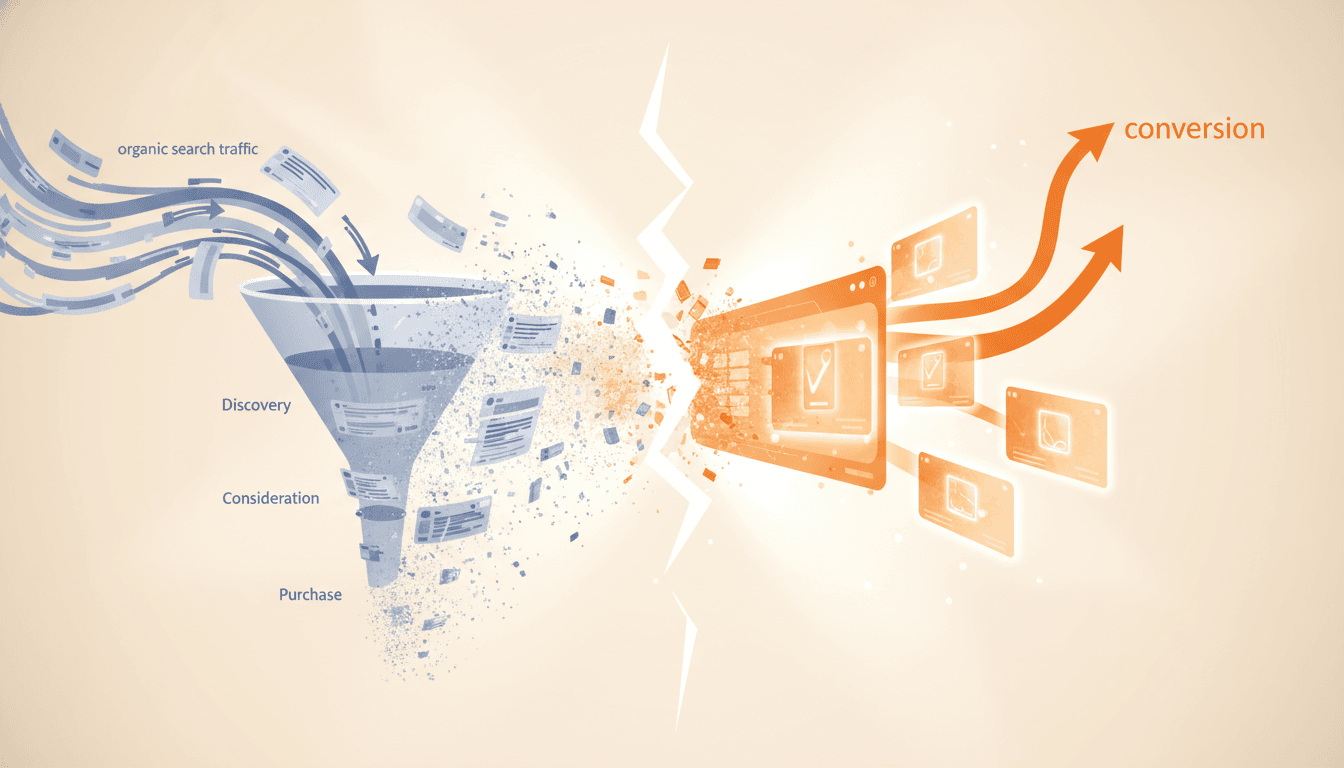
[IMG: Split-screen visualization showing traditional search funnel fragmenting on the left versus AI-powered discovery funnel consolidating on the right, with revenue flow indicators]


---


## The Structural Shift Has Already Begun

In 2004, Google's PageRank algorithm democratized e-commerce. Building authority, ranking for keywords, and capturing traffic became the standard formula. For two decades, this approach worked flawlessly. In 2025, it is broken.

The numbers tell a stark story: **58% of Google searches now result in zero clicks to external websites**—a metric that has accelerated sharply since AI Overviews began rolling out. Simultaneously, brands cited by AI assistants convert at 2.3x the rate of traditional paid search results.

The market is repricing in real time, and organizations that fail to recognize this shift within the next 12 months risk structural disadvantage that compounds over years. This is not a gradual transition. It is a competitive restructuring happening faster than most annual planning cycles can accommodate.


---


## The Structural Collapse: Why 58% Zero-Click Rate Signals the End of Organic Search Economics

[IMG: Line graph showing zero-click search rate trajectory from 2019 to 2025, with sharp acceleration curve beginning in 2023 when AI Overviews launched]

The evidence is overwhelming. According to [SparkToro's Zero-Click Search Study](https://sparktoro.com), **58.5% of U.S. Google searches now result in zero clicks to external websites**—a dramatic acceleration since AI Overviews began capturing commercial query categories in 2023. For two decades, e-commerce brands built revenue models on a simple assumption: search volume equals site traffic. That assumption no longer holds.

What makes this disruption acute is *which* searches are disappearing. AI Overviews are not capturing low-value informational queries. They are systematically intercepting the highest-intent commercial searches—product comparisons, buying guides, best-of lists—the exact query types that historically drove e-commerce conversion.

[SparkToro and Datos research](https://sparktoro.com) confirms that AI-generated results now appear on over 60% of U.S. Google queries, reducing organic click-through rates on commercial searches by 25–35% compared to pre-AI baselines.

The critical reframe for e-commerce executives: zero-click search doesn't mean zero-value queries. It means **the value is being extracted by AI platforms, not captured by the brand**. According to [Forrester Research](https://www.forrester.com), AI assistants are compressing the traditional e-commerce funnel from an average of 7–12 touchpoints to as few as 2–3 AI-mediated interactions.

The customer journey is still happening. The brand simply isn't part of it. The acceleration is not gradual—it is exponential, with Google's AI Overviews expansion into commercial categories moving faster than most brands' quarterly planning cycles.

Mid-market and smaller e-commerce brands that depend on organic search for 30% or more of their traffic face immediate revenue model disruption. Revenue impact modeling suggests brands with heavy organic dependency could face **20–40% traffic losses** as AI Overview coverage expands through the remainder of 2025 and into 2026.

The brands most exposed are those that treated organic search as a low-cost acquisition channel and never built redundancy. For most e-commerce organizations, the disruption is not coming. It has already arrived.


---


## The Trust Premium: Why AI Recommendations Convert 2.3x Better Than Paid Search

[IMG: Bar chart comparing conversion rates across channels: AI recommendations, organic search, paid search, and display advertising, with AI recommendations clearly dominant]

The conversion advantage of AI-cited brands is not marginal—it is transformational. **Hexagon's analysis of 10,000+ brands across eight product categories** found that brands appearing in AI assistant recommendations converted at 2.3x the rate of brands appearing only in traditional paid search results.

Understanding why this premium exists is essential for executives deciding where to allocate capital. The mechanism is rooted in consumer psychology: when people encounter a brand in an AI recommendation, they perceive it as independent validation rather than paid placement.

[BrightEdge's AI Search Consumer Behavior Report](https://www.brightedge.com) found that consumers who discover a brand through an AI Overview report **41% higher trust scores** compared to those encountering the same brand through paid search ads. This "authority halo" cannot be purchased. It must be earned.

The demographic shift reinforces this trend. According to [Morning Consult's AI Consumer Behavior Tracker](https://morningconsult.com), **71% of consumers aged 18–44 now use an AI assistant for product research at least once per month**—up from 31% in 2023. Among this cohort, 43% report that AI recommendations have directly replaced a search engine query they would have previously conducted.

These are not experimental users. They are the core purchasing demographic for most e-commerce categories. The economic implications extend beyond conversion rates: Hexagon's data shows that **brands with structured AI visibility strategies report 15–28% lower customer acquisition costs** compared to control groups relying on traditional paid search.

AI-referred visitors arrive with higher purchase intent and require fewer paid retargeting exposures before conversion—compressing the cost structure of the entire acquisition funnel. As Jim Yu, CEO of BrightEdge, observed: *"Brands that appear in those results inherit a trust premium that paid advertising simply cannot replicate. This is the new moat in e-commerce."* For executives still treating AI visibility as optional, that moat is being built by competitors right now.


---


## The Death of the Keyword Auction: How AI Visibility Is Earned, Not Purchased

Traditional paid search operates on a transparent model: the highest budget wins visibility. AI recommendation systems operate on fundamentally different logic. Here, **brand reputation, data quality, entity consistency, and contextual relevance determine who gets cited**. Budget is largely irrelevant.

This inversion has profound competitive implications. Hexagon's cross-category analysis reveals that AI search recommendation frequency is:

- **78% correlated with review volume and recency**—the single most impactful signal
- **67% correlated with structured data completeness**—schema markup, product attributes, pricing data
- **Only 12% correlated with traditional domain authority**

The SEO hierarchy that brands spent two decades optimizing for has been functionally overturned. Category leaders with weak data infrastructure can be outranked by challengers with superior structured data and entity management—a competitive restructuring that was impossible under the keyword auction model.

Here's how this plays out in practice: brands that have invested in schema markup, product data completeness, consistent review profiles, and AI-readable content architecture are surfaced preferentially by generative engines. Brands lacking this infrastructure are structurally invisible regardless of product quality or brand recognition.

[Gartner's Digital Commerce Predictions](https://www.gartner.com) confirm that brands without structured product data and AI-readable content schemas cannot overcome this disadvantage through increased paid search spending. Challenger brands in home goods and electronics are already displacing established incumbents in AI recommendation results—not through superior products or larger budgets, but through superior data infrastructure.

The competitive window created by this restructuring is real, but narrow. As more brands recognize the new ranking factors, the ease of displacing incumbents through structured data investment will decline rapidly.

Infrastructure investment for mid-market brands typically ranges from $50,000 to $200,000 for a comprehensive structured data implementation—a fraction of what those same brands spend annually on paid search. As Rand Fishkin, CEO of SparkToro, noted: *"The brands that win in AI search aren't necessarily the ones with the biggest ad budgets—they're the ones that have built genuine authority signals that AI systems can recognize and trust."* The auction is over. The authority competition has begun.


---


## The CPC Inflation Trap: Why Traditional Paid Search Is Becoming Economically Unsustainable

[IMG: Dual-axis chart showing declining click volumes alongside rising CPCs from 2022–2025, with projected trajectory through 2026]

The economics of traditional paid search are deteriorating faster than most brands' finance teams have modeled. [WordStream's E-Commerce Advertising Benchmarks](https://www.wordstream.com) document a **34% year-over-year increase in average CPC for e-commerce keywords in 2024**, driven by a structural paradox: as AI search captures high-intent queries, the remaining traditional search inventory becomes simultaneously less valuable and more contested.

Fewer clicks available means more brands competing for each one. This dynamic is not self-correcting, and CPC inflation in e-commerce categories is projected to continue at **20–25% annually through 2026** as AI Overview coverage expands.

For mid-market brands allocating 60% or more of their digital budget to traditional paid search, the margin compression is not a future risk—it is a present-tense erosion of business viability. A brand spending $2M annually on paid search in 2023 is effectively paying $2.7M for equivalent visibility in 2025, with lower average purchase intent per click.

The compounding effect is what makes this scenario acute. Declining click volumes force more brands into competition for shrinking inventory, which drives CPC inflation, which forces budget increases to maintain volume, which further concentrates spend in a deteriorating channel.

By 2026, brands face a binary choice: accept margin compression or exit e-commerce categories where AI search has become the dominant discovery mechanism. Melissa Reeve, VP Analyst at Gartner's Marketing Practice, framed the stakes clearly: *"Brands visible in AI ecosystems will enjoy declining CAC and expanding margins, while brands locked into traditional paid search will face a cost spiral that erodes profitability. The window to reposition is open now, but it won't be open indefinitely."*

For boards reviewing digital marketing ROI, the CPC trajectory is not a line item problem. It is a revenue model problem.


---


## The AI Visibility Investment Framework: Rebalancing Your Digital Budget for 2025–2026

The strategic response to AI search disruption is not to abandon paid search—it is to recognize that **AI visibility has become the highest-ROI customer acquisition channel** and to allocate capital accordingly. Hexagon's analysis of growth-stage e-commerce brands suggests an optimal 2025–2026 budget allocation of:

- **40% traditional paid search** (protecting proven channels while reducing exposure)
- **35% AI visibility optimization** (building compounding authority signals)
- **25% owned content and community** (establishing independent customer relationships)

This represents a significant rebalancing from the historical 70/20/10 split that characterized e-commerce investment from 2015 through 2023. The 35% AI visibility allocation funds structured data infrastructure, review management systems, entity consistency programs, and AI-optimized content architecture—investments that generate compounding returns rather than the linear spend-to-visibility relationship of paid search.

Brands with mature AI visibility strategies report CAC reductions of 15–28% while simultaneously improving conversion rates. Here's how to execute this reallocation without disrupting existing performance:

- **Phase the transition**: Reduce paid search allocation by 5–8% per quarter while ramping AI visibility infrastructure investment
- **Protect high-performing campaigns**: Identify which paid search campaigns are still delivering acceptable ROAS and maintain those while cutting underperforming spend
- **Reinvest efficiency gains**: As AI visibility reduces CAC, redirect savings into further infrastructure investment rather than reverting to paid search
- **Establish baseline metrics**: Measure AI recommendation volume, AI-referred conversion rates, and AI-driven CAC before reallocation to track progress accurately

Brands that delay reallocation beyond Q2 2025 risk entering the AI visibility market as followers rather than early movers—competing against brands that have already established recommendation authority and compounding data signals. The budget decision is not a marketing question. It is a capital allocation question with board-level implications.


---


## The Structured Data Imperative: Why Data Quality Is Now Foundational Infrastructure

[IMG: Technical diagram showing the relationship between structured data inputs (schema markup, review data, entity consistency, product attributes) and AI recommendation engine outputs]

AI systems recommend brands they can read. This is not a metaphor—it is a technical reality with direct revenue implications. **Brands lacking structured product data, consistent review profiles, and AI-readable content schemas are effectively invisible to generative search engines**, regardless of product quality, brand recognition, or paid search investment.

Gartner's 2025 Digital Commerce Predictions confirm this structural disadvantage explicitly. The specific data signals that drive AI recommendation frequency are measurable and prioritizable:

- **Review volume and recency**: 78% correlation with AI recommendation frequency—the single most impactful signal
- **Structured data completeness**: 67% correlation—schema markup, product attributes, pricing data, availability signals
- **Entity consistency**: Consistent brand name, product descriptions, and categorization across all platforms and directories
- **AI-readable content architecture**: Long-form content that addresses conversational queries, not just keyword-optimized page titles

Implementing this infrastructure requires coordination across product, marketing, and technical teams. This is not a marketing department initiative that can be delegated to an SEO specialist. It demands product teams standardize data attributes, engineering teams implement schema markup, and customer success teams systematize review collection.

The organizational coordination requirement is itself a signal that this belongs on the board agenda. The competitive advantage window is narrow but real: brands implementing structured data infrastructure in 2025 will establish authority signals—particularly review volume and recency—that are genuinely difficult for late-movers to replicate quickly.

Review signals compound over time. A brand with 24 months of structured review data will maintain a meaningful AI visibility advantage over a brand that begins building the same infrastructure 18 months later. The decision to invest is also a decision about competitive positioning in 2027 and beyond.


---


## The $45 Billion Opportunity: Market Growth and Competitive Positioning Through 2028

The scale of the opportunity is not incremental. [eMarketer's AI Commerce Revenue Forecast](https://www.emarketer.com) projects that AI-powered search recommendations and conversational commerce will grow from **$8.4 billion in U.S. e-commerce revenue in 2024 to $45 billion by 2028**—a 5x expansion representing the fastest-growing customer acquisition channel in e-commerce history.

For context, that trajectory exceeds the growth rates of mobile commerce and social commerce at equivalent stages of adoption. The category-level distribution of this growth is not uniform: electronics, home goods, and fashion categories are seeing the fastest AI adoption rates, driven by the high research intensity of purchase decisions in these segments.

Perplexity AI's shopping feature, launched in late 2024, now processes an estimated **10 million commerce-related queries per day**, with users completing purchases at a rate 3x higher than equivalent Google Shopping sessions. Amazon's Rufus AI shopping assistant, deployed to over 300 million active customers, is reshaping on-platform discovery by surfacing products through conversational context rather than keyword matching—making traditional Amazon SEO tactics increasingly insufficient.

Looking ahead, the competitive implications of this growth are asymmetric. Market share in AI-driven commerce will likely concentrate around brands that establish recommendation authority early, for the same reason that organic search rankings historically concentrated around domain authority leaders.

The [Grand View Research AI in E-Commerce Market Report](https://www.grandviewresearch.com) projects the global AI in e-commerce market reaching $22.6 billion by 2032, with AI-powered product discovery accounting for the largest single investment segment. For category leaders, this represents an opportunity to extend competitive moat. For challengers, it represents a rare window—open now, closing within 12–18 months—to displace incumbents that are slow to recognize the structural shift.


---


## The Board-Level Strategic Imperative: Why This Is Not a Marketing Department Problem

[IMG: Organizational chart showing AI visibility strategy requiring coordination across C-suite, with board-level oversight connecting product, marketing, technology, and finance functions]

Scott Galloway, Professor of Marketing at NYU Stern, framed the strategic question with precision: *"The question executives need to be asking isn't 'how do we optimize for ChatGPT?' It's 'what does it mean for our entire revenue model when the intermediary between our brand and our customer is an AI that we don't control and can't pay to influence?' That's a board-level strategic question, not a marketing tactics question."*

Companies treating AI visibility as a tactical SEO initiative will be outmaneuvered by competitors that have elevated it to a revenue model question. The strategic decisions required exceed marketing authority:

- **Capital allocation**: Committing $50K–$200K+ for structured data infrastructure requires CFO and board approval
- **Organizational restructuring**: Coordinating AI visibility efforts across product, marketing, and engineering requires C-suite mandate
- **Portfolio decisions**: Determining which e-commerce categories to defend versus abandon as AI search shifts competitive dynamics requires strategic planning involvement
- **Risk modeling**: Quantifying the revenue exposure from delayed response requires finance team engagement with realistic scenario models

By 2027, Gartner predicts that brands without a dedicated AI search optimization strategy will experience an average **30% decline in organic discovery traffic** as generative engines consolidate recommendation authority toward a smaller set of AI-endorsed brand authorities.

Modeling the revenue impact of that scenario—at current traffic volumes and conversion rates—typically produces a number that belongs in a board presentation, not a marketing report. The competitive window is 12–18 months: organizations that delay strategic response by 6 months will find the early-mover advantage harder to capture.

Those that delay 12–18 months risk structural disadvantage that compounds over time as competitors build recommendation authority signals that are difficult to replicate quickly. The board-level metrics that matter are AI recommendation volume by category, AI-referred conversion rate versus paid search, CAC trends by channel, and market share capture in AI-driven searches. These are not vanity metrics—they are leading indicators of revenue model viability.


---


## Implementation Roadmap: From Strategy to Execution in 90 Days

Strategic clarity must precede tactical execution. Before allocating budget or assigning resources, executive teams need to answer a foundational question: is AI visibility core to competitive strategy, or secondary to it? The answer determines the scale and urgency of the implementation that follows.

**Phase 1 — Weeks 1–4: Audit and Baseline**

- Conduct a comprehensive AI visibility audit: test brand appearance across ChatGPT, Perplexity, Google Gemini, and AI Overviews for the 20 highest-value query categories
- Assess structured data gaps: schema markup coverage, product data attribute completeness, review profile health, entity consistency across directories
- Benchmark competitors: identify which brands in the category are already appearing in AI recommendations and analyze their data infrastructure
- Establish baseline metrics: AI recommendation volume, AI-referred traffic, conversion rates by source

**Phase 2 — Weeks 5–8: Prioritization and Resource Allocation**

- Prioritize infrastructure investments by expected impact: review integration typically delivers fastest ROI, followed by product data completeness and schema markup
- Define cross-functional ownership: assign accountability across product, marketing, and engineering teams with executive sponsorship
- Secure budget allocation: present the competitive case and ROI modeling to secure capital for Phase 3 implementation
- Identify quick wins: review solicitation programs and basic schema markup can often be deployed within 30 days

**Phase 3 — Weeks 9–12: Implementation and Measurement Launch**

- Begin structured data implementation, prioritizing highest-revenue product categories
- Launch review volume and recency programs with systematic follow-up processes
- Establish AI visibility dashboards tracking recommendation frequency, referred traffic, and conversion rates
- Define 6-month and 12-month milestones for AI visibility growth and CAC improvement

Common pitfalls to avoid include treating AI visibility as a one-time project rather than ongoing infrastructure, failing to secure cross-functional ownership, and measuring success exclusively through traditional SEO metrics that don't capture AI recommendation activity.


---


## The Competitive Window Is Closing: Why 2025 Is the Critical Year for Strategic Positioning

The inflection point has arrived. AI search has moved from emerging channel to dominant discovery mechanism for digitally native consumers, and the competitive dynamics of e-commerce customer acquisition are repricing in real time. Brands that establish AI recommendation authority in 2025 will benefit from compounding reputation signals—particularly review volume, structured data depth, and entity consistency—that are genuinely difficult for late-movers to replicate on an accelerated timeline.

The competitive saturation timeline is predictable:

- **Q1–Q2 2025**: Technology-forward category leaders recognize the strategic imperative
- **Q3–Q4 2025**: Fast-followers in mainstream e-commerce categories begin pursuing AI visibility strategies
- **2026 and beyond**: Laggards respond to competitive pressure—at which point early-mover advantages have compounded significantly

For most e-commerce organizations, the decision window is **6–12 months**. Delay beyond Q2 2025 and the structural disadvantage becomes progressively harder to overcome.

The scenario planning is straightforward. Early movers who invest in AI visibility infrastructure in 2025 will enter 2027 with compounding recommendation authority, declining CAC, and expanding market share in AI-driven commerce. Fast-followers who begin in late 2025 will compete from a trailing position but can still capture meaningful share.

Late-movers who delay until 2026 will find the market increasingly consolidated around brands that established AI recommendation authority when the window was open. The brands that will dominate e-commerce in 2027 and 2028 are making strategic and infrastructure decisions about AI visibility today. The question for every e-commerce executive reading this is simple: which scenario does the organization's current trajectory put it in?


---


## Start Building Your AI Visibility Strategy Today

The structural shift in e-commerce customer acquisition is not a future event to plan for—it is a present-tense competitive dynamic reshaping revenue models across every category. The 58.5% zero-click rate, the 2.3x conversion premium for AI-cited brands, the 34% CPC inflation, and the $45 billion market opportunity are not projections. They are the current state of the market organizations are competing in right now.

The brands that capture disproportionate share of the AI commerce opportunity will be those that made strategic and infrastructure decisions in 2025, before competitive saturation made early-mover advantage table stakes. The window is open. The question is whether an organization will move through it.

**Book a 30-minute strategy session with Hexagon's AI search specialists to audit current AI visibility, benchmark against competitors in the category, and develop a 90-day implementation roadmap. Hexagon specialists will help identify which infrastructure investments will deliver fastest ROI and position the brand to capture share of the $45 billion AI search opportunity. [Book your session today.](https://calendly.com/ramon-joinhexagon/30min)**
H
Hexagon Team
Published May 28, 2026