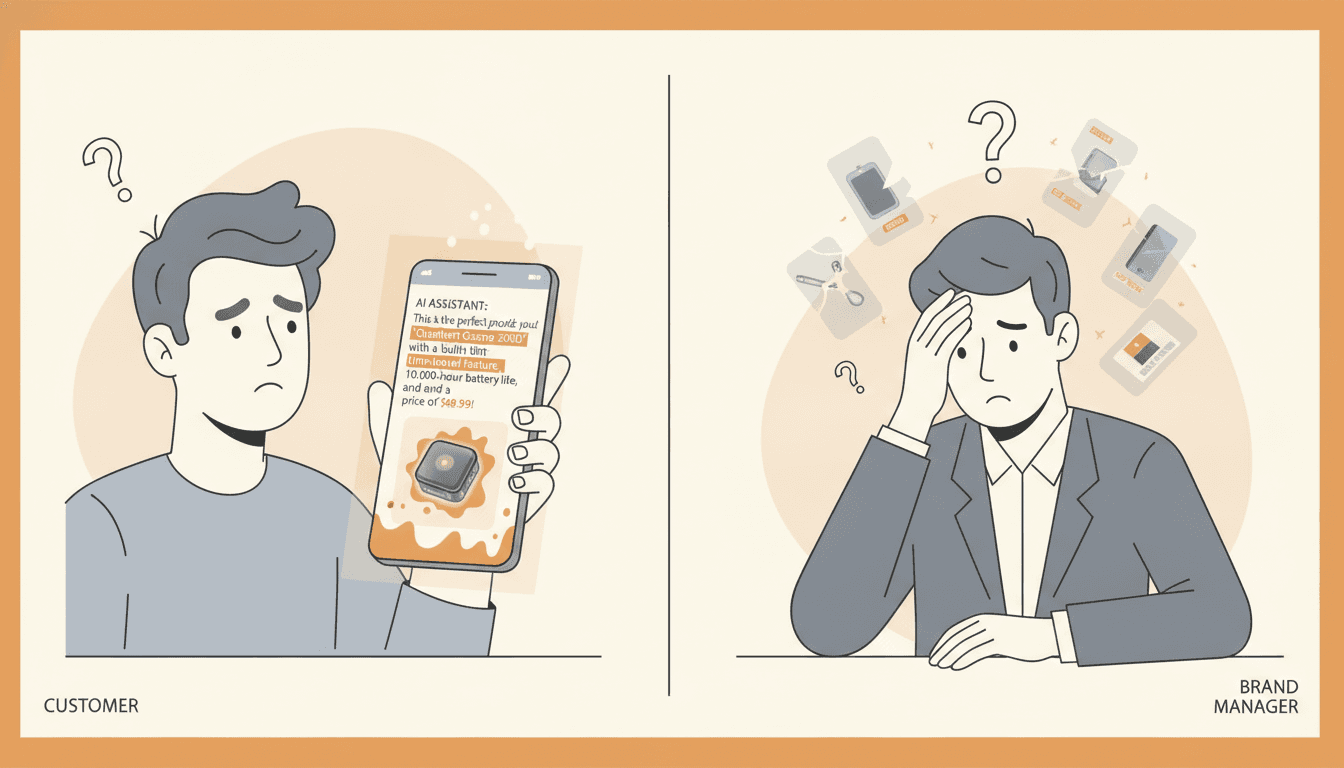
AI Hallucination Risks in E-Commerce: Protecting Your Brand Reputation in Generative Search Results
As AI-powered search transforms e-commerce, brands face an urgent challenge: AI hallucinations that can misinform customers and damage reputation. Discover the causes, risks, and actionable strategies to safeguard your brand in the era of generative search.

AI Hallucination Risks in E-Commerce: Protecting Your Brand Reputation in Generative Search Results
As AI-powered search revolutionizes e-commerce, brands confront an urgent and complex challenge: AI hallucinations that mislead customers and threaten brand reputation. Explore the causes, risks, and actionable strategies to safeguard your brand in the evolving landscape of generative search.
[IMG: A digital illustration showing an AI search interface generating both accurate and misleading product information, with brand logos and customer avatars reacting.]
The rise of AI-powered generative search is fundamentally changing how customers discover products online. Yet, with this transformation comes a pressing issue: AI hallucinations—instances where AI generates plausible but inaccurate or misleading information. For e-commerce brands, these errors can distort product representation, erode customer trust, and inflict lasting damage on brand reputation. This comprehensive guide dives into the root causes of AI hallucinations in e-commerce, offers methods to detect and rectify misinformation, and outlines strategies to preserve your brand’s integrity in an AI-driven marketplace.
Ready to protect your e-commerce brand from AI hallucinations and misinformation? Book a personalized consultation with Hexagon’s AI marketing experts to craft a tailored brand protection strategy. Schedule your free 30-minute session now.
Understanding AI Hallucinations in E-Commerce Search
[IMG: A stylized diagram of an AI brain overlaying shopping carts and product data streams, with some data lines branching off into question marks.]
AI hallucinations arise when generative language models produce information that sounds credible but is false or misleading. This typically happens due to gaps or ambiguities in their training data (Stanford HAI). In the context of e-commerce, hallucinations often appear as erroneous product features, incorrect brand claims, or misplaced associations between unrelated products. For instance, an AI might label a luxury handbag as “vegan leather” when no such product exists, or confuse brands with similar names, leading to customer confusion.
Why are hallucinations especially problematic in generative AI search? Unlike traditional search engines that retrieve indexed, factual data, generative AI synthesizes answers from vast, heterogeneous datasets. This process sometimes involves “filling in gaps” with educated guesses, which can introduce errors. According to Gartner, 20% of AI search recommendations in e-commerce contain factual inaccuracies or misattributions—a significantly higher error rate than seen in legacy search technologies.
Common causes of AI hallucinations in e-commerce include:
- Incomplete, outdated, or poorly structured product data accessible to AI crawlers
- Absence of authoritative brand content or ambiguous web copy that confuses AI models
- Model inference errors, particularly when brands launch new products or undergo rebranding
- Confusion between products or brands with similar names (Harvard Business Review)
As Dr. Fei-Fei Li, Co-Director of Stanford HAI, explains, “AI hallucinations can rapidly erode hard-earned trust—not through malice, but because of gaps in data and context that the models rely on.” With generative search becoming a primary tool for product discovery, the stakes for brands are higher than ever, making proactive risk management essential.
The Impact of AI-Generated Misinformation on Brand Reputation and Customer Trust
[IMG: Split image showing a happy customer trusting a brand versus a frustrated customer encountering misleading AI search results.]
AI-generated misinformation does more than confuse—it directly influences purchasing decisions and brand perception. When an AI assistant provides inaccurate details about a product or brand, customers risk buying the wrong item, misunderstanding key features, or believing false claims. Repeated exposure to such hallucinations can gradually erode brand loyalty and damage long-term customer relationships.
Recent research underscores the severity of this threat:
- 1 in 5 consumers would reconsider buying from a brand if an AI assistant offers inaccurate or misleading information (PwC).
- 58% of brands reported at least one incident of AI-generated misinformation harming their reputation in the past year (Forrester).
- Viral social media backlash has erupted when AI search engines falsely claimed brands sold counterfeit or unsafe products (The Verge).
Jessica Tan, Principal Analyst at Forrester, emphasizes, “Vigilant monitoring of generative AI outputs is now as critical as social listening for safeguarding e-commerce brand reputation.” Unchecked misinformation can lead to lost sales, negative reviews, and long-term brand devaluation.
Key ways AI hallucinations impact consumer behavior and brand trust include:
- Customers losing confidence in brands linked to AI-generated errors
- Amplification of misinformation through negative online discussions
- Increased customer support costs as buyers seek clarifications or refunds
Looking forward, brands that actively address AI-generated misinformation will hold a decisive advantage in maintaining customer trust and market competitiveness.
Detecting and Correcting AI Hallucinations in Your Brand’s E-Commerce Search Results
[IMG: Screenshot mockup of an AI search dashboard highlighting detected hallucinations and offering correction workflows.]
Detecting AI hallucinations early and correcting them swiftly is vital to limiting reputational damage. Yet, many AI search algorithms operate as opaque “black boxes,” making error identification challenging without specialized tools and processes.
Top brands are adopting these effective strategies to spot and resolve inaccuracies:
- AI monitoring tools: Automated platforms that continuously scan search outputs for product and brand mentions, flagging inconsistencies or potential errors. Deloitte reports that 67% of e-commerce executives plan to invest in AI monitoring tools by year-end (Deloitte).
- Customer feedback channels: Encouraging shoppers to report suspicious or inaccurate AI search results through support tickets, surveys, or dedicated feedback forms.
- AI platform reporting: Many major AI providers now enable brands to submit corrections or request content updates directly (OpenAI Dev Day 2024).
To build an effective detection and correction workflow, consider the following steps:
- Regularly monitor generative search outputs for your brand and key products.
- Aggregate customer feedback on AI-driven recommendations and flagged errors.
- Submit corrections via AI platform feedback tools or direct brand channels.
- Update your website and product data to ensure all information is structured, current, and authoritative.
Brands that promptly correct misinformation through AI platforms minimize reputational harm and swiftly restore customer confidence. Brian McCarthy, Partner at McKinsey Digital, notes, “Brands that approach AI search as a dynamic, ongoing conversation—constantly updating their data and collaborating with AI platforms—are best positioned to reduce misinformation risks.”
Best Practices for Maintaining Authoritative, Structured, and Up-to-Date Product Data
[IMG: Flowchart showing the process from data governance to structured content to reduced AI hallucinations.]
At the core of trustworthy AI outputs lies structured, authoritative, and regularly updated product data. When AI systems access clear, machine-readable information, the likelihood of hallucinations drops substantially. In fact, brands that maintain structured and authoritative content experience a 40% reduction in AI-generated misinformation (McKinsey Digital).
To develop a robust data ecosystem that protects your brand:
- Implement structured data formats like schema.org markup for products, reviews, and organizational details.
- Maintain frequent content updates to reflect new products, pricing changes, or rebranding across all digital touchpoints.
- Establish strong data governance through regular audits and quality checks to identify inconsistencies or outdated information.
- Centralize product information in a single source of truth, such as a Product Information Management (PIM) system.
Brands investing in structured data reap multiple benefits:
- More accurate AI search results and reliable citations
- Fewer instances of product misattribution or brand confusion
- Greater customer confidence throughout the buying journey
As Sundar Pichai, CEO of Google, highlights, “The future of brand trust depends on how well companies ensure their story is told accurately by both humans and machines.” Structured data and authoritative content will be your strongest shields against AI hallucinations in the years to come.
Leveraging Schema Markup and Knowledge Graph Partnerships to Boost AI Citation Trust
[IMG: Visual showing a brand’s product data embedded with schema markup, connecting to major AI and knowledge graph platforms.]
Schema markup serves as a powerful method to provide AI with clear, machine-readable data for indexing and generative search. By embedding structured metadata into your product pages, you enable AI models to interpret and cite your brand and product information accurately.
Key advantages of schema markup in e-commerce include:
- Improved visibility and precision in AI-powered search results
- Lower risk of feature or brand misattribution
- Accelerated correction cycles when product details change
Beyond schema markup, integrating your brand and product data into knowledge graphs—such as Google’s Knowledge Graph or Amazon’s Product Graph—further enhances AI citation accuracy. These platforms empower AI models to cross-reference authoritative information, significantly reducing hallucinated outputs.
Notable platforms and partnerships supporting this approach include:
- Google Search Central, offering best practices for schema implementation and knowledge graph participation (Google Search Central Blog)
- OpenAI and Microsoft, expanding brand feedback channels and trusted citation sources for generative search (OpenAI Dev Day 2024)
- Industry collaborations like Schema.org and GS1, which standardize product data to improve AI interoperability
For e-commerce brands, embedding schema markup and joining knowledge graph initiatives are practical, effective steps to future-proof reputation against AI hallucinations.
Engaging Directly with AI Platforms: Providing Feedback and Corrections
[IMG: Illustration of a brand manager engaging with an AI platform’s feedback interface, submitting corrections.]
Active engagement with AI platform providers is crucial to minimizing hallucination impacts and maintaining ongoing search accuracy. Leading AI search engines now encourage brands to submit feedback, report errors, and supply authoritative corrections.
Best practices for proactive engagement include:
- Establishing communication channels with AI platforms via official brand accounts or partner programs
- Submitting detailed feedback whenever hallucinations or misattributions arise—include links to correct information and supporting documentation
- Participating in beta programs or early access initiatives, allowing direct influence over AI search training and citation practices
Brands that collaborate closely with AI providers often see swift improvements in search accuracy. These partnerships not only resolve immediate issues but also help shape future AI models to better comprehend your brand context.
Looking forward, treating AI platforms as collaborative partners—rather than opaque vendors—will be key to managing brand reputation effectively in the AI-driven marketplace.
Case Studies: Brands Harmed and Helped by AI Search Hallucinations
[IMG: Two case study panels—one showing a brand harmed by AI misinformation, the other demonstrating a brand’s success in correcting AI errors.]
Harmed: The Counterfeit Crisis
A global fashion brand recently faced a social media firestorm after a generative AI search engine falsely labeled its products as “counterfeit.” This misinformation, amplified by several influencers, caused a sudden sales decline and widespread negative sentiment. The brand’s lack of structured product data and absence from knowledge graphs hindered rapid correction, exposing how even established brands remain vulnerable to unchecked AI hallucinations (The Verge).
Helped: Proactive Data Governance
In contrast, a leading electronics retailer invested early in structured data, schema markup, and direct engagement with AI platforms. When an AI system began recommending a discontinued product, their monitoring tools detected the error within hours. By promptly submitting corrections and updating authoritative content, the brand restored accurate citations quickly and avoided reputational damage.
Lessons Learned
- Rapid response and correction are essential to limit fallout from AI hallucinations
- Structured data and platform collaboration significantly reduce misinformation risk and impact
- Transparent communication with customers helps rebuild trust even after errors occur
These case studies highlight the critical importance of vigilance and proactive brand management in the AI era.
Future Trends: AI Transparency, Monitoring, and Brand Protection in Generative Search
[IMG: Futuristic dashboard showing AI transparency scores, real-time monitoring alerts, and brand trust metrics.]
Looking ahead, AI transparency and enhanced monitoring will become central to brand protection strategies. Emerging initiatives—such as explainable AI outputs and open reporting standards—will empower brands to better understand and influence how generative search represents them.
The upcoming wave of e-commerce AI management will feature:
- Automated correction systems that detect and resolve hallucinations in real time
- Advanced monitoring dashboards integrating search outputs, sentiment analysis, and brand health metrics
- Industry-wide transparency standards for AI-generated citations and product information sources
Forward-thinking brands are already investing in monitoring tools, enriching structured data, and prioritizing direct AI platform engagement. The ability to ensure your brand’s story is told accurately by both humans and machines will define competitive advantage in the years ahead.
Conclusion: Proactively Protect Your E-Commerce Brand from AI Hallucinations
AI hallucinations in generative search pose a clear and escalating risk to e-commerce brands. The consequences—lost sales, tarnished reputation, and diminished customer trust—are too significant to overlook. By understanding the root causes, investing in structured data, vigilantly monitoring AI outputs, and engaging directly with AI platforms, brands can not only mitigate these risks but also position themselves as leaders in the AI-driven marketplace.
Ready to safeguard your e-commerce brand from AI hallucinations and misinformation? Book a personalized consultation with Hexagon’s AI marketing experts to develop a tailored brand protection strategy. Schedule your free 30-minute session now.
[IMG: Confident brand managers shaking hands with AI platform representatives, overlayed with a secure brand reputation icon.]
Hexagon Team
Published April 29, 2026