brandsbrandgoogle
Why Most E-Commerce Brands Remain Invisible to AI Search Engines: The Hidden Barriers Explained
Less than 7% of mid-market e-commerce brands appear in AI assistant recommendations — even when they rank on page one of Google. Here's why AI invisibility is a structural problem, not an SEO problem, and what the hidden barriers actually are.
14 min read
---


# Why Most E-Commerce Brands Remain Invisible to AI Search Engines: The Hidden Barriers Explained

*Less than 7% of mid-market e-commerce brands appear in AI assistant recommendations — even when they rank on page one of Google. Here's why AI invisibility is a structural problem, not an SEO problem, and what the hidden barriers actually are.*

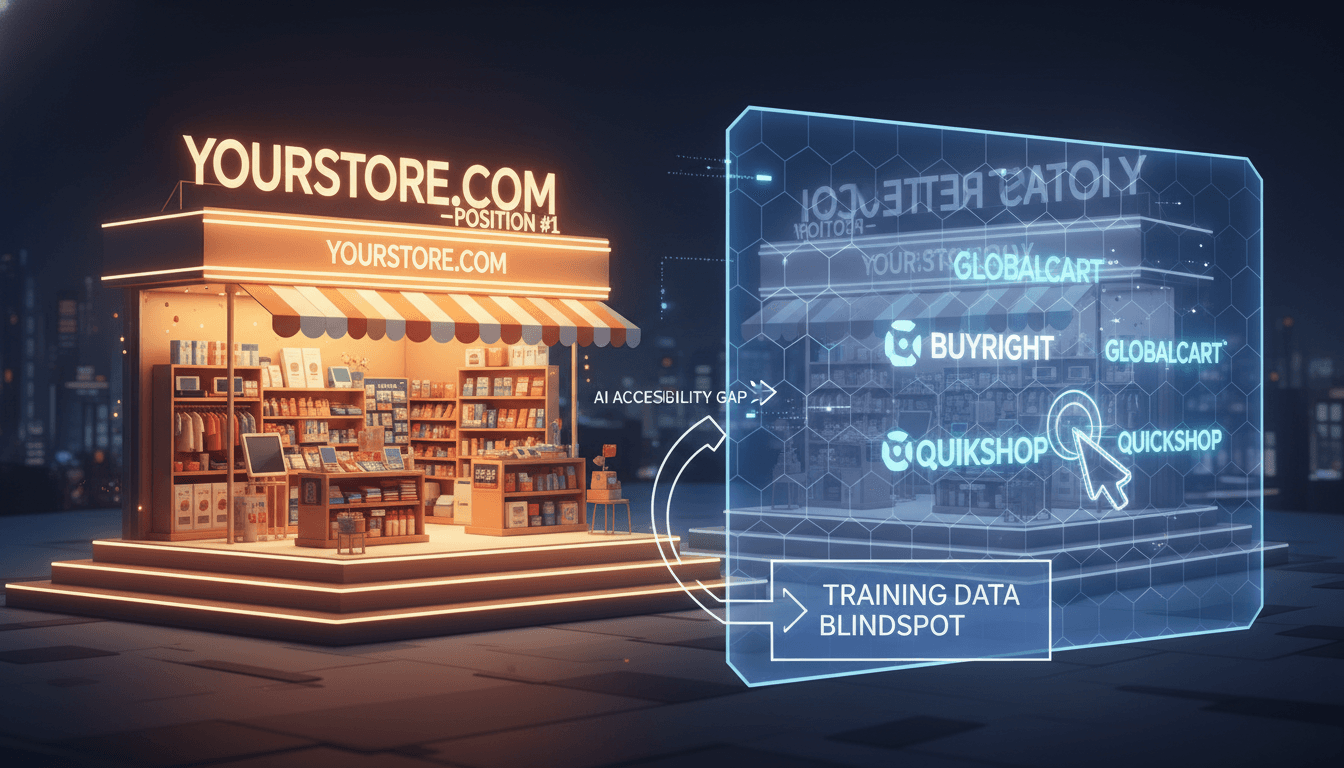
[IMG: Split-screen visual showing a brand ranking #1 on Google search results on the left, and the same brand absent from a ChatGPT product recommendation response on the right — illustrating the visibility gap]

Most e-commerce brands have spent months optimizing product pages, building backlinks, and climbing Google's rankings. SEO metrics look strong, and organic traffic is growing. Then someone asks ChatGPT for a product recommendation in the brand's category, and it doesn't appear. Neither does it show up in Perplexity's results or Google's AI Overviews.

This isn't a failure of SEO strategy. It's evidence of a structural problem that traditional optimization can't solve.

Less than 7% of mid-market e-commerce brands appear in unprompted AI assistant recommendations, even when they rank on page one of Google. The gap isn't about visibility in the traditional sense — it's about invisibility by design. AI search engines operate on fundamentally different rules than Google, and most e-commerce brands have never learned them.


---


## The AI Visibility Crisis: Why Google Rankings Don't Translate to AI Search

The core problem is this: **AI search doesn't work like Google.**

Google crawls individual pages, indexes them, and ranks them based on backlinks and on-page signals. AI systems operate differently. They build a probabilistic understanding of the world from training data, then recommend brands they're *confident* about — not brands that rank highest. Domain authority, backlink volume, and traditional SEO signals are largely irrelevant in this new environment.

The numbers reveal a troubling gap. According to the [Gartner Digital Commerce Trends Report 2024](https://www.gartner.com), less than 7% of mid-market e-commerce brands (those with $1M–$50M annual revenue) appear in unprompted AI assistant recommendations when consumers ask for product category suggestions. AI systems overwhelmingly surface enterprise brands, Amazon listings, or editorially-reviewed products instead.

What's at stake is substantial. The global AI search market is projected to reach [$119 billion by 2030](https://www.grandviewresearch.com), and AI-influenced e-commerce decisions are expected to account for 45% of all online product discovery by 2027. This is not a temporary phase or a niche trend — it's a structural shift in how consumers discover and purchase products.

The window to establish early presence is already narrowing. Brands that delay action face exponentially higher barriers as competitors lock in citation patterns and recommendation slots.


---


## Barrier #1: The Training Data Gap — Brand Invisibility Before Critical Cutoff Dates

AI language models like ChatGPT and Claude build brand knowledge primarily from training data collected before a fixed cutoff date. ChatGPT's knowledge cutoff is April 2024, while Perplexity and Claude operate on different training windows. Brands that lacked substantial web presence before those dates are effectively invisible to the model's base knowledge — regardless of how well they rank today.

This creates a structurally unfair disadvantage for newer brands. Those founded after 2020 face particular challenges, simply because less content about them existed during critical data collection windows. As [Aleyda Solis, International SEO Consultant and Founder of Orainti](https://www.orainti.com), puts it: "Training data cutoffs create a cruel irony for growing brands: the moment they most need visibility — when scaling — is precisely when they're most likely to fall below the threshold AI models need to include them."

No amount of retroactive SEO can fix this gap. Building AI visibility now requires thinking ahead of model training cycles — not just optimizing for today's algorithms.


---


## Barrier #2: Entity Authority vs. Link Authority — AI Doesn't Care About Backlinks

Here's the critical distinction: Google evaluates web pages. AI systems evaluate **entities** — and those are fundamentally different objects.

An entity is a brand as understood across the entire web: its name, category, reputation, and how it's consistently described across independent sources. Entity authority builds from corroborating third-party mentions, not backlink volume. A brand with 10,000 low-authority backlinks may be completely invisible to AI, while a brand with 100 high-authority, independent mentions may be prominently recommended.

The data is stark. According to a [SparkToro and Rand Fishkin AI Citation Analysis 2024](https://sparktoro.com), AI-generated answers cite sources from the top 20% of domain authority sites approximately 91% of the time. This means AI systems are drawing from major publications, established review sites, and retail giants — not from individual brand websites, regardless of optimization.

The corroboration gap is acute. Only 14% of e-commerce brands have been mentioned in three or more independent, high-authority editorial sources in the past 12 months, according to a [Moz and BrightEdge AI Visibility Benchmark Study 2024](https://moz.com). AI systems require this kind of cross-platform corroboration before confidently recommending a brand.

A brand with thousands of backlinks from low-authority sites remains invisible to AI — because entity recognition depends on the *quality and independence* of sources, not their volume. As Rand Fishkin notes: "The brands that win in AI search aren't necessarily the ones with the best products or the most Google traffic — they're the ones that have built the richest, most corroborated information footprint across the web."


---


## Barrier #3: Content Structure Misalignment — Product Pages Aren't Built for AI Comprehension

E-commerce product pages are built to convert. They feature high-quality images, concise specifications, social proof, and prominent calls to action. This architecture is excellent for human buyers — and nearly useless for AI comprehension.

AI crawlers need informational depth, contextual narrative, and FAQ-style content to extract brand meaning. Standard product page structure doesn't provide it. According to [Baymard Institute E-Commerce UX Research](https://baymard.com), most e-commerce product pages are structured for transactional conversion rather than informational depth — precisely the opposite of what AI systems need.

Conversion-optimized pages often actively obscure the informational signals AI needs to map a brand to a recognizable need. For example, a brand selling premium ergonomic office chairs may rank highly for "ergonomic chair" on Google, but if the site lacks buying guides, comparison content, FAQs, and contextual editorial copy, AI systems have no material to build a confident brand understanding from.

AI systems require multiple content formats — guides, FAQs, comparison content — to understand positioning. This requires a fundamentally different content architecture than traditional e-commerce design.


---


## Barrier #4: The Structured Data Deficit — Missing the Technical Foundation AI Requires

Schema markup is not optional for AI visibility — it's foundational. Structured data allows AI systems to extract meaning from a page without relying entirely on natural language interpretation. Without it, AI crawlers cannot reliably categorize a brand, verify its offerings, or map it to a knowledge graph entity.

The adoption gap is stark. According to an [Ahrefs State of the Web Crawl Study 2024](https://ahrefs.com), 72% of e-commerce websites lack sufficient structured data markup to be reliably interpreted by AI crawlers. Fewer than 3 in 10 sites have fully implemented Product, Organization, Review, and BreadcrumbList schema — the minimum structured data footprint needed for consistent AI entity recognition.

The good news: structured data implementation is the most immediate, controllable lever available to e-commerce brands. It doesn't require media outreach, editorial relationships, or years of brand-building. It requires technical execution — and it creates the foundation on which every other AI visibility strategy depends.


---


## Barrier #5: The Winner-Takes-Most Dynamic — AI Surfaces One to Three Brands, Not Ten

Google shows ten results per page. AI assistants show one to three brand recommendations. This is not a minor difference — it's a fundamental change in competitive dynamics that makes AI visibility dramatically higher-stakes than traditional search.

According to [BrightEdge AI Search Visibility Report 2024](https://brightedge.com), ChatGPT typically surfaces just 1–3 brands in product recommendation queries, and Perplexity and Google AI Overviews follow similar patterns. The competitive landscape has shifted from a ten-slot game to a three-slot game.

This dynamic creates compounding advantages for early movers. Being the first AI-recommended brand in a category creates citation advantage — once an AI system confidently associates a brand with a category, that association is reinforced through repeated recommendations and subsequent web mentions. The barrier to entry is higher than in traditional SEO, but so is the payoff for brands that establish presence early.

Looking ahead, the urgency is concrete. Brands that act now will compete for those one to three recommendation slots. Brands that wait will find those slots already occupied by competitors who moved first.


---


## Barrier #6: The Third-Party Corroboration Requirement — A Brand's Website Isn't Enough

AI systems require multiple independent, high-authority sources to verify brand claims before surfacing a recommendation. A brand's own website — no matter how well-optimized — is insufficient on its own. This fundamentally changes the visibility game for independent e-commerce brands, creating a hard dependency on earned media and editorial coverage.

According to [Wired's analysis of how AI chatbots decide what to recommend](https://wired.com), AI assistants require "corroborating signals" — multiple independent sources saying similar things about a brand — before confidently recommending it. This raises the bar for discoverability significantly compared to traditional SEO.

Building third-party corroboration infrastructure — through PR, editorial partnerships, review platform presence, and industry publication coverage — is now a core visibility requirement, not a nice-to-have marketing activity. The strategic shift is significant: a brand's own website is less important than what others say about it.


---


## Barrier #7: The Knowledge Anchor Problem — Wikipedia and Knowledge Panels as Trust Signals

Wikipedia pages and Google Knowledge Panels function as primary trust anchors for AI entity recognition. AI systems use these platforms to verify that a brand entity is legitimate, categorize it accurately, and confirm information they've encountered elsewhere. Without these anchors, AI systems lack the verification signals needed to make confident recommendations.

The impact is measurable. Brands with active Wikipedia pages are 4.7x more likely to appear in AI assistant recommendations than comparable brands without one, according to a [Search Engine Land AI Knowledge Graph Study 2024](https://searchengineland.com). Wikipedia is heavily weighted in AI training data and used as a primary entity verification source.

Yet the majority of mid-market e-commerce brands have no Wikipedia page, no Wikidata record, and incomplete Google Knowledge Panels. These platforms are not peripheral marketing channels — they are the infrastructure through which AI systems confirm that a brand is real, trustworthy, and worth recommending.


---


## Barrier #8: The Compounding Invisibility Effect — Why Inaction Creates Exponential Risk

AI invisibility is not a static problem — it compounds over time. According to [MIT Technology Review's analysis of AI search and information asymmetry](https://technologyreview.mit.edu), AI recommendation systems exhibit a "rich get richer" dynamic: brands already present in training data receive more AI citations, which generates more web mentions, which further reinforces their presence in future model updates.

Brands absent from this cycle fall further behind with each model iteration. The trajectory is clear: as AI-influenced e-commerce decisions are expected to account for 45% of all online product discovery by 2027, inaction becomes increasingly costly.

Brands that establish AI presence now gain compounding advantage. Brands that delay face exponentially higher barriers as competitors lock in citation patterns, training data presence, and the winner-takes-most recommendation slots that define AI search. The window to act is not permanently open.

[IMG: Diagram showing the compounding invisibility cycle — absent brand → no citations → no training data presence → absent brand — contrasted with the compounding visibility cycle for brands that act early]


---


## What AI Search Engines Actually Look For: The Signals Brands Have Been Missing

Understanding what AI systems actually evaluate is the first step toward building visibility. The signal hierarchy is fundamentally different from Google SEO, and most e-commerce brands are optimizing for the wrong signals entirely.

Here's how the AI visibility signal stack breaks down:

- **Entity corroboration** — Multiple independent, high-authority sources confirming brand identity, category, and positioning
- **Schema markup** — Organization, Product, Review, and FAQ schema as prerequisites for reliable entity recognition
- **Knowledge anchors** — Wikipedia pages, Wikidata entries, and Google Knowledge Panels as trust verification signals
- **Informational content depth** — Buying guides, FAQs, comparison content, and editorial copy that signals brand expertise
- **Cross-platform presence** — Consistent brand mentions across social platforms, review sites, and media publications
- **Editorial authority** — Coverage in publications that AI systems weight as high-credibility sources

AI systems weight editorial mentions 91% of the time in recommendations, making earned media presence more strategically valuable than owned media optimization. FAQ and comparison content signals brand expertise to AI systems in ways that product pages simply cannot.


---


## How AI Search Visibility Differs from Google Visibility: The Fundamental Shift

The differences between Google visibility and AI visibility are not incremental — they're categorical. Understanding the contrast is essential for building the right strategy:

- **Google ranks pages; AI systems rank entities.** A single well-optimized page can rank on Google. AI visibility requires a brand to be understood as a coherent entity across the entire web.
- **Google measures authority through links; AI measures authority through corroboration.** Backlink volume is largely irrelevant to AI confidence scores.
- **Google rewards conversion optimization; AI rewards comprehension optimization.** The page architecture that drives Google rankings often actively hinders AI visibility.
- **Google shows 10 results; AI surfaces 1–3 recommendations.** The competitive stakes are dramatically higher in AI search.
- **Google's algorithm is relatively transparent; AI decision-making is probabilistic and opaque.** There is no keyword ranking report for AI visibility — it requires a different measurement framework entirely.
- **Google is dominated by owned media; AI is dominated by earned media.** What others say about a brand matters more than what the brand says about itself.

This shift is permanent — not a temporary trend. Brands that continue treating AI search as an extension of Google SEO will continue to be invisible.

[IMG: Side-by-side comparison table: Google vs. AI Search — contrasting ranking units, authority signals, content priorities, result volume, and media type weighting]


---


## The Path Forward: Building AI Discoverability Infrastructure Before the Window Closes

AI visibility is not a one-time optimization — it's an infrastructure build. The barriers are structural, but they're not insurmountable. The brands acting now are establishing the foundation that will compound into dominant AI recommendation presence over the next several years.

Here's how a phased approach to AI discoverability infrastructure looks in practice:

**Immediate actions** — Implement full schema markup (Organization, Product, Review, FAQ), audit existing content for informational depth, and create FAQ pages and buying guides optimized for AI comprehension.

**Medium-term** — Build an earned media strategy targeting high-authority editorial placements, establish presence on review platforms AI systems weight heavily, and create comparison and category content that signals topical authority.

**Long-term** — Pursue Wikipedia entry and Wikidata record, establish Google Knowledge Panel, and build systematic third-party corroboration through consistent PR and editorial outreach.

The brands that treat AI visibility as infrastructure — rather than a campaign or a tactic — will be the ones occupying those one to three recommendation slots when 45% of online product discovery runs through AI channels by 2027. The compounding advantage of early action is real, and the compounding disadvantage of inaction is equally real.


---


## The Strategic Imperative: Acting Before First-Mover Advantage Closes

The window to establish first-mover advantage is closing. Brands already building AI discoverability infrastructure are accumulating citation patterns, training data presence, and entity authority that will be difficult for late entrants to displace. The question isn't whether AI search will reshape e-commerce discovery — it already is.

The question is whether a brand will be visible when it does. Most e-commerce brands lack the infrastructure to compete for AI visibility. The barriers are structural — but they're not permanent.

Brands seeking to establish AI visibility should audit their current presence across the eight barriers outlined above. The strategic reorientation required is significant, but the brands making it now will establish positions that are difficult for competitors to displace.

[**Schedule a 30-minute strategy session to audit AI visibility and build a discoverability strategy →**](https://calendly.com/ramon-joinhexagon/30min)
H
Hexagon Team
Published May 25, 2026