brandbrandstraining
What Happens When AI Search Engines Don't Know Your Brand: The Training Data Problem
Nearly 40% of e-commerce brands are either completely unrecognized or misrepresented by major AI assistants—not because of poor marketing, but because of a structural gap in how AI systems learn about the world. Here's what that means for your revenue, and what to do about it.
14 min read

---


# What Happens When AI Search Engines Don't Know Your Brand: The Training Data Problem

*Nearly 40% of e-commerce brands are either completely unrecognized or misrepresented by major AI assistants—not because of poor marketing, but because of a structural gap in how AI systems learn about the world. Here's what that means for revenue, and what brands can do about it.*

[IMG: Split-screen visual showing a consumer typing a product query into ChatGPT on one side, and a brand's well-designed product page going unnoticed on the other—representing the disconnect between brand quality and AI visibility]


---


A customer is searching ChatGPT right now for "best sustainable water bottles." The AI returns five recommendations—and a particular brand isn't among them. That product has superior reviews. Its shipping is faster. The brand is genuinely better. Yet the AI has never heard of it.

This isn't a marketing failure. It's a structural one.

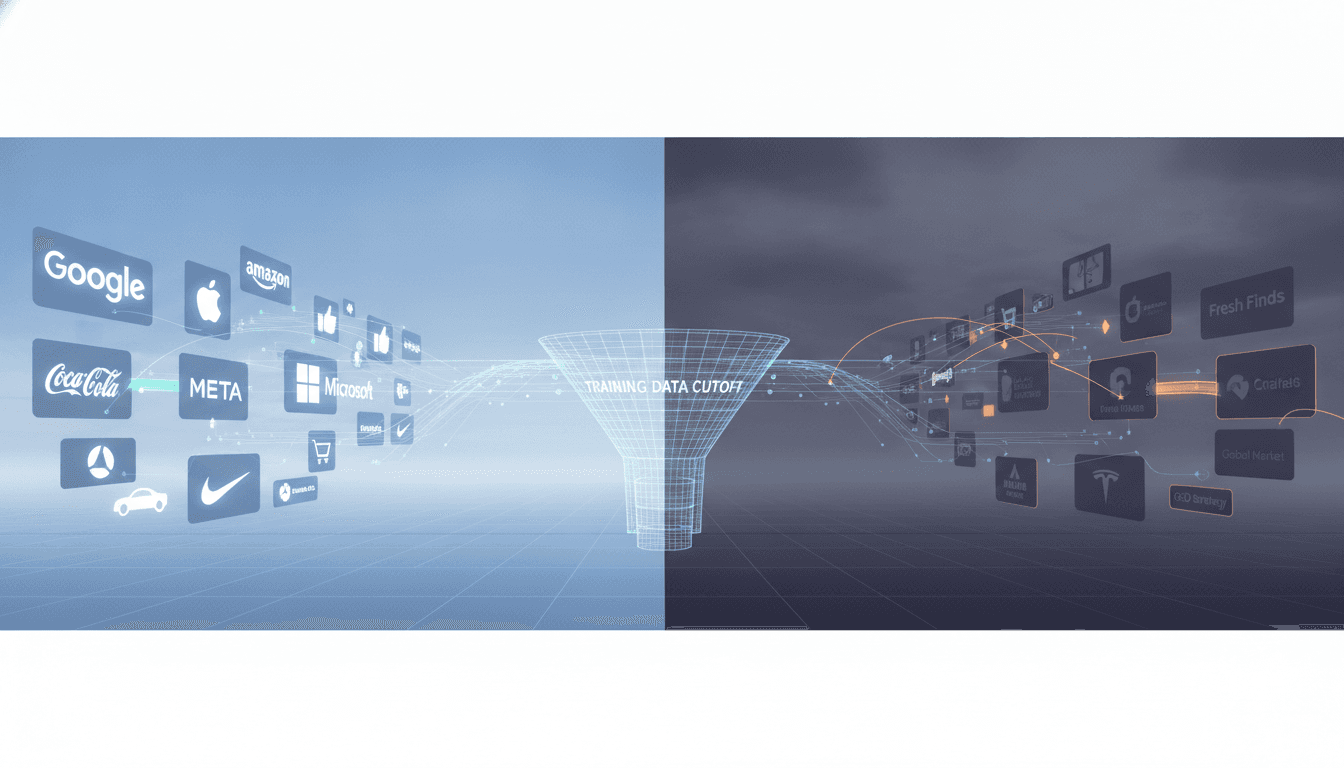
ChatGPT's training data froze in April 2023. If a brand launched after that date, scaled significantly after that date, or simply hadn't accumulated enough mentions in authoritative sources by then, it doesn't exist in the model's world. The brand isn't invisible because it's inferior—it's invisible because it's absent from the training data that shaped how the AI understands the category.

According to recent audits, [nearly 40% of e-commerce brands](https://www.gartner.com) are either completely unrecognized or misrepresented by major AI assistants. The problem isn't marketing strategy. It's the structure of how AI systems learn about the world.


---


## The Core Problem: AI Training Data Isn't Live (And Brands Aren't in It)

Most marketers assume AI search works like Google—crawling the web in real time, surfacing the most relevant results. It doesn't.

**AI search engines operate from frozen training datasets with fixed knowledge cutoff dates.** This fundamental difference makes them work in an entirely different way than live search engines. GPT-4's training data cuts off at approximately April 2023.

Claude 3.5 Sonnet extends to April 2024. Even newly launched AI tools work from data that's already close to a year old at release—the typical lag between a model's training cutoff and its public launch runs 6–12 months.

This creates a structural invisibility problem for any brand that launched, scaled, or gained meaningful traction after those cutoff dates.

Andrej Karpathy, Former Director of AI at Tesla and Former Research Scientist at OpenAI, captured the dynamic precisely: *"Large language models are essentially a compressed, lossy snapshot of the web at a particular moment in time. If a brand wasn't part of that snapshot—either because it launched later or because it simply wasn't discussed enough in authoritative sources—it doesn't exist to that model."*

The business stakes are rising fast. [Gartner projects](https://www.gartner.com) that 27% of total Google search traffic will be displaced by AI-generated answers by end of 2025. Meanwhile, 72% of consumers using AI for shopping report that the AI recommended a brand they weren't already searching for—which means AI recommendation is actively shaping brand discovery.

Invisible brands miss this entirely. Being invisible to AI means **zero consideration** when consumers ask AI assistants for product recommendations. A website could be perfectly optimized. Reviews could be stellar. The product could be the category leader. None of that matters if the AI doesn't know the brand exists.

This is a structural problem, not a content problem—and it requires a different solution.


---


## Why Brands Aren't in AI Training Data: The Authority Problem

Training data is not democratically sourced. It disproportionately reflects large, high-authority, well-linked domains. Smaller brands are systematically underrepresented, regardless of product quality.

[Over 1 trillion tokens of text data were used to train GPT-4](https://openai.com/research/gpt-4), yet the distribution heavily favors English-language, high-PageRank web domains. AI training datasets like Common Crawl, which underpins much of GPT and other LLM training, [disproportionately represent large, well-linked domains](https://commoncrawl.org)—meaning small-to-mid-size e-commerce brands with thin backlink profiles contribute negligible signal to the model's brand knowledge.

Here's how this works: product pages, no matter how well-written, carry minimal weight in training datasets compared to editorial coverage and third-party mentions. The signal that moves the needle isn't what a brand says about itself—it's what credible external sources say about it.

Research from [Profound's industry analysis](https://www.profound.com) found that 58% of AI-generated product recommendations referenced only brands appearing in three or more high-authority third-party editorial sources. The AI's recommendation isn't based on a brand's website. It's based on who's written about the brand in places the AI trusts.

Sridhar Ramaswamy, CEO of Snowflake and Former SVP of Ads at Google, described it plainly: *"We're entering an era where a brand's discoverability is determined not by its own content, but by the corpus of the internet's opinion of it. Training data gaps are the new SEO penalty—except most brands don't even know they've been penalized."*

The data bias problem compounds for newer brands. Even with aggressive marketing spend, a brand that hasn't accumulated coverage in high-authority third-party sources faces **structural invisibility** regardless of effort. Understanding this dynamic is the first step toward solving it.


---


## The Measurable Business Impact: What Invisibility Costs Brands

[IMG: Data visualization showing the projected rise of AI-influenced shopping queries from 2023 to 2026, with a highlighted gap representing revenue lost by AI-invisible brands]

AI-influenced shopping queries are rising rapidly. This is not a future problem. It is happening now, and the cost of invisibility is compounding with every consumer who turns to an AI assistant before visiting a brand website.

When an AI model is asked about a brand it has insufficient training data on, one of three things happens. It will hallucinate plausible-sounding but false information. It will admit it doesn't know. Or it will recommend a competitor it does have data on.

According to [Stanford HAI research on LLM hallucination](https://hai.stanford.edu), all three outcomes are damaging for the invisible brand. None of them lead to a sale.

The numbers tell a clear story:

- **72%** of consumers using AI for shopping report the AI recommended a brand they weren't already searching for
- **27%** of Google search traffic is projected to be displaced by AI-generated answers by end of 2025
- **Nearly 40%** of e-commerce brands tested were unrecognized or misrepresented by at least two of three major AI assistants

Brands without AI presence are losing market share to AI-visible competitors in the same category—competitors who may not have better products, but who have built the third-party authority that AI systems recognize and trust. The longer a brand waits, the larger that gap becomes.


---


## The Difference Between AI Search (Frozen Data) and RAG Systems (Live Data)

Not all AI search systems work the same way. Understanding the distinction helps brands prioritize where to invest visibility efforts.

**Traditional AI models like ChatGPT rely entirely on training data.** They cannot access new information unless browsing mode is explicitly enabled—and even then, ChatGPT's browsing-enabled mode supplements rather than replaces the training data foundation. The model still defaults to training data patterns when forming recommendations.

**Retrieval-augmented generation (RAG) systems like Perplexity work differently.** [Perplexity AI combines a RAG architecture with live web search](https://www.perplexity.ai), meaning it can surface more current brand information by indexing live content. This offers a faster path to visibility for brands that haven't yet made it into major model training datasets.

Here's how the two paths compare:

- **Traditional LLMs (ChatGPT, Claude):** Require presence in historical training data; visibility builds over model update cycles (typically 6–12 months between major releases)
- **RAG systems (Perplexity, Bing Copilot):** Index live content; structured data and schema markup improve accuracy; still weight source authority heavily

For example, a brand launching today might gain visibility in Perplexity within weeks through strong structured data and review platform presence, but would need to wait for the next GPT training cycle to appear in ChatGPT. The critical insight is that **both systems require external validation.** RAG systems still weight source authority heavily—a brand cannot rely solely on its own website content to become visible in either environment.

Credible external coverage remains the common denominator for AI recognition across both architectures. This is the key leverage point.


---


## How to Close the Training Data Gap: The GEO Strategy

Generative Engine Optimization (GEO) is fundamentally different from traditional SEO. Where SEO optimizes a brand's own content to rank in search results, **GEO focuses on building presence in the third-party, high-authority sources that AI systems treat as ground truth**.

Lily Ray, VP of SEO Strategy & Research at Amsive Digital, framed the shift clearly: *"The question e-commerce marketers should be asking isn't 'how do I rank on Google?' anymore—it's 'does the AI know who I am, and does it trust what it knows?' Those are fundamentally different problems that require fundamentally different strategies."*

The authority threshold is measurable. Research from [BrightEdge's Generative AI Visibility Report](https://www.brightedge.com) found that brands with active, consistent coverage in online review platforms, industry publications, and user-generated content forums were **3x more likely to be accurately described by generative AI engines** compared to brands relying solely on their own website content.

The 58% figure from Profound reinforces this: the brands AI recommends are the ones with three or more high-authority external mentions. The GEO strategy centers on building presence across these high-leverage channels:

- **Editorial reviews** in publications like Wirecutter, CNET, and category-specific outlets
- **Reddit discussions** and relevant community forums where real users mention the brand
- **Industry publications** that carry high domain authority in the vertical
- **Structured data platforms** and review aggregators like Trustpilot and G2
- **Wikipedia-eligible brand profiles**, which are among the most reliably ingested sources across all major LLM training datasets

Rand Fishkin, Co-founder of SparkToro and Former CEO of Moz, put it directly: *"The brands that will win in the AI era are not necessarily those with the best products—they're the ones whose story has been told often enough, in credible enough places, that AI systems have absorbed it as fact. If a brand has only ever told its story on its own website, it's essentially whispering in a room where the AI wasn't listening."*

Consistent third-party mentions create the authority threshold that makes AI systems confident enough to recommend a brand. GEO is the strategy for building that threshold systematically.


---


## Actionable Steps to Build AI Visibility Today

[IMG: Step-by-step roadmap graphic showing the eight GEO action steps, designed as a clean horizontal timeline with icons for each stage]

Building AI visibility requires a structured approach. Here's how to start closing the training data gap today.

**Step 1: Audit current AI visibility.** Brands should query ChatGPT, Claude, and Perplexity with category-level questions relevant to their business. Document whether the brand appears, how it's described, and whether the information is accurate. This baseline reveals the size of the visibility gap and where to focus first.

**Step 2: Identify high-authority publications and platforms in the category.** Research which editorial outlets, review sites, and industry publications appear most frequently in AI-generated responses for the product category. These are the sources that matter most for the specific vertical and should become the targeting list.

**Step 3: Build presence in third-party review platforms.** Brands should establish and actively manage profiles on Trustpilot, G2, and any industry-specific review aggregators relevant to their category. Consistent, high-volume reviews on these platforms contribute meaningful signal to both RAG systems and future training data updates.

**Step 4: Pursue earned media and editorial coverage.** Brands should pitch to industry publications, product review outlets, and journalists covering their category. A single placement in a high-authority publication carries more AI visibility weight than dozens of self-published blog posts.

**Step 5: Implement structured data and schema markup.** [Structured data markup via schema.org](https://schema.org), detailed product feeds, and consistent NAP data across directories improve the likelihood that RAG systems like Perplexity and Bing Copilot can accurately surface and describe a brand when they index live content.

**Step 6: Build community presence on Reddit and relevant forums.** Authentic participation in Reddit communities and niche forums generates the kind of user-generated mentions that AI systems draw on heavily. Community engagement builds the organic mentions AI systems rely on when forming recommendations.

**Step 7: Create a Wikipedia-eligible brand profile if applicable.** A brand's Wikipedia page is one of the most reliably ingested sources across all major LLM training datasets. If a brand meets Wikipedia's notability guidelines, establishing a well-sourced profile is a high-leverage asset for AI brand visibility.

**Step 8: Monitor AI visibility as training data updates roll out.** Each new model update or training data refresh creates a new window for visibility. Brands that have built the right external presence will be captured in those updates—making ongoing monitoring essential for tracking progress and identifying gaps.


---


**Ready to see where a brand stands?** Book a 30-minute GEO audit with Hexagon's team to assess current AI visibility across ChatGPT, Claude, and Perplexity—and get a custom roadmap for closing the training data gap. The team will identify which high-authority sources matter most for the category and prioritize the moves that will get a brand visible to AI before competitors do. [Schedule a free audit here](https://calendly.com/ramon-joinhexagon/30min).


---


## Why Acting Now Gives Brands a Competitive Advantage

The window to establish AI visibility before competitors do is narrowing. As more brands recognize the training data gap, the cost and difficulty of earning high-authority mentions will increase. Editorial placements become more competitive. Review platforms become more crowded. The path to the authority threshold gets harder to climb.

Early movers in GEO will establish brand authority that compounds over time. Each high-authority mention earned today contributes to the external corpus that AI systems will draw on in the next training data update. Each new model release creates a fresh opportunity to be included—but only for brands that have already built the right presence.

Waiting means paying higher costs later and facing entrenched competitors who have already established AI visibility in the category. The brands acting now are building a durable competitive advantage that will be difficult to displace once it's set. This window won't stay open indefinitely.


---


## What Happens Next: The Future of AI-Driven Discovery

[IMG: Forward-looking illustration showing a consumer's shopping journey beginning with an AI assistant query, branching into brand discovery for AI-visible brands and complete invisibility for brands without GEO presence]

AI-influenced shopping queries will continue to rise as consumers build trust in AI recommendations. The 27% Google search traffic displacement projected by Gartner for end of 2025 signals a massive, accelerating shift in how consumers discover products—and how marketing budgets need to be allocated to capture that discovery.

The brands winning in AI search will be those with strong third-party authority, not just strong websites. This fundamentally changes how e-commerce brands should think about marketing investment—shifting budget from website-only optimization toward building the external authority ecosystem that AI systems recognize and trust.

Looking ahead, the brands losing will be those that assume traditional SEO and content marketing are enough. The discovery layer is shifting beneath them, and the cost of inaction is measured in market share ceded to AI-visible competitors who understood the training data problem early.

The structural reality is this: AI systems recommend what they know, and they know what the authoritative corners of the internet have told them. **The brands that invest in GEO now will capture disproportionate share of AI-driven discovery**—not because they had better products, but because they had the foresight to make sure the AI knew their story.


---


*Is a brand invisible to AI assistants? [Schedule a free 30-minute GEO audit with Hexagon](https://calendly.com/ramon-joinhexagon/30min) to find out exactly where it stands across ChatGPT, Claude, and Perplexity—and get a prioritized roadmap for closing the training data gap before competitors do.*
H
Hexagon Team
Published June 11, 2026