The Evolution of Generative Engine Optimization: Trends and Predictions for E-Commerce in 2027
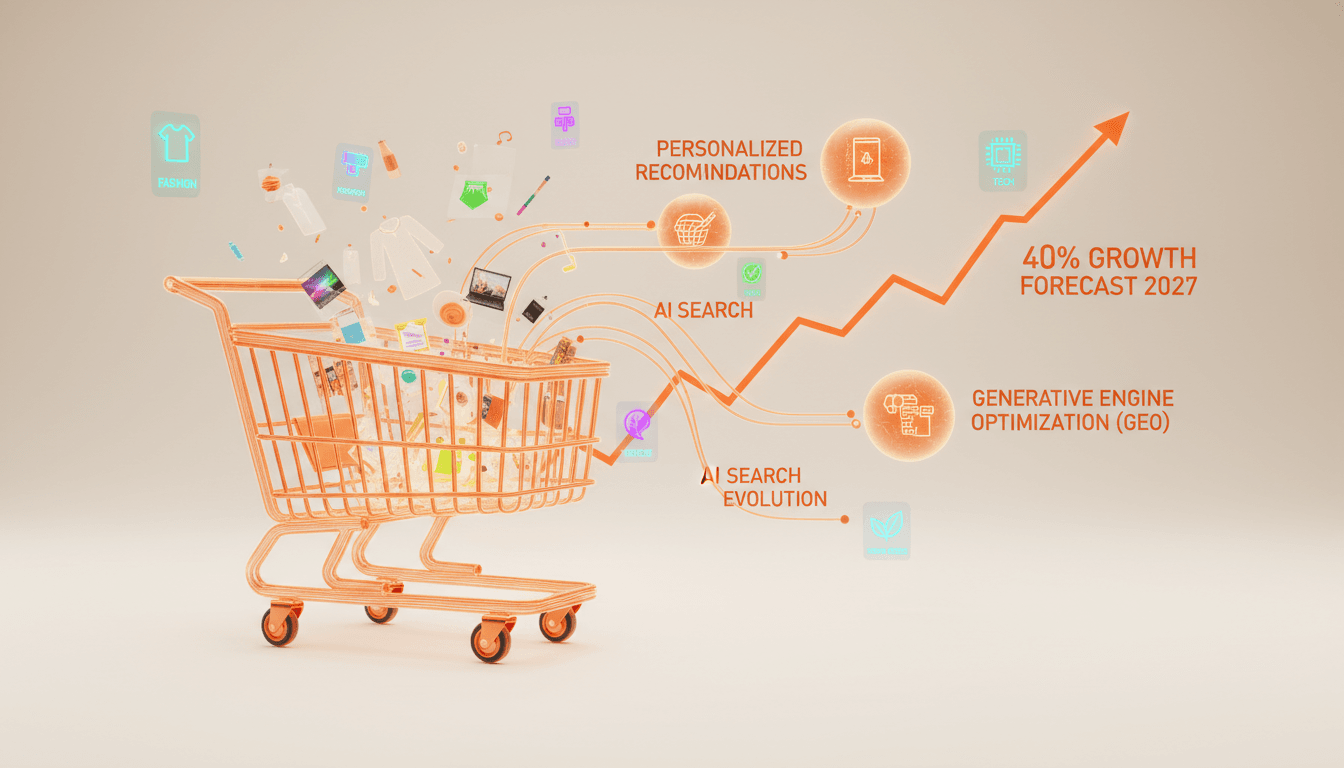
By 2027, generative AI will drive a 40% increase in product recommendations. Discover how Generative Engine Optimization (GEO) is reshaping e-commerce and what brands must do to stay ahead.
The Evolution of Generative Engine Optimization: Trends and Predictions for E-Commerce in 2027
By 2027, generative AI will drive a 40% increase in product recommendations. Discover how Generative Engine Optimization (GEO) is reshaping e-commerce and what brands must do to stay ahead.
[IMG: Futuristic e-commerce interface with AI-driven product recommendations]
Introduction to Generative Engine Optimization (GEO) and Its Importance in E-Commerce
Imagine a future where artificial intelligence not only powers search but fundamentally transforms how consumers discover and purchase products online. By 2027, generative AI engines are projected to fuel a staggering 40% increase in product recommendations (Statista). This shift is set to redefine the e-commerce landscape, making Generative Engine Optimization (GEO) an indispensable strategy for brands aiming to thrive in this AI-driven marketplace.
GEO refers to the strategic process of optimizing a brand’s digital presence and content to maximize visibility within AI-powered product recommendation engines. Unlike traditional SEO, which primarily focuses on keywords and backlinks, GEO emphasizes how generative AI interprets complex consumer queries and surfaces products accordingly. With over 60% of e-commerce product searches expected to originate from generative AI engines by 2027 (Gartner), mastering GEO is no longer optional—it’s essential.
The impact of GEO is evident in compelling statistics:
- Brands optimized for generative AI engines achieve 2.5x higher conversion rates compared to those relying solely on traditional SEO (Forrester).
- AI-driven product recommendations are forecasted to grow by 40% between 2025 and 2027.
- Citation rates—how often brands are referenced in AI-generated responses—have surpassed backlinks as key ranking signals (Moz).
As Rand Fishkin, Co-founder of SparkToro, insightfully states, “GEO is not just the future of SEO—it’s the new foundation for brand discovery and loyalty in an AI-first world.” The message is clear: brands must adapt swiftly or risk falling behind.
Ready to future-proof your e-commerce brand with cutting-edge GEO strategies? Book a free 30-minute consultation with Hexagon’s AI marketing experts today.
Key GEO Trends Shaping E-Commerce in 2027
As e-commerce enters this new era, generative engines—not just keywords—will determine which brands capture consumer attention. Several pivotal trends are driving the evolution of GEO, each reshaping the competitive landscape in profound ways.
The Rise of Citation Share and Structured Data as Critical Ranking Factors
Citation share has emerged as a crucial metric in GEO, measuring how frequently a brand is referenced or recommended within AI-generated responses. This metric now eclipses traditional indicators like backlinks or keyword density (Moz). Cutting-edge GEO analytics platforms track ‘AI citation share’ to equip brands with actionable insights into their competitive positioning (BrightEdge).
Equally important is structured data. AI engines increasingly depend on rich, well-organized product feeds—detailing inventory, pricing, and customer reviews—to generate accurate, context-aware recommendations (OpenAI Research Blog). Brands leveraging structured data report up to 35% higher inclusion rates in AI-driven recommendations compared to those using conventional product descriptions (Forrester).
Blending On-Site Data Structuring with Off-Site Content and Social Proof
Winning in GEO requires brands to adopt a data-provider mindset. As SEO expert Aleyda Solis observes, “Brands that think like data providers, structuring their product and story for generative engines, will win the next wave of e-commerce growth.” This approach involves a seamless integration of:
- On-site structured data: Schema markup, real-time inventory updates, and detailed product attributes.
- Off-site content and social proof: User-generated content, influencer endorsements, and third-party reviews.
Generative AI engines synthesize these on-site and off-site signals to assess brand authority and relevance. The convergence of social commerce and influencer marketing with GEO is evident, as AI engines now reference both website data and external brand mentions to inform recommendations (Sprout Social).
The Shift to Conversational and Authentic Content for AI Search Engines
As generative AI engines grow more sophisticated, they increasingly interpret not only user intent but also context and sentiment (McKinsey Digital). This evolution is driving a marked shift toward conversational and authentic content:
- Product descriptions and landing pages now emulate natural language and dialogue.
- User reviews, Q&A sections, and customer stories receive heightened priority from AI engines.
Dr. Priya Patel, Head of AI Research at Hexagon, underscores this change: “With AI search, traditional SEO tactics alone are insufficient. E-commerce leaders must prioritize real-time data, authenticity, and conversational relevance.”
Real-Time Data Feeds and Continuous AI Algorithm Updates
AI search algorithms are evolving faster than ever, with quarterly updates replacing the traditional yearly cadence (Search Engine Journal). This acceleration demands that brands adopt agile, continuous optimization strategies. Real-time data feeds—updating inventory levels, pricing, and user feedback—are critical to maintaining visibility in generative product recommendations.
Supporting this shift, key statistics reveal:
- 72% of brands plan to increase investment in GEO-specific content and data structuring by 2027 (eMarketer).
- 55% of top e-commerce sites currently employ AI citation trackers to monitor brand mentions (BrightEdge).
- The quarterly AI algorithm updates compel organizations to be nimble, focusing on continuous data and content refinement.
[IMG: Visual of data feeds, structured markup, and AI citation analytics dashboard]
How Brands Should Adapt Their AI Search Strategies for Future Algorithm Changes
The rapid pace of AI search evolution means brands can no longer rely on one-time optimization efforts. Instead, continuous, agile GEO strategies are essential. Here’s how forward-thinking organizations can prepare to thrive:
Implement Agile GEO Strategies to Keep Pace with Quarterly AI Updates
With AI algorithms updating every quarter, strategies effective today may quickly become outdated. Brands should:
- Form dedicated GEO task forces or squads empowered to respond swiftly to AI search changes.
- Conduct monthly audits of product data accuracy, content quality, and citation share metrics.
- Employ A/B testing to rapidly refine conversational content and structured data.
Lily Ray, Senior Director at Amsive Digital, emphasizes, “Brands prioritizing AI citation share and adapting proactively to quarterly algorithm shifts will dominate product recommendations by 2027.”
Invest in Analytics Tools to Track AI Citation Share and Recommendation Inclusions
Emerging GEO analytics platforms provide granular insights into:
- Citation share: The share of brand mentions in AI-generated search results.
- Recommendation inclusions: How frequently and in what context products appear in generative engines’ top suggestions.
- Competitive benchmarking: Comparing your brand’s GEO performance against industry rivals.
Given that 55% of top e-commerce sites use AI citation trackers (BrightEdge), not adopting these tools risks falling behind the competition.
Create Conversational, Authentic Content Tailored for Generative AI Engines
Generative engines reward brands delivering:
- Natural, dialogue-driven product copy and FAQs.
- User testimonials and story-driven case studies.
- Rich multimedia content—images, video, audio—that enhances AI’s understanding of the brand narrative.
For instance, beauty and food brands that transitioned to conversational, personalized product content experienced a 28% increase in new customer acquisition (Hexagon Case Studies).
Leverage Structured Data to Improve AI Indexing and Recommendation Accuracy
Robust structured data empowers generative engines to:
- Interpret complex product attributes such as dietary restrictions, allergens, or wellness features.
- Incorporate real-time inventory and pricing into recommendations.
- Deliver highly personalized and contextually relevant matches for consumers.
As Dr. Priya Patel highlights, “E-commerce leaders must focus on real-time data, authenticity, and conversational relevance.”
Ready to future-proof your e-commerce brand with cutting-edge GEO strategies? Book a free 30-minute consultation with Hexagon’s AI marketing experts today.
Industries Benefiting Most from Evolving GEO Technologies
Certain industries stand to gain disproportionately from the advances in GEO, especially those where personalization, context, and conversational recommendations are critical.
Beauty, Fashion, Food, and Health: The GEO Vanguard
These sectors rely heavily on nuanced consumer preferences and rapidly shifting trends. GEO enables brands in these categories to respond effectively to:
- Personalized queries involving skin types, dietary needs, or fashion styles.
- Real-time product availability, ingredient transparency, and wellness considerations.
For example, 36% of consumer queries in beauty and health now involve conversational AI product recommendations, a significant jump from 14% in 2023 (Hexagon Internal Data). This surge illustrates consumers’ growing preference for tailored, dialogue-driven guidance.
How Conversational AI Product Recommendations Are Transforming Consumer Queries
Generative engines now synthesize multiple factors:
- Consumer intent, context, and emotional sentiment.
- User-generated content, authentic reviews, and expert opinions.
This evolution turns product discovery from a static list into an interactive, evolving experience shaped by natural language and real-time data.
Case Studies: Significant Customer Acquisition and Conversion Gains
- Beauty and fashion brands optimized for AI recommendations in 2026 reported a 28% increase in new customer acquisition versus those relying on traditional SEO (Hexagon Case Studies).
- GEO-optimized brands have achieved 2.5x higher conversion rates (Forrester).
- The health and food sectors benefit as AI search increasingly incorporates dietary, allergen, and wellness data to deliver personalized recommendations (Harvard Business Review).
Looking forward, industries with strong personalization needs will continue to lead GEO adoption, setting benchmarks for others.
[IMG: Case study visuals—before and after GEO optimization in beauty, fashion, and health e-commerce]
Best Practices for Achieving GEO Success in 2027 and Beyond
Succeeding in the GEO era requires a comprehensive approach that combines data structuring, authentic content, and real-time analytics. Here’s how brands can position themselves for sustained success:
Integrate On-Site Structured Data with Off-Site Social Proof and Content Marketing
- Implement detailed schema markup across all products and categories.
- Maintain real-time, accurate product feeds covering inventory, pricing, and reviews.
- Amplify off-site signals through influencer collaborations, media mentions, and user-generated content.
Success in GEO hinges on seamlessly blending on-site data structuring with off-site content and social proof (Sprout Social).
Maintain Authenticity and Conversational Tone in AI-Optimized Content
- Craft brand narratives that resonate deeply with both AI engines and human shoppers.
- Prioritize user stories, Q&A formats, and rich multimedia assets.
- Cultivate a community of brand advocates by encouraging and highlighting genuine product feedback.
Utilize Real-Time Data Feeds to Enhance AI-Driven Recommendations
- Continuously feed generative engines with up-to-date inventory, pricing, and availability.
- Ensure data integrity to avoid errors or outdated information that could harm rankings.
- Use analytics to detect emerging trends and adjust recommendations dynamically.
Continuous Monitoring and Agile Adjustment Based on AI Citation Share Analytics
- Regularly track AI citation share and brand inclusion metrics.
- Swiftly respond to algorithm updates with iterative improvements in content and data.
- Benchmark performance against competitors to identify optimization opportunities.
As Dr. Priya Patel advises, “Continuous monitoring and agile adjustment are non-negotiables for future GEO success.”
[IMG: Workflow diagram showing integration of structured data, social proof, and real-time analytics for GEO]
Looking Ahead: Predictions for the Future of Generative Engine Optimization
The next wave of GEO innovation will be shaped by advances in AI capabilities, evolving consumer expectations, and emerging regulatory frameworks. Brands should prepare for:
Advances in Generative AI Capabilities and Their Impact on E-Commerce
- Generative engines will become proficient at synthesizing multimodal data—combining text, visuals, audio, and real-time sensor inputs.
- Recommendations will be dynamically personalized, factoring in context, sentiment, and even biometric signals.
Growing Importance of AI Transparency and Consumer Trust in GEO
- Consumers will increasingly demand transparency around how AI generates recommendations.
- Regulatory scrutiny will drive requirements for explainable AI processes and robust privacy protections.
Adoption of GEO Strategies by Emerging Industries
- Sectors traditionally outside e-commerce—such as automotive, real estate, and B2B services—will adopt GEO to enhance discovery and engagement.
- Early adopters in these fields will set best practices and build competitive moats.
Long-Term Strategic Planning for Brands to Remain Competitive
- 72% of brands intend to boost GEO investments by 2027 (eMarketer).
- Future GEO success will hinge on deep integration of AI analytics, real-time data feeds, and cross-functional collaboration among marketing, IT, and product teams.
Ultimately, brands investing in GEO today—embracing agility, transparency, and data-driven decision-making—will lead the next era of e-commerce.
[IMG: Futuristic vision of AI-powered e-commerce interfaces and consumer interactions]
Conclusion: Preparing Your E-Commerce Brand for the GEO Revolution
Generative Engine Optimization has evolved from a niche tactic into a core strategic imperative for every e-commerce brand. As AI-driven engines revolutionize product discovery, key factors like citation share, structured data, and conversational content have become essential battlegrounds for visibility and growth.
Brands that adopt GEO early are already reaping rewards: higher conversion rates, stronger customer engagement, and enhanced brand loyalty. The winners combine technical excellence with authentic storytelling and a commitment to agile optimization.
The GEO revolution is here. Those who act now will define the future of e-commerce leadership.
Ready to future-proof your e-commerce brand with cutting-edge GEO strategies? Book a free 30-minute consultation with Hexagon’s AI marketing experts today.
Hexagon Team
Published April 9, 2026