searchbrandscommerce
The Economics of AI-Powered Recommendations: How Generative Search Is Reshaping E-Commerce Revenue Models
AI search isn't a future disruption—it's a present-tense revenue event. This guide walks CFOs and marketing leaders through the economics of zero-click commerce, the margin opportunity in AI-recommended purchases, and the budget allocation framework that separates first movers from those defending yesterday's channels.
19 min read
---


# The Economics of AI-Powered Recommendations: How Generative Search Is Reshaping E-Commerce Revenue Models

*The revenue models of e-commerce brands are already changing—whether leadership teams are prepared for it or not. This guide walks CFOs and marketing leaders through the economics of zero-click commerce, the margin opportunity in AI-recommended purchases, and the budget allocation framework that separates first movers from those defending yesterday's channels.*


---


## The Inflection Point Is Now

The revenue model for e-commerce is already shifting—structurally and measurably. With [65% of searches now ending without a click](https://sparktoro.com/blog/zero-click-searches-study) and AI Overviews reshaping nearly half of all Google results, the traditional traffic-to-revenue funnel that powered e-commerce growth for the past decade is fundamentally broken.

Here's how the opportunity emerges: AI-recommended purchases convert at higher order values, lower return rates, and 30–60% lower acquisition costs than paid search. The question is not whether AI search will reshape revenue models—it is whether brands will capture the margin improvement opportunity or watch competitors claim it first.

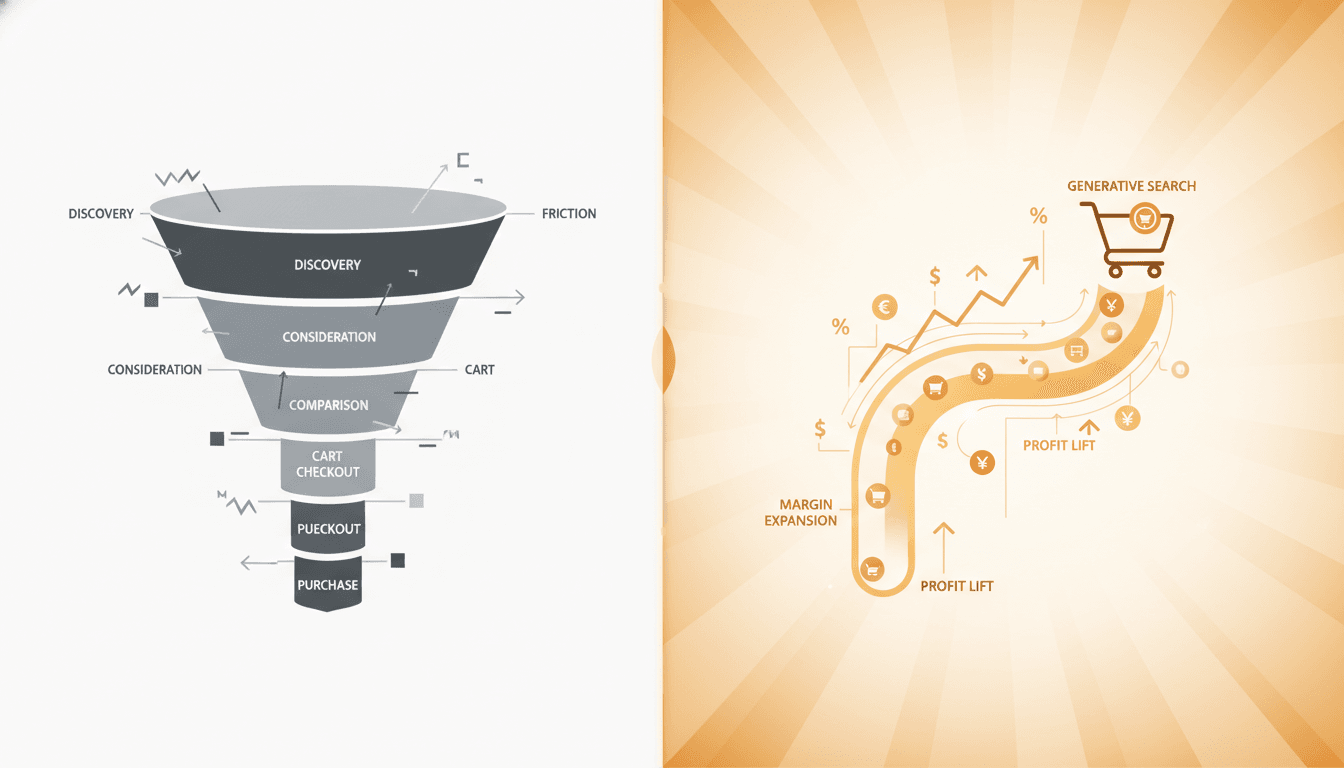
[IMG: Split-screen visualization showing a declining traditional search funnel on the left and a rising AI-recommendation commerce flow on the right, with revenue metrics annotating each path]


---


## The Revenue Threat Is Real: Understanding Zero-Click Commerce Economics

Zero-click search is not a future risk—it is a present-tense revenue erosion event affecting budgets and forecasts right now. [SparkToro and Datos research](https://sparktoro.com/blog/zero-click-searches-study) confirms that an estimated **65% of all Google searches** end without a single click to any website. This figure is expected to grow as AI Overviews and conversational AI interfaces continue to expand across the search experience.

The structural shift is compounding rapidly. [Google's AI Overviews now appear on approximately 47% of all U.S. search results pages](https://www.brightedge.com/resources/research-reports), dramatically compressing the real estate available for traditional organic results and paid ads below the fold. For brands whose revenue models depend on category pages, comparison content, or informational landing pages, this is not a trend to monitor—it is a margin event already in motion.

The numbers quantify the damage precisely. A [2024 Semrush study](https://www.semrush.com/blog/ai-overviews-impact-on-organic-ctr/) found that websites featured in Google AI Overviews received an average click-through rate of just **3.6%**, compared to **13.8%** for the top traditional organic result—a **74% reduction in traffic** for the same SERP position. Industry analyses from [Search Engine Land and Semrush](https://searchengineland.com/) suggest informational and product comparison pages have seen 20–40% reductions in click-through rates since AI Overviews expanded in 2024.

The revenue impact is not uniform across business models. It hits hardest for brands whose top-of-funnel depends heavily on:

- **Informational content** (buying guides, how-to articles, product education)
- **Comparison pages** (best-of lists, product vs. product content)
- **Category landing pages** that previously captured high-intent organic traffic
- **Long-tail keyword strategies** built on answer-style content

Rand Fishkin, Co-founder of SparkToro, has observed that the market is entering an era of "dark commerce"—where AI assistants influence billions of dollars in purchase decisions without generating a single trackable click. Brands that do not adapt their attribution models will systematically undervalue their most important marketing investments and over-invest in channels that look good on a dashboard but are losing influence in the real world.

The implication for revenue planning is direct: the metric of success must shift from organic traffic volume to **AI citation frequency**. Brands still measuring SEO success by keyword rankings are optimizing for a world that is rapidly disappearing.


---


## The Margin Opportunity: Why AI-Recommended Purchases Outperform Paid Search

The zero-click story has a counterintuitive flip side that most finance and marketing leaders have not yet modeled. AI-recommended purchases do not just maintain revenue—they improve the unit economics of e-commerce in ways that compound directly into margin.

[Salesforce's 2024 State of Commerce report](https://www.salesforce.com/resources/research-reports/state-of-commerce/) found that **AI-influenced orders carried an average order value 12% higher** than non-AI-influenced orders across its merchant network. This AOV premium exists because AI assistants contextualize recommendations based on user needs and budget signals, surfacing premium or bundled solutions rather than lowest-cost options.

For a brand doing $50M in annual e-commerce revenue, a 12% AOV lift across AI-influenced orders is material—not a rounding error. The economics extend far beyond the transaction itself.

Brands cited and recommended by AI assistants benefit from what [McKinsey research](https://www.mckinsey.com/capabilities/growth-marketing-and-sales/our-insights) describes as a **"trust halo effect"**: consumers who discover a product through an AI recommendation report higher purchase confidence and lower post-purchase regret. Lower return rates translate directly into gross margin improvement—a lever that paid search cannot replicate.

The acquisition cost differential is equally compelling. The cost-per-acquisition for customers converting after an AI assistant recommendation is estimated to be **30–60% lower than CPA from Google paid search**, because these buyers arrive further along in the decision journey with higher purchase intent. For CFOs modeling channel economics, that CPA differential—combined with the AOV premium and lower return rates—produces superior unit economics at every stage of the customer lifecycle.

The demographic dimension makes this opportunity even more urgent. According to a [2025 Search Engine Journal survey](https://www.searchenginejournal.com/state-of-ai-search-consumer-survey/), **62% of consumers aged 18–44 used an AI assistant to research a product purchase in the past 90 days**—up from 31% in the same survey conducted in 2023. This is the highest-LTV customer segment for most e-commerce brands.

Generative Engine Optimization (GEO) is not a top-of-funnel experiment—it is a direct investment in the customer segments that drive the most revenue and the most lifetime value.

[IMG: Unit economics comparison chart showing AI-recommended purchases vs. paid search across AOV, CPA, return rate, and LTV metrics]


---


## The Attribution Crisis: Why Budget Allocation Is Based on Incomplete Data

The most dangerous aspect of the AI search transition is not what brands can see—it is what they cannot. **Last-click and pixel-based attribution models are structurally blind to AI-influenced conversions**, and most brands are making budget decisions with systematically incomplete visibility into where revenue actually originates.

Here's how the gap opens: a consumer researches a product category in ChatGPT or Perplexity, receives a brand recommendation, then navigates directly to the brand's website or searches the brand name on Google. The conversion registers as direct traffic or branded search in Google Analytics. The AI recommendation that initiated the purchase journey becomes invisible to every standard reporting tool.

[Forrester Research](https://www.forrester.com/research/) has documented that traditional last-click attribution models are becoming structurally obsolete precisely because AI assistants influence purchase decisions at the awareness and consideration stage without generating a trackable click event.

This attribution gap has a predictable and costly consequence: it drives continued overspend in declining-efficiency channels. Marketers can see the click, but not the AI recommendation that preceded it. The paid search line item looks defensible on a dashboard; the AI-influenced conversion that preceded it is invisible.

[Marketing mix modeling (MMM) is experiencing a renaissance](https://www.nielsen.com/insights/2024/annual-marketing-report/) among sophisticated e-commerce brands for exactly this reason—MMM's ability to measure incremental impact across unmeasured channels makes it the most viable near-term methodology for the AI search era.

Close the attribution gap with these practical steps:

- **Implement MMM or brand lift studies** to establish a baseline for AI-influenced conversions and AOV premiums
- **Track leading indicators** such as citation frequency in AI responses, review volume, and brand search lift as proxies for AI recommendation activity
- **Shift from last-click to multi-touch attribution frameworks** that can capture AI touchpoints across platforms
- **Monitor direct and branded search trends** as downstream signals of AI-driven brand discovery

Brands that close this attribution gap first will reallocate budgets more accurately—and gain a compounding advantage over competitors still optimizing against incomplete data.


---


## Budget Reallocation Is Already Happening: The Paid Search to GEO Shift

The market has already started voting with its budgets. Global spending on Google Search Ads grew just **7% year-over-year in Q4 2024**—the slowest growth rate since 2020—while investment in content marketing and organic authority-building **grew 22% among enterprise e-commerce brands** in the same period, according to [eMarketer's Digital Ad Spend Report](https://www.emarketer.com/content/digital-ad-spend-report-q4-2024). This divergence is not coincidental. It reflects a market-level recognition that paid search efficiency is declining as AI intermediaries absorb more of the pre-click purchase journey.

The brands driving that 22% content investment increase are building the inputs that drive AI recommendation visibility. Structured data, authoritative content, citation frequency, and review volume are the signals that AI recommendation algorithms weight most heavily. Early movers are building authority assets that will compound into AI recommendation visibility as these algorithms mature and stabilize.

For brands still on the sideline, the competitive risk is asymmetric. [OpenAI's ChatGPT, with over 200 million weekly active users as of early 2025](https://openai.com/blog/), has integrated real-time shopping capabilities and product carousels—meaning a significant and growing share of product discovery now happens entirely within the ChatGPT interface.

[Perplexity AI crossed 15 million daily active users in early 2025](https://techcrunch.com/2025/) and launched Perplexity Shopping, a native commerce feature allowing users to purchase products directly within the AI interface. These are not prototype features—they are live commerce channels with growing transaction volume.

The window for first-mover advantage is narrow but still open. AI recommendation algorithms are being shaped by the current content landscape—the structured data, citation networks, and authority signals that exist today. Brands delaying reallocation risk both competitive disadvantage in a growing channel and continued wasted spend in a declining-efficiency one.

[IMG: Line graph showing diverging investment trends: paid search growth (7% YoY) vs. content marketing investment (22% YoY) among enterprise e-commerce brands, 2022–2024]


---


## Building the Competitive Moat: Trust Signals and AI Recommendation Visibility

AI recommendation algorithms do not reward ad spend—they reward trust signals. The inputs that drive AI recommendation visibility are **structured data, authoritative third-party citations, review volume, and consistent brand narrative** across the web. For brands accustomed to buying their way to visibility through paid search, this represents a fundamental shift in how competitive advantage is built and defended.

Here's how the moat compounds: investments made to win AI recommendations simultaneously strengthen traditional SEO authority, improve paid search quality scores, and build brand equity that reduces customer acquisition costs across every channel. This is not a zero-sum trade-off between AI visibility and traditional marketing—the inputs overlap almost completely.

A brand that builds genuine content authority for AI search is also building a stronger position in organic search, a more defensible brand in direct search, and a more efficient paid media environment.

The defensibility of this moat is what makes early investment particularly valuable. Andy Taylor, VP of Research at Tinuiti, has noted that the brands winning in AI search are not necessarily the ones with the biggest ad budgets—they are the ones with the most authoritative, well-structured, and trustworthy content. For the first time in a decade, a mid-market brand with genuine expertise can outcompete a Fortune 500 company for AI recommendation share.

The moat is built on three defensible asset classes:

- **Content depth**: Comprehensive, expert-level content that AI models recognize as authoritative
- **Citation frequency**: Consistent mentions and links from credible third-party sources, earned through PR and partnerships
- **Review velocity**: High-volume, high-quality customer reviews that signal purchase confidence and product quality

Once established, these assets are extremely difficult for competitors to replicate quickly—creating a compounding visibility advantage that grows as AI algorithms continue to stabilize around existing authority signals.


---


## The Demographic Imperative: Why Best Customers Are Already Using AI Search

The urgency of budget reallocation is not theoretical—it is driven by where the most valuable e-commerce customers are already conducting their purchase research. According to [Search Engine Journal's 2025 consumer survey](https://www.searchenginejournal.com/state-of-ai-search-consumer-survey/), **62% of consumers aged 18–44 used an AI assistant to research a product purchase in the past 90 days**. That figure has doubled from 31% in 2023—a two-year doubling curve that shows no signs of decelerating.

This is not niche behavior among early adopters. It is mainstream behavior among the demographic that represents the highest lifetime value for most e-commerce brands. The 18–44 cohort drives the majority of online discretionary spending, has the highest repeat purchase rates, and is most likely to become long-term brand loyalists.

Brands not visible in AI-mediated purchase journeys are effectively invisible to their best prospects at the moment of highest purchase intent. The demographic signal is compounded by platform growth. AI search tools are not static—they are adding users, features, and commerce capabilities at a rate that makes the 62% figure a floor, not a ceiling.

For senior marketing leaders, the strategic implication is direct: the audience most worth reaching is already using AI to make purchase decisions, and that behavior will only deepen over the next 24 months.


---


## The Three-Horizon Budget Framework: Defending, Building, and Innovating

Effective budget reallocation for the AI search era does not require abandoning paid search overnight. It requires a structured, horizon-based approach that defends existing efficiency while building toward the channels where growth is compounding.

**Horizon 1 — Defend (0–6 months):** Brands should protect existing paid search efficiency while it remains viable. This means optimizing campaigns for quality score improvements, extending match types carefully to capture remaining intent signals, and improving landing page relevance to sustain conversion rates as click volumes face pressure. Horizon 1 is about maximizing the return on existing spend, not growing it.

**Horizon 2 — Build (6–18 months):** Brands should invest in content authority and structured data for GEO. This is the primary reallocation target—the horizon where the most significant budget shift should occur. Building AI-readable content libraries, increasing citation frequency through PR and partnerships, expanding review volume through customer incentive programs, and establishing consistent brand narrative across the web are the core activities. This is where the moat is constructed.

**Horizon 3 — Innovate (18+ months):** Brands should build direct AI platform partnerships and native commerce integrations. This includes exploring API integrations with ChatGPT, Perplexity, and other AI platforms, developing native shopping features within AI interfaces, and piloting product feed integrations that surface brand inventory directly within AI recommendation responses. [Gartner forecasts that 30% of all product searches will occur on AI-powered interfaces by 2026](https://www.gartner.com/en/documents/predicts-2025-future-of-search)—up from an estimated 5% in 2023.

This is a **layering framework, not a replacement framework**. GEO is a new, high-ROI demand-generation layer that operates alongside paid media—not instead of it. Budget allocation should reflect the economics and timeline of each horizon: defend what works, invest in what's emerging, and pilot what's nascent.

Melissa Reeve, VP Analyst at Gartner Marketing Practice, has stated that CFOs need to start treating Generative Engine Optimization the way they treated SEO in 2005—as an early-mover investment with asymmetric returns. The brands that build AI visibility now, while the algorithms are still being shaped, will establish recommendation moats that will be extremely difficult for later entrants to overcome.


---


## Practical Allocation Framework: How to Rebalance Marketing Budget for AI Search

Translating the three-horizon framework into actual budget numbers requires starting with the right baseline. **Current paid search spend is the budget most at risk from declining efficiency**—and the most logical source of capital for reallocation. The 7% YoY growth rate in paid search spend signals a channel approaching saturation; the 22% growth in content investment signals where efficiency is rising.

Here's how a practical reallocation operates across budget lines:

- **Allocate 15–25% of paid search budget reductions to GEO content and authority-building.** This is the hedge against zero-click erosion. Even modest reductions in paid search spend, redirected to content authority programs, begin building the asset base that drives AI recommendation visibility.
- **Implement structured data across all product pages, review sections, and FAQ content.** Structured data is foundational for AI recommendation visibility and represents the highest leverage investment per resource dollar. This is the non-negotiable first step.
- **Build a content authority program with three components:** increase citation frequency through PR and editorial partnerships; expand review volume through customer incentive programs; establish consistent brand narrative across all owned and earned web presence.
- **Implement MMM or brand lift studies** to measure AI-influenced conversions and optimize budget allocation based on actual economics rather than last-click attribution. This replaces the attribution gap with measurable signal.
- **Set aside 5–10% of total marketing budget for AI platform partnerships and native integrations.** This is long-term option value—the Horizon 3 investment that positions the brand for direct commerce within AI interfaces as those channels mature.

The global market for AI in e-commerce is projected to grow from approximately $8 billion in 2024 to over $45 billion by 2032, with [AI-powered product recommendation engines representing the single largest investment segment](https://www.grandviewresearch.com/industry-analysis/ai-in-e-commerce-market). Brands that build the internal capability to participate in that market now will compound that advantage as the market scales.

[IMG: Budget allocation diagram showing three-horizon reallocation from paid search baseline, with percentage ranges for GEO content, structured data, MMM, and AI platform partnerships]


---


## The Scale of the Opportunity: $1.2 Trillion in AI-Influenced E-Commerce GMV

The economic stakes of this transition are not marginal. [Boston Consulting Group estimates](https://www.bcg.com/publications/2024/ai-and-the-future-of-commerce) that by 2027, AI-driven product discovery could influence up to **$1.2 trillion in global e-commerce GMV**—representing roughly **20% of all projected online retail sales**. For e-commerce brands, this figure reframes the entire investment conversation.

The question is not whether AI will reshape the revenue model. The question is what share of that $1.2 trillion influence will flow through brands that invested in AI visibility early.

First-mover advantage in GEO compounds over time in ways that are structurally similar to early SEO investment. Brands that built domain authority in 2005–2010 still benefit from that authority today—because authority signals are self-reinforcing and difficult to replicate quickly. The same dynamic applies to AI recommendation visibility: brands establishing citation frequency, structured data coverage, and review volume now will benefit from visibility advantages that competitors cannot easily replicate once algorithms stabilize around existing authority signals.

The window for capturing first-mover advantage is narrow but still open. With Gartner projecting 30% of product searches on AI interfaces by 2026, brands investing in GEO today are building for a channel that will be a primary demand-generation surface within the current planning cycle. Delaying investment means accepting a smaller share of a rapidly growing market—and a steeper climb to authority once the window closes.


---


## Common Objections and Practical Responses

**"AI search is still too small to justify budget reallocation."**

The data does not support this position. Sixty-two percent of the 18–44 demographic—the highest-LTV e-commerce segment—is already using AI for product research. Gartner projects 30% of all product searches will occur on AI interfaces by 2026. Waiting for AI to be "big enough" means ceding first-mover advantage in a channel that is already influencing the purchase journeys of the customers most worth reaching.

**"Brands don't know how to measure GEO ROI."**

For example, start with brand lift studies and MMM to establish a baseline for AI-influenced conversions. Track citation frequency and review volume as leading indicators of AI recommendation activity. Measure AOV and return rates for customers arriving via direct or branded search after known AI-heavy research periods—these are downstream signals of AI influence that standard analytics can partially capture.

**"Paid search is still working."**

True—but growth is slowing at 7% YoY, and efficiency is declining as AI intermediaries absorb more of the pre-click journey. The three-horizon framework does not require abandoning paid search. It requires defending existing efficiency in Horizon 1 while simultaneously building in Horizon 2. The risk is not in reallocation—it is in failing to rebalance before the efficiency decline accelerates.

**"Brands don't have the content resources to build authority at scale."**

For example, start with high-intent product pages and category pages where AI recommendation visibility delivers the highest ROI per page. Use customer reviews and third-party citations as force multipliers—these are high-authority signals that do not require large internal content teams to generate. Prioritize structured data implementation first, as it delivers the highest leverage per resource dollar and creates the foundation for all subsequent authority-building efforts.

[IMG: Decision tree graphic mapping common objections to practical first steps, formatted as a quick-reference tool for marketing leadership presentations]


---


## Next Steps: Building an AI Search Strategy

The path from awareness to action on AI search strategy follows a clear sequence. Brands that execute this sequence in 2025 will enter 2026—when Gartner projects 30% of product searches will occur on AI interfaces—with established authority and measurable AI recommendation visibility.

- **Audit current trust signal inventory.** Assess structured data coverage across product pages, citation frequency in third-party sources, review volume and recency, and brand narrative consistency across web presence.
- **Measure current AI Overview and AI recommendation exposure.** Use tools like Semrush or Moz to identify which branded and category queries are triggering AI Overviews, and whether the brand is cited within them.
- **Implement MMM or brand lift studies** to establish a baseline for AI-influenced conversions and AOV premiums. This is the foundation for data-driven budget reallocation decisions.
- **Develop a 12-month content authority roadmap.** Prioritize high-intent product and category pages, expand review volume through customer incentive programs, and increase citation frequency through PR and editorial partnerships.
- **Build internal alignment on budget reallocation** using the three-horizon framework as the communication structure. The framework allows marketing leaders to communicate urgency without abandoning existing channels—a critical factor for CFO and board-level buy-in.
- **Pilot AI platform partnerships.** Explore integrations with ChatGPT, Perplexity, or Gemini to test native commerce opportunities and begin building the Horizon 3 capability that will matter most by 2026–2027.

Sundar Pichai, CEO of Alphabet, has framed the shift as not an SEO problem—but a revenue architecture problem. Brands that still measure success by keyword rankings and organic traffic are optimizing for a world that is rapidly disappearing. The new question is: when a consumer asks an AI what to buy, does the brand get mentioned?

That answer is now a top-line revenue driver. The brands that treat that question as urgent—and act on it now—will be the ones capturing disproportionate share of the $1.2 trillion in AI-influenced GMV that BCG projects by 2027. The economics are clear. The window is open. The framework is here.


---


Brands ready to build a GEO strategy tailored to their revenue model and competitive position should connect with experienced advisors. Looking ahead, e-commerce leaders who help brands architect the budget reallocation and content authority investments that turn AI search visibility into margin improvement can guide this transition effectively. [Schedule a 30-minute strategy session](https://calendly.com/ramon-joinhexagon/30min) to walk through current exposure to zero-click commerce and opportunities in AI recommendation visibility.
H
Hexagon Team
Published June 7, 2026