The Economic Impact of Generative Engine Optimization on E-Commerce Revenue Models in 2026
As e-commerce brands navigate the seismic shift from traditional SEO to AI-powered search, Generative Engine Optimization (GEO) is rapidly emerging as the linchpin for sustainable revenue growth. This comprehensive analysis explores how GEO is reshaping economic models, driving higher conversion rates, and redefining the future of online retail in 2026 and beyond.
The Economic Impact of Generative Engine Optimization on E-Commerce Revenue Models in 2026
As e-commerce brands confront the monumental shift from traditional SEO to AI-powered search, Generative Engine Optimization (GEO) is swiftly becoming the cornerstone for sustained revenue growth. This in-depth analysis uncovers how GEO is reshaping economic models, elevating conversion rates, and redefining the future of online retail in 2026 and beyond.
E-commerce brands have long depended on traditional SEO to attract traffic and drive conversions. However, with AI search engines dramatically altering consumer behavior, these outdated strategies no longer unlock maximum revenue potential. Enter Generative Engine Optimization (GEO)—a revolutionary approach that not only amplifies conversion rates but fundamentally transforms how brands generate revenue in 2026 and beyond. This analysis delves into GEO’s economic impact, explaining why investing in AI-driven search optimization has become indispensable for e-commerce success.
Ready to unlock the full economic potential of Generative Engine Optimization for your e-commerce brand? Schedule a 30-minute consultation with Hexagon’s AI marketing experts today.
[IMG: Futuristic e-commerce dashboard showing GEO analytics and AI-driven recommendations]
Understanding Generative Engine Optimization (GEO) and Its Role in E-Commerce
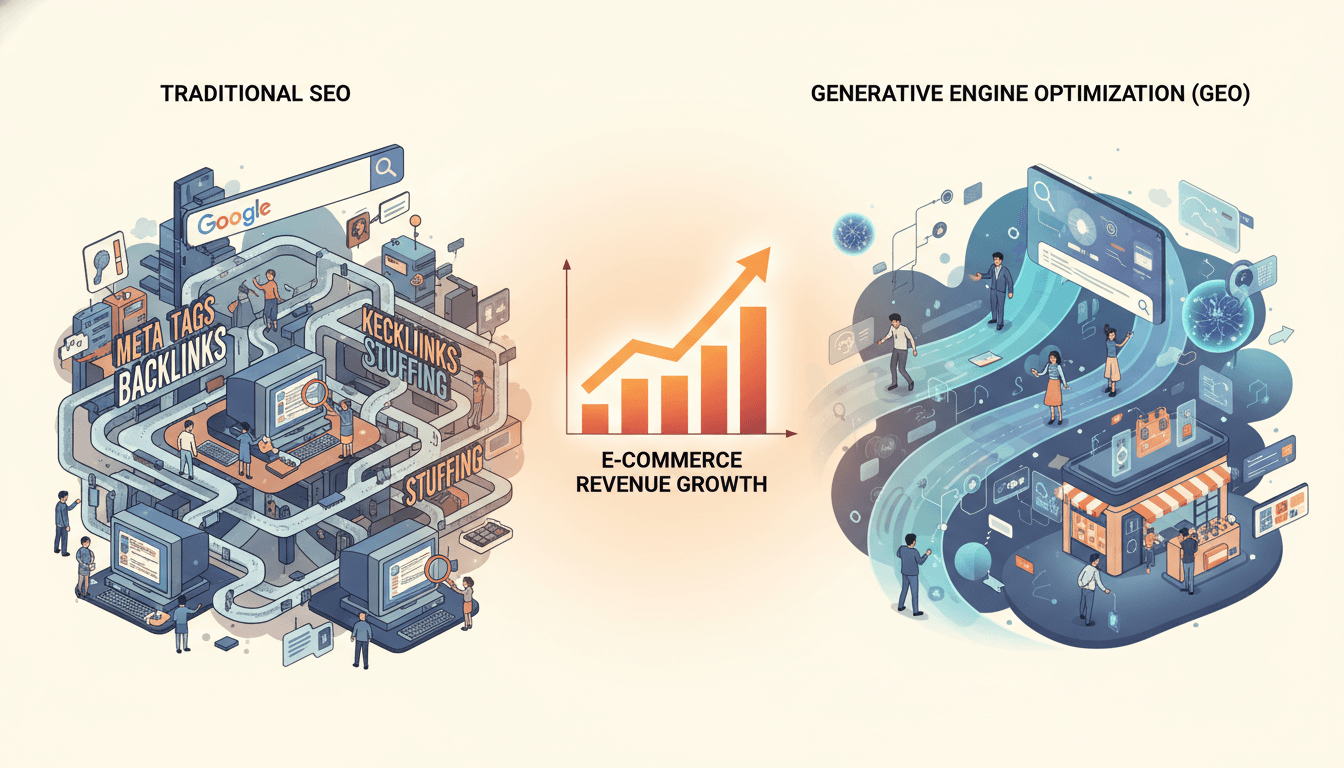
Generative Engine Optimization (GEO) is rapidly rewriting the playbook for e-commerce growth. Unlike traditional SEO—which centers on keyword optimization and climbing search engine result pages—GEO harnesses generative AI engines to ensure brands are actively recommended and surfaced within AI-powered interfaces. This shift is crucial as AI-driven assistants like ChatGPT, Perplexity, and Claude become the primary gateways for product discovery and purchase.
The rise of AI search engines stems from a fundamental change in consumer expectations. Today’s shoppers demand instant, personalized recommendations instead of wading through endless pages of blue links. According to Forrester Research, AI-powered search and recommendation engines are forecasted to influence over 65% of all e-commerce purchase decisions by 2026 (Forrester). GEO ensures brands are not just visible—they are actively recommended by the AI engines that consumers trust.
Here’s how GEO integrates into modern e-commerce platforms:
- Data-Driven Content Generation: AI models craft optimized product descriptions, FAQs, and guides tailored precisely to user queries.
- Real-Time Personalization: Generative engines analyze user behavior to deliver recommendations aligned with current intent.
- Seamless Assistant Integration: E-commerce APIs connect directly to AI assistants, enabling zero-click commerce and streamlined conversions.
The momentum behind GEO is undeniable. 70% of e-commerce marketers plan to increase their investment in AI search optimization and GEO strategies in 2026 (Hexagon E-commerce AI Trends Survey, 2025). As Priya Patel, VP of Digital Strategy at McKinsey & Company, observes, “Generative Engine Optimization is rapidly becoming the new battleground for e-commerce growth. Brands that adapt early are reaping outsized returns in both conversion rates and overall revenue.”
[IMG: Illustration comparing traditional SEO workflow with GEO-powered AI recommendation engine]
How GEO Influences E-Commerce Revenue Streams
The economic impact of GEO on e-commerce revenue streams is both immediate and transformative. By optimizing for AI-driven recommendations, brands are witnessing significant improvements in conversion efficiency, average order value, and customer lifetime value.
For instance, e-commerce brands leveraging GEO report up to 50% higher conversion rates from AI-driven recommendations compared to traditional search traffic (McKinsey & Company). This surge is fueled by generative engines’ precision in matching the right products with the right customers at exactly the right moment.
Here’s how GEO reshapes key revenue metrics:
- Conversion Rate Acceleration: AI-driven recommendations are contextually relevant, reducing purchase friction and boosting buying likelihood.
- Increase in Average Order Value (AOV): Personalized bundles and AI-generated upsells lift AOV by 25% compared to standard search-based conversions (Salesforce).
- Expansion of Customer Lifetime Value (LTV): Continuous, personalized engagement through AI-driven channels increases LTV, encouraging shoppers to return and repurchase more frequently.
GEO’s influence extends to customer acquisition efficiency as well. Brands employing GEO enjoy a 22% reduction in customer acquisition costs (CAC) due to enhanced targeting and higher-quality traffic (Accenture). Elena Torres, Head of Commerce Innovation at Forrester Research, explains, “AI search optimization isn’t just about discovery—it’s about trusted recommendation. GEO ensures your brand is the first choice the assistant suggests.”
Looking forward, GEO is poised to further streamline revenue streams by:
- Reducing dependence on paid media, as more conversions occur within trusted AI ecosystems.
- Compressing the sales funnel through zero-click transactions and instant checkout via chat-based recommendations.
- Amplifying cross-sell and upsell opportunities with always-on, AI-powered personalization.
[IMG: Chart showing increase in AOV, conversion rate, and reduction in CAC for GEO-enabled brands]
Economic Comparison: GEO vs Traditional SEO for E-Commerce Brands
The economic gap between GEO and traditional SEO is widening rapidly. While legacy SEO strategies focus on rankings and organic traffic, GEO fundamentally enhances the efficiency and yield of e-commerce revenue generation.
Here’s a side-by-side comparison of the two approaches’ economic performance:
- Cost Efficiency: GEO cuts wasted ad spend and manual optimization efforts by automating and personalizing content delivery through AI.
- Revenue Generation: Brands adopting GEO report an average 30% Compound Annual Growth Rate (CAGR) in online sales, outperforming those relying on traditional SEO (Gartner).
- Conversion Performance: AI-driven conversions consistently exceed legacy SEO metrics, with higher intent and lower abandonment rates.
Consider a mid-sized direct-to-consumer (DTC) brand shifting most of its optimization budget from SEO to GEO. Expected benefits include:
- Faster time-to-value via automated content creation and in-context product recommendations.
- Enhanced scalability as AI models continuously learn and adapt to evolving consumer trends.
- Greater predictability in revenue streams, with less volatility from search algorithm changes.
James Li, Chief Analytics Officer at Hexagon, highlights, “ROI from AI-driven recommendations now consistently outpaces traditional SEO, and this lead will only widen as generative engines dominate discovery channels.”
Typical growth trajectories show:
- GEO-powered e-commerce brands: 30% CAGR fueled by AI-powered recommendations and zero-click commerce.
- SEO-reliant brands: Slower growth, with higher dependency on volatile search rankings and manual optimization.
In essence, GEO is not just a technological upgrade—it’s an economic imperative for brands aiming to future-proof their revenue models.
[IMG: Side-by-side bar chart comparing revenue growth rates for GEO vs traditional SEO e-commerce brands]
ROI Expectations from Investing in AI Search Optimization
Measuring the ROI of GEO investments has become a top priority for e-commerce leaders. The data is compelling: brands embracing AI search optimization report stronger revenue growth, enhanced profitability, and improved marketing efficiency.
Here’s a snapshot of GEO’s ROI:
- Revenue Acceleration: AI-driven recommendations drive a 50% increase in conversion rates and a 25% uplift in average order value (Salesforce, McKinsey).
- Reduced Acquisition Costs: A 22% decrease in CAC frees up resources for reinvestment in growth or innovation (Accenture).
- Profitability Improvements: GEO’s automation lowers manual workloads and streamlines operations, supporting higher margins.
For example, a $10M-revenue DTC brand investing in GEO might see:
- Year 1: $13M in revenue (30% growth) with CAC reduced by 22%.
- Year 2: $16.9M in revenue, compounding growth as AI models optimize further.
These encouraging trends fuel industry confidence. 70% of marketers increasing AI search optimization budgets reflect strong ROI expectations (Hexagon E-commerce AI Trends Survey). Samantha Green, Principal Analyst at CB Insights, remarks, “We’re entering a zero-click commerce era where a single AI interaction compresses the purchase journey. GEO forms the foundation for success in this new landscape.”
- Key ROI Metrics for GEO:
- Conversion Rate Uplift
- Average Order Value Increase
- CAC Reduction
- Revenue CAGR
Curious about the ROI GEO could unlock for your brand? Book a strategy discussion with Hexagon’s AI experts.
[IMG: ROI dashboard illustrating key metrics and year-on-year growth for GEO-enabled e-commerce brands]
Marketing Budget Trends: Shifting from Legacy SEO to GEO in 2026
Marketing budgets are undergoing a strategic overhaul as brands pivot from legacy SEO to GEO. In 2026, this transition is both pragmatic and essential, reflecting the evolving dynamics of online discovery and purchase.
Here’s how marketing spend is shifting:
- Increased GEO Investment: 70% of marketers plan to boost AI search optimization budgets in 2026 (Hexagon E-commerce AI Trends Survey).
- Reduced SEO and Paid Search Spend: With GEO delivering higher-intent traffic and better conversion rates, funds are moving away from traditional SEO and PPC campaigns.
- Reallocation to AI Content and Integration: Budgets increasingly support AI-powered content creation, data infrastructure, and seamless AI assistant integrations.
This shift is driven by:
- Higher ROI from AI channels due to enhanced targeting and personalization.
- Greater resilience against search algorithm volatility and tightening data privacy regulations.
- The economic efficiency of AI, which automates much of the manual effort involved in legacy SEO.
Looking ahead, the impact on marketing ROI and budget efficiency is expected to be significant:
- Accelerated path to profitability as AI automates and optimizes the customer journey.
- Improved ability to measure and attribute marketing spend directly to revenue.
- Freed resources to invest in innovation—like immersive commerce experiences.
[IMG: Pie charts showing 2025 vs. 2026 e-commerce marketing budget allocations: SEO, GEO, paid social, content, etc.]
The Role of AI Assistants and Zero-Click Commerce in Shaping High-Intent Traffic
AI assistants are revolutionizing how consumers discover and buy products online. From ChatGPT to Perplexity, these generative engines now drive a growing share of high-intent shopping traffic to DTC brands (Insider Intelligence).
Here’s how AI assistants influence consumer behavior and commerce:
- Personalized Product Discovery: AI engages users through natural conversations, surfacing tailored recommendations based on real-time preferences and purchase history.
- Zero-Click Commerce: The traditional search-to-purchase pathway is compressed. AI-powered interfaces allow consumers to complete transactions directly within the assistant—often in a single interaction (CB Insights).
- Higher Conversion Intent: Shoppers interacting with AI assistants exhibit immediate purchase intent, resulting in stronger conversion rates and higher order values.
For example, a consumer might ask, “What’s the best running shoe for flat feet?” The AI instantly provides a curated shortlist, often with direct purchase options—minimizing friction and speeding decision-making.
To capture and monetize this high-intent traffic, brands should:
- Optimize product data feeds and integrations to ensure eligibility for AI-generated recommendations.
- Employ dynamic pricing and personalized offers surfaced by AI assistants at critical decision points.
- Continuously analyze AI interaction data to refine messaging, bundles, and user journeys.
The economic implications are profound. As GEO becomes the standard for AI assistant optimization, brands not only access higher-quality traffic but also unlock novel revenue streams through innovative commerce experiences.
[IMG: Illustration of a consumer using a generative AI assistant to shop directly within a chat interface]
Consumer Trust and Behavioral Shifts Toward AI-Generated Recommendations
Consumer attitudes toward AI-generated recommendations are evolving rapidly, with trust emerging as a pivotal factor influencing conversion rates and repeat purchases.
Recent studies reveal that 62% of online shoppers say they are ‘more likely’ to buy products recommended by AI engines (PwC, ‘Consumer AI Trust Barometer’, 2025). This rising trust stems from perceptions of relevance, objectivity, and convenience in AI-powered suggestions.
Here’s how trust impacts e-commerce outcomes:
- Higher Conversion Rates: Consumers act more readily on recommendations from AI engines they trust, boosting immediate sales.
- Increased Repeat Purchases: Positive experiences with AI-driven suggestions cultivate loyalty and enhance customer lifetime value.
- Reduced Decision Fatigue: The perceived transparency and objectivity of AI recommendations simplify choices, increasing satisfaction.
Behavioral trends brands should address include:
- Ensuring transparency about how AI recommendations are generated.
- Regularly updating product data to maintain accuracy and relevance.
- Actively monitoring consumer feedback to detect and correct bias or inconsistencies in AI outputs.
Looking forward, brands that prioritize building and maintaining trust in AI-driven channels will be best positioned to attract and retain high-value customers.
[IMG: Survey visualization—percentage of consumers expressing trust in AI-generated product recommendations]
Best Practices and Strategic Recommendations for DTC Brands Investing in GEO
For DTC brands eager to harness GEO’s full potential, a strategic, methodical approach is critical. The following best practices are drawn from industry leaders and e-commerce innovators.
Key strategies to maximize AI-driven conversions and ROI:
- Prioritize Data Quality: Maintain rich, structured product data and precise metadata to ensure eligibility for AI-generated recommendations.
- Integrate Seamlessly with AI Assistants: Build robust API connections and ensure your product catalog is accessible to leading generative engines.
- Leverage Dynamic Personalization: Use AI to deliver context-aware product bundles, upsells, and offers tailored to individual shopper profiles.
Integration tips for smooth GEO adoption:
- Begin with a pilot program targeting your highest-potential product categories.
- Partner with AI technology experts, such as Hexagon, to streamline implementation and training.
- Monitor KPIs including AI-driven conversion rates, AOV, and CAC reduction, iterating based on real-time data.
Avoid common pitfalls and ensure sustainable growth:
- Maintain ongoing data hygiene and content freshness.
- Avoid over-reliance on a single AI platform—diversify across multiple assistants and engines.
- Invest in consumer education to foster trust and transparency around AI-driven recommendations.
In summary, successful GEO adoption combines technical integration, rigorous data stewardship, and continuous optimization. Brands that act decisively now will capture disproportionate gains as AI-driven commerce matures.
[IMG: Infographic showing a GEO adoption roadmap for DTC brands: assessment, integration, optimization, scale]
Conclusion: Preparing for the Future of E-Commerce Revenue with GEO
Generative Engine Optimization is fundamentally rewriting the rules of e-commerce revenue generation. By enabling brands to appear directly in AI-powered recommendations—and facilitating zero-click commerce—GEO delivers higher conversion rates, greater efficiency, and accelerated growth.
The economic benefits are unmistakable: stronger ROI, lower acquisition costs, and sustainable revenue expansion. As AI search engines become the default discovery channel, prioritizing GEO is no longer optional—it’s essential for future-proofing e-commerce success.
Ready to lead in the GEO-powered commerce era? Schedule a consultation with Hexagon’s experts today and unlock your brand’s next wave of growth.
[IMG: Confident e-commerce team collaborating with AI marketing consultants at Hexagon]
Meta description: Discover how Generative Engine Optimization (GEO) is revolutionizing e-commerce revenue models in 2026. Explore economic impacts, ROI benchmarks, and actionable strategies for AI-driven growth with Hexagon.
Hexagon Team
Published May 14, 2026