The Economic Impact of AI-Powered Generative Search on E-Commerce Revenue Models
By 2027, AI-powered generative search will influence 40% of global e-commerce transactions, fundamentally transforming how brands generate revenue, allocate marketing budgets, and measure success. Discover how this seismic shift is rewriting the economics of e-commerce – and what your brand must do to stay ahead.
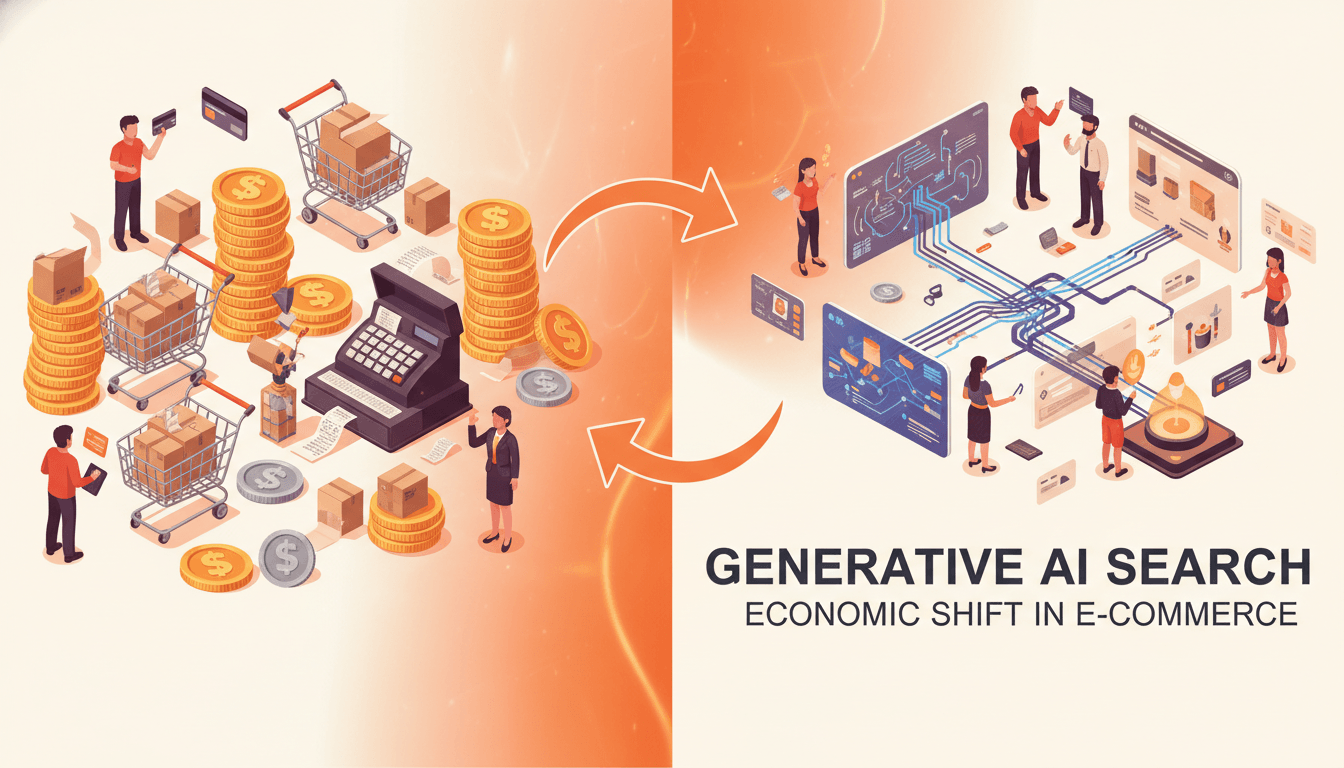
The Economic Impact of AI-Powered Generative Search on E-Commerce Revenue Models
By 2027, AI-powered generative search will influence 40% of global e-commerce transactions, fundamentally transforming how brands generate revenue, allocate marketing budgets, and measure success. Discover how this seismic shift is rewriting the economics of e-commerce—and what your brand must do to stay ahead.
[IMG: Futuristic illustration of consumers shopping online, AI assistants and product recommendations visible on screens]
Introduction: The Rise of AI-Powered Generative Search in E-Commerce
AI-powered generative search is rapidly emerging as the driving force behind the next wave of online commerce. Unlike traditional keyword-driven search, generative AI harnesses advanced language models to truly understand consumer intent, synthesize vast product data, and deliver personalized recommendations at scale. For e-commerce brands, this leap isn’t merely about smarter search—it’s about fundamentally reshaping the entire customer experience.
Forecasts reveal that by 2027, generative AI search platforms will influence an astounding 40% of all global e-commerce transactions (Gartner, 2024). This is not a distant future—AI is already accelerating consumer decision-making, collapsing the traditional purchase funnel, and disrupting how brands attribute revenue across channels. As Sucharita Kodali, retail analyst at Forrester, emphasizes, “Generative AI search is not only changing how consumers find products, but also how brands must rethink attribution and customer journeys. The brands that adapt quickly will set themselves apart.”
Grasping the economic implications of this shift is essential for any brand aiming to thrive in the AI-driven marketplace. The integration of AI into search is poised to upend long-standing revenue models, redefine marketing ROI benchmarks, and challenge traditional assumptions about customer acquisition and retention.
Ready to optimize your e-commerce revenue model with AI generative search? Book a 30-minute strategy session with Hexagon here.
How AI Generative Search is Changing E-Commerce Revenue Streams
The infusion of AI-powered generative search into e-commerce is rewriting the playbook for revenue generation. Let’s explore how this transformation unfolds:
Accelerated Purchase Decisions
AI-driven product recommendations now grasp subtle consumer preferences in real time. These systems analyze browsing behavior, reviews, and contextual cues to deliver hyper-relevant product suggestions instantly.
- Direct-to-consumer brands report a 15-20% reduction in the average length of their conversion funnel after adopting AI generative search (Shopify Plus, 2024).
- Customers receive immediate answers, comparisons, and tailored recommendations, enabling them to move seamlessly from discovery to checkout within a single session.
This acceleration not only fosters quicker conversions but also increases impulse purchases, thereby boosting average order values.
[IMG: AI-powered product recommendation interface on an e-commerce site]
Shortening of the Traditional Conversion Funnel
Traditionally, the purchase funnel involved multiple stages: awareness, consideration, comparison, and finally, conversion. Generative AI search compresses these steps by offering holistic, conversational guidance.
- Customers can pose broad questions and receive curated product lists, reviews, and even post-purchase advice—all within a single interface.
- The friction of toggling between multiple pages or sources disappears, enhancing overall funnel efficiency.
Brian Walker, Chief Strategy Officer at Bloomreach, succinctly notes, “Brands that prioritize AI-driven discovery are experiencing shorter funnels, improved ROI, and deeper customer relationships. The economics of e-commerce are being rewritten in real time.”
Improved Marketing ROI
The economic benefits for brands embracing AI-powered search assistants are already compelling:
- A 30-50% increase in marketing ROI within the first year has been reported (Forrester Consulting, 2024).
- More precise audience targeting and content matching reduce wasted ad spend and boost conversion rates.
- Enhanced personalization further elevates engagement and average basket size.
Notably, these gains extend beyond large enterprises; smaller retailers leveraging AI discovery tools are also seeing significant improvements.
Reduced Customer Acquisition Costs
AI search is fundamentally reshaping the economics of customer acquisition. With smarter targeting and higher relevance, brands can lower paid media spend while increasing returns.
- Brands with a strong AI search presence experience 22% lower customer acquisition costs (CAC) compared to those relying solely on traditional digital marketing (McKinsey & Company, 2024).
- AI’s ability to match products to precise intent means fewer wasted impressions and clicks.
This reduction in CAC is especially critical as digital ad costs continue to rise. Brands that harness AI generative search can reinvest these savings into other growth initiatives.
Increased Customer Lifetime Value
AI-powered search not only streamlines acquisition but also nurtures long-term customer value.
- Brands report a 17% average increase in customer lifetime value (CLV) after 12 months of AI search optimization (Deloitte Digital, 2024).
- Personalized discovery and seamless support foster loyalty and encourage repeat purchases.
Looking forward, as AI systems continue to learn and tailor experiences, these gains in CLV are expected to accelerate.
Key Takeaways:
- AI generative search accelerates purchase decisions and compresses the conversion funnel.
- E-commerce brands observe 30-50% higher marketing ROI and 22% lower CAC through AI search integration.
- Customer lifetime value rises by an average of 17% with ongoing AI search optimization.
The New Attribution Challenges Introduced by AI-Powered Marketing
While AI-powered generative search revolutionizes the customer journey, it also introduces unprecedented challenges in attribution. Let’s examine these complexities:
Blurring the Traditional Customer Journey
AI assistants aggregate and synthesize information from multiple sources, creating a fluid, nonlinear journey. Consumers may interact with brands across various channels but ultimately attribute their purchase to the AI assistant that recommended the product.
- The traditional model of tracking discrete touchpoints—email, paid ads, website visits—fails to capture this new decision-making process.
- Purchases are increasingly credited to AI recommendations rather than a specific marketing channel.
Harvard Business Review highlights this shift: “Brands relying on AI search face new attribution challenges, as consumers often credit purchases to AI recommendations rather than specific channels” (Harvard Business Review, 2024).
[IMG: Diagram showing complex customer journey with AI assistant touchpoints]
Declining Reliability of Last-Click Attribution
Last-click attribution has long been the industry standard for measuring digital marketing effectiveness. However, as AI search compresses and blurs the customer journey, this model is rapidly losing relevance.
- Legacy last-click metrics are unreliable because AI assistants frequently serve as the final, decisive touchpoint.
- Brands risk undervaluing early-stage marketing efforts that influence AI recommendations.
David Edelman, former CMO at Aetna and Harvard Business School lecturer, observes, “With AI assistants driving purchasing decisions, traditional last-click attribution models are becoming obsolete. Brands must adopt multi-touch and AI-centric attribution frameworks.”
Evolving Attribution Frameworks
To fully capture AI-powered marketing’s impact, brands must rethink their measurement strategies. Emerging frameworks address the realities of AI-driven journeys:
- Multi-touch attribution models allocate value across all customer interactions, not just the final click.
- AI-centric attribution tools analyze conversational data, AI assistant logs, and cross-channel engagement to provide a comprehensive view.
- Some brands develop custom algorithms that factor in AI recommendation influence, even when purchases occur on different platforms.
Accenture’s research confirms, “Traditional last-click attribution models are less effective as AI assistants blur the path-to-purchase by aggregating recommendations” (Accenture, 2024).
Implications for Marketing Measurement and Budgeting
This shift toward AI-powered attribution has profound effects on budget allocation and ROI measurement:
- Marketing teams must invest in advanced analytics and attribution solutions to track performance accurately.
- Budgeting becomes more dynamic, emphasizing content quality, AI integration, and multi-channel orchestration.
- Precise attribution is essential for justifying spend and optimizing future campaigns.
Brands that proactively adapt their attribution strategies will be best positioned to harness AI generative search’s economic benefits.
Adjusting Marketing Budgets and Strategies for AI Generative Search
The rise of AI-powered generative search demands a fundamental reallocation of marketing resources. Here’s how leading brands are evolving their strategies and budgets to win:
Shifting Ad Spend Toward AI Search Optimization
Marketers are rapidly redirecting funds from traditional paid search and social ads toward AI search optimization and high-quality content creation.
- 35% of search and social ad budgets are now being shifted toward AI search optimization and content (eMarketer, 2024).
- This shift reflects the growing importance of being discoverable by AI assistants, rather than simply outbidding competitors for ad placements.
Brands are investing in structured product data, optimized descriptions, and review aggregation to ensure their offerings are prioritized by AI platforms.
[IMG: Pie chart illustrating marketing budget allocation shift to AI search optimization]
Prioritizing Content Over Paid Ads
With AI discovery platforms ranking products based on relevance and quality, brands are moving away from reliance on paid ads.
- High-quality, structured content—such as product guides, FAQs, and rich media—now plays a central role in surfacing on AI.
- Investments in customer reviews, user-generated content, and technical SEO are increasing.
Connie Chan, General Partner at Andreessen Horowitz, observes, “The rise of AI-powered product recommendations is leveling the playing field—smaller brands optimizing for AI search can now reach consumers without massive ad budgets.”
Investing in Direct AI Integrations and Attribution Tools
E-commerce platforms are actively building direct integrations with AI assistants to ensure seamless access to product data, inventory, and reviews.
- Brands allocate resources to APIs, custom feeds, and real-time data synchronization with leading generative search providers.
- Adoption of AI-centric attribution tools is accelerating, enabling marketers to track engagement and conversions driven by AI recommendations.
For instance, TechCrunch reports that major e-commerce platforms are launching dedicated integrations to bypass traditional ad spend and maximize AI-driven discovery (TechCrunch, 2024).
Opportunities for Smaller and Challenger Brands
AI generative search is democratizing e-commerce visibility. Relevance—not budget—is becoming the primary driver of discovery.
- Challenger brands investing in quality content and AI optimization are surfacing alongside or even above legacy players.
- Smaller DTC brands gain a competitive advantage, as AI search prioritizes well-reviewed, relevant products over those with the largest ad spend (Andreessen Horowitz, 2024).
- This levels the playing field, enabling innovative entrants to capture share in established categories.
Strategic Recommendations for Marketers
To capitalize on AI-powered generative search’s economic impact, marketers should:
- Audit product data and content to ensure AI discoverability.
- Reallocate a portion of paid ad budgets toward AI search optimization, content, and API integrations.
- Invest in attribution solutions that track AI-driven conversions across channels.
- Foster a culture of agility, continuously testing and iterating strategies as AI platforms evolve.
Ready to optimize your e-commerce revenue model with AI generative search? Book a 30-minute strategy session with Hexagon here.
Case Studies: Brands Winning with AI Generative Search Integration
Real-world case studies illustrate the tangible economic benefits unlocked by AI-powered generative search. Here’s how forward-thinking brands are driving revenue growth and operational efficiency:
Case Study 1: DTC Apparel Brand
A leading direct-to-consumer apparel brand integrated AI search assistants across its e-commerce experience, optimizing product data and content for generative discovery.
- Within 12 months, the brand reported a 44% increase in marketing ROI (Forrester Consulting, 2024).
- Customer acquisition costs dropped by 20%, as AI-driven recommendations matched products to intent more efficiently.
- The brand also saw a 15% rise in repeat purchases, attributed to more relevant post-purchase recommendations.
Case Study 2: Specialty Beauty Retailer
A specialty beauty retailer invested heavily in structured product content and direct integrations with leading AI search platforms.
- The retailer experienced a 32% increase in ROI from AI search-driven traffic.
- Customer lifetime value (CLV) rose by 19%, fueled by cross-sell and upsell recommendations delivered by AI.
- The average funnel length shrank by 18%, with more customers converting in a single session.
[IMG: Before-and-after graph showing marketing ROI lift after AI search integration]
Case Study 3: Challenger Home Goods Brand
A challenger home goods brand leveraged AI-powered generative search to compete with established players, focusing on relevance and quality reviews.
- Despite a smaller ad budget, the brand’s products were surfaced alongside category leaders, doubling traffic from generative platforms.
- Marketing ROI soared by 50%, with a 24% drop in CAC compared to the previous year.
- According to the brand’s CMO, “AI search has enabled us to punch above our weight and acquire high-value customers at a lower cost.”
Strategic Adaptations Leading to Growth
Across these examples, several themes emerge:
- Strategic investment in AI discoverability and quality content delivers measurable ROI.
- Direct AI integrations and optimized product data reduce customer acquisition costs.
- Brands that adapt swiftly to AI-driven discovery realize faster growth and deeper customer loyalty.
Future Outlook: Preparing for the AI-Driven E-Commerce Economy
Looking ahead, the economic impact of AI-powered generative search on e-commerce will only intensify. Brands that prepare now will be best positioned for sustainable growth.
Emerging Trends in Generative Search Economics
Several key trends are shaping the next phase of AI-driven commerce:
- AI generative search is forecasted to influence 40% of global e-commerce transactions by 2027 (Gartner, 2024).
- The convergence of conversational commerce, real-time fulfillment, and hyper-personalized recommendations will further compress purchase cycles.
- Data privacy and ethical AI use will become central to building trust and differentiating brands.
[IMG: Timeline chart projecting the growing influence of generative AI search in e-commerce]
Proactive Adoption of New Attribution Models
Brands must act swiftly to adopt attribution frameworks that accurately reflect the AI-driven path to purchase.
- Multi-touch and AI-centric attribution will become essential for precise measurement and budgeting.
- Marketers should invest in analytics that map AI assistant interactions, search queries, and conversion triggers.
Agility in Marketing Budgets and Content Strategies
As the landscape evolves, agility will be the key to success.
- Brands should continuously reassess media mix, content formats, and integration strategies.
- Frequent experimentation and rapid iteration will uncover fresh opportunities for AI-driven growth.
Key Takeaways for Sustainable Revenue Growth
- The economics of e-commerce are being redefined by generative AI search.
- Strategic adaptation—in attribution, content, and budget allocation—is critical to capturing value.
- Brands that invest early in AI search optimization and attribution will outpace competitors in the AI-driven economy.
Conclusion: Capturing Value in the AI-Powered E-Commerce Landscape
AI-powered generative search is fundamentally transforming how e-commerce brands generate revenue, allocate marketing budgets, and measure performance. The shift from traditional search and paid ads to AI-driven discovery demands new approaches to attribution, content, and customer engagement.
Strategic adaptation is now the cornerstone of competitive advantage. Brands that embrace AI optimization, rethink attribution models, and invest in high-quality content will capture greater value as generative search becomes the dominant force in digital commerce.
Ready to optimize your e-commerce revenue model with AI generative search? Book a 30-minute strategy session with Hexagon here.
[IMG: Modern e-commerce team collaborating on AI search optimization strategy]
Hexagon Team
Published May 13, 2026