trainingbrandsbrand
The AI Search Training Data Problem: Why Your E-Commerce Brand Is Missing from ChatGPT
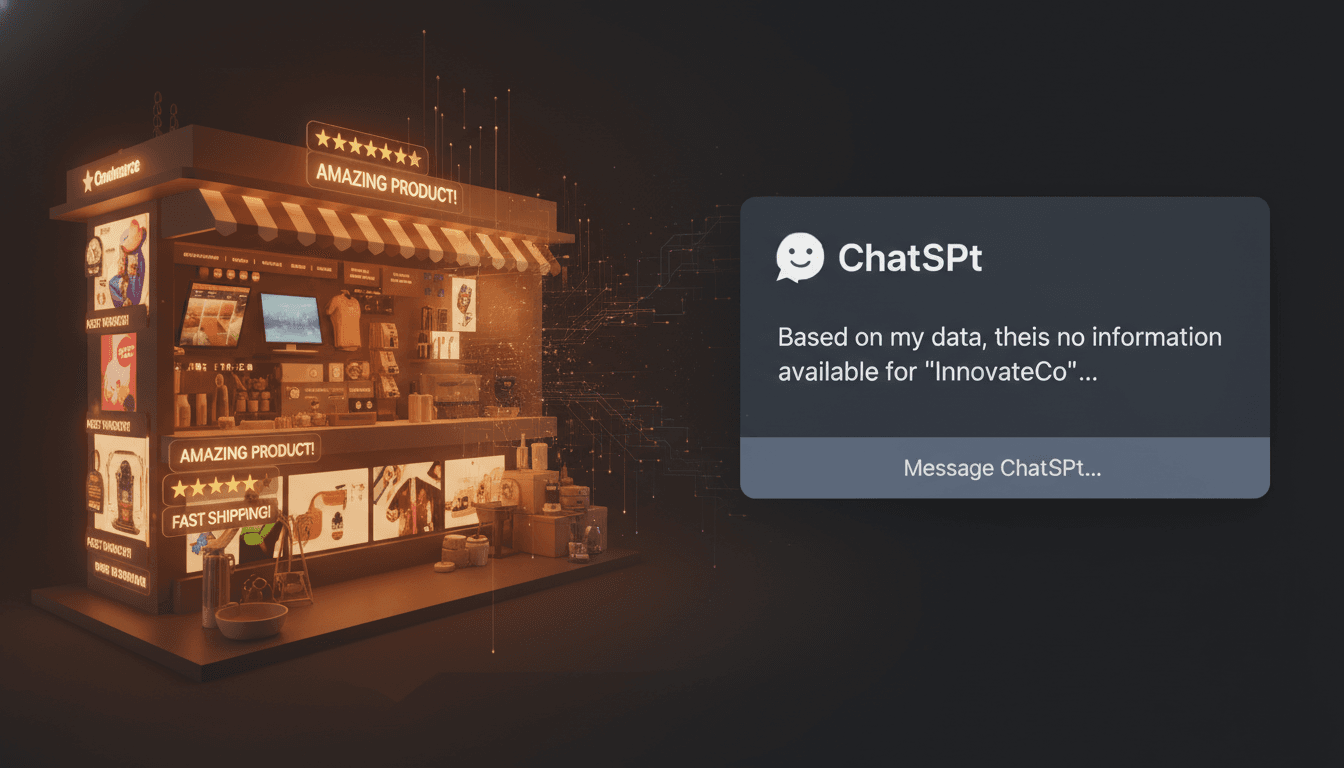
You've built a great product. You have the reviews to prove it. So why does ChatGPT keep recommending your competitors? The answer isn't your brand quality—it's a structural data problem that's quietly reshaping which e-commerce brands win in the age of generative AI.
14 min read
---


# The AI Search Training Data Problem: Why E-Commerce Brands Are Missing from ChatGPT

*Brands have built great products with strong reviews and solid retention metrics. Yet when consumers ask ChatGPT for recommendations, these brands never appear. The answer isn't product quality—it's a structural data problem that's quietly reshaping which e-commerce brands win in the age of generative AI.*

[IMG: Split-screen visual showing a consumer asking ChatGPT for a product recommendation on one side, and a frustrated DTC brand founder looking at analytics on the other—conveying the disconnect between brand quality and AI visibility]


---


Many brands have built superior products compared to their competitors. These DTC brands often have stronger customer reviews, better retention metrics, and cleaner supply chains than established players. Yet when someone asks ChatGPT for a recommendation in their category, these newer brands never appear.

Instead, consumers receive suggestions for legacy retailers and established players from five years ago. This pattern is not random—it reflects a fundamental structural problem in how AI systems are trained.

ChatGPT isn't ignoring newer brands because they lack quality. The model was trained on a frozen snapshot of the internet from October 2023, and most newer brands weren't prominent enough in that snapshot to survive the filtering process. This is the AI training data problem, and it's quietly reshaping which e-commerce brands win and lose.


---


## Understanding the Scale of the Problem

The implications are staggering. According to the [Salesforce State of the Connected Customer Report (2024)](https://www.salesforce.com/resources/research-reports/state-of-the-connected-customer/), **58% of consumers aged 18–34 have already used an AI assistant to research or discover a product before purchasing**. This makes AI recommendation visibility a top-of-funnel priority comparable to Google SEO.

With the global e-commerce market projected to reach [$1.3 trillion by 2025](https://www.emarketer.com/), the brands capturing AI-driven discovery share are disproportionately those that built strong digital footprints before major LLM training cutoffs. The competitive advantage compounds over time as AI-driven discovery accelerates.

Understanding this problem is the first step toward fixing it. Here's what brands need to know.


---


## What Is the AI Training Data Problem (And Why It Matters for E-Commerce)

Large language models don't browse the internet when answering questions. Instead, they draw from **frozen training snapshots**—massive datasets compiled at a specific point in time, after which the model's knowledge is sealed. [ChatGPT (GPT-4o) has a knowledge cutoff of October 2023](https://openai.com/index/gpt-4o-system-card/), Claude has an early 2024 cutoff, and Meta's LLaMA 3 stops at December 2023.

Any brand that launched, rebranded, or scaled significantly after those dates simply does not exist in the model's base knowledge. This creates a fundamental visibility problem that differs from traditional search engines.

Unlike Google Search, which crawls the web continuously and updates its index daily, LLMs operate on historical snapshots that are locked in place. A brand that was invisible in October 2023 remains invisible in ChatGPT today—regardless of how successful it has become since then.

This is a **quality-agnostic problem**. Newer brands are systematically excluded from AI recommendations regardless of product quality. A superior product from a 2024 startup loses to an adequate product from an established 2018 brand, not because the model prefers inferior quality, but because the older brand had more time to accumulate citations, reviews, and mentions before the training cutoff.


---


## How AI Models Get Trained on Product Information

LLMs are trained on enormous web crawls filtered through aggressive quality gates. The primary training corpora—[CommonCrawl, C4, The Pile, and WebText](https://arxiv.org/abs/2101.00027)—collectively index billions of web pages. However, the filtering process is brutal and systematic.

According to [analysis of the RedPajama dataset by Together AI (2023)](https://github.com/togethercomputer/RedPajama-Data), **over 90% of tokens in the most widely used LLM pre-training datasets originate from just a few hundred thousand high-authority domains**. This concentration has direct consequences for DTC brands.

CommonCrawl indexes roughly 3–5 billion web pages per crawl, yet high-authority domains like Reddit, Wikipedia, and major news outlets comprise 30–50% of filtered training tokens. The C4 dataset—used to train Google's T5 and many downstream models—was filtered from 156 billion tokens down to roughly 34 billion, a [78% reduction](https://arxiv.org/abs/2104.08758) that primarily eliminated pages lacking sufficient external references or domain authority.

The filtering process systematically deprioritizes pages with low inbound link counts, thin content, or limited third-party citation. Most DTC brand websites, lacking the inbound link density of established players, contribute negligible signal to model training.

For example, a homepage—no matter how beautiful or conversion-optimized—is essentially invisible to the systems that build LLMs. The model cannot assess quality from first-party content alone.

As [Andrej Karpathy, former Director of AI at Tesla and ex-OpenAI Research Scientist](https://karpathy.ai/), explains: "Language models are, at their core, a compression of the internet as it existed at a specific moment in time. If a brand wasn't meaningfully represented in that moment—through editorial coverage, reviews, forum discussions, and authoritative mentions—it simply doesn't exist in the model's world. It's not a bug; it's a fundamental architectural reality."

[IMG: Diagram illustrating the LLM training pipeline—from raw web crawl to quality filtering to tokenization to model weights—with annotations showing where DTC brands are filtered out]


---


## The Knowledge Cutoff Trap

The knowledge cutoff creates a hard deadline for brand visibility in base models. According to the [Hexagon AI Visibility Benchmark Report (2024)](https://joinhexagon.com/), **less than 5% of DTC brands founded after 2021 appear in unprompted AI product recommendation responses**, compared to over 60% of brands founded before 2018 with established media coverage.

This gap illustrates the compounding disadvantage of late entry into the pre-LLM training data window. Brands that are invisible to AI today become progressively more invisible over time as AI-assisted discovery accelerates.

Here's how the feedback loop works: AI recommendations influence which brands receive future editorial coverage. That editorial coverage feeds the next generation of training data. Missing the current training window means missing the next one, too.

As [Azeem Azhar, Founder of Exponential View](https://www.exponentialview.co/), explains: "The knowledge cutoff problem is actually two problems: there's the recency gap, where new brands simply weren't in the training data, and there's the authority gap, where brands existed but weren't cited enough to survive the data filtering process. Both are addressable, but they require completely different strategies."


---


## Real-Time AI Search vs. Static Training Data

Not all AI tools operate the same way, and conflating them leads to misdirected strategy. **Base ChatGPT (without browsing enabled) draws entirely from frozen training weights**. When a user asks for a product recommendation, the model cannot verify whether a brand still exists, has updated its product line, or changed its pricing.

[Perplexity AI and Bing Copilot](https://docs.perplexity.ai/) take a fundamentally different approach. These systems use real-time web retrieval layered on top of base LLM knowledge—a technique called Retrieval-Augmented Generation (RAG). This means they crawl the web during the query itself, creating a distinct advantage for newer brands with strong, crawlable web presences.

However, real-time AI systems still heavily weight high-authority domains and structured data. According to the [BrightEdge AI Search Grader Report (2024)](https://www.brightedge.com/), **67% of AI-generated product recommendations in tested categories referenced brands that were also featured on the first page of Google results**. This confirms that traditional SEO authority remains a strong proxy for AI training data inclusion.

Brands need different optimization approaches for each AI environment, but authority signals matter across all of them.

[IMG: Side-by-side comparison table showing how ChatGPT (static), Perplexity (RAG), and Bing Copilot (RAG) each process brand information differently, with optimization implications for each]


---


## The Editorial Authority Advantage

If there is a single lever that most directly predicts AI brand visibility, it is **third-party editorial authority**. Independent reviews, press articles, listicles, expert roundups, and forum discussions function as the primary signals that LLMs use to build brand associations and product attributes.

First-party content alone—no matter how well-written or SEO-optimized—is insufficient for AI visibility. According to [analysis by Profound, an AI brand visibility platform (2024)](https://www.profound.com/), brands appearing in **10 or more independent third-party editorial reviews or roundup articles are approximately 3 times more likely to be surfaced in AI assistant product recommendations** than brands with equivalent sales but only first-party content.

Mentions in Reddit, Quora, YouTube, and independent publications carry disproportionate weight in training data. Press coverage, expert roundups, and listicles function as "AI-readable signals" that create the citation depth required for both training inclusion and real-time retrieval.

This is not supplementary to an AI visibility strategy. This is the strategy itself.

As [Rand Fishkin, Co-Founder & CEO of SparkToro](https://sparktoro.com/), observes: "The brands winning in AI search right now aren't necessarily the best products—they're the brands that were most talked about on the internet before the training cutoff. That's a solvable problem, but only if marketers understand why it's happening in the first place."


---


## Structured Data, Wikipedia, and Entity Signals

Beyond editorial coverage, there is a foundational layer of technical signals that determines how well AI systems can understand and recommend a brand. **Structured data markup**—specifically [Schema.org Product, Organization, and Review schemas](https://schema.org/)—makes brand information machine-readable for both real-time AI systems and the crawlers that feed training pipelines.

Yet fewer than 44% of e-commerce sites implement it correctly, according to the [Web Almanac 2023 by HTTP Archive](https://almanac.httparchive.org/en/2023/structured-data). This represents a significant missed opportunity for AI visibility.

Wikipedia presence is a particularly powerful signal. According to [EleutherAI's documentation of The Pile dataset](https://pile.eleuther.ai/), Wikipedia content is included in virtually every major training corpus at high weight. Brands with Wikipedia pages are far more likely to be recommended by LLMs because the model has encountered a structured, authoritative, third-party description during training.

LLMs use entity recognition to understand brand relationships and product attributes. An inconsistent brand entity—different names, descriptions, or category associations across the web—creates ambiguity that reduces the likelihood of correct AI attribution. These are table-stakes for AI visibility in 2024 and beyond.


---


## The Compounding Invisibility Problem

AI-assisted discovery is not a future scenario—it is accelerating right now. The brands that are invisible today are accumulating a disadvantage that becomes harder to reverse with each passing month. **AI recommendations influence which brands receive future editorial coverage**, creating a feedback loop where visibility generates more visibility.

Future LLM training cycles will favor brands already visible in current AI outputs. The brands winning AI discovery now will be overrepresented in the next generation of training data, reinforcing their position in the models that follow.

The cost of inaction is not staying flat. It is falling further behind.

As [Lily Ray, VP of SEO Strategy & Research at Amsive Digital](https://amsive.com/), puts it: "We're entering an era where a brand's discoverability is determined not just by website SEO, but by the entire corpus of things ever written about it across the web. AI models are essentially running a reputation audit on every brand at inference time—and most DTC brands are failing that audit silently."

[IMG: Line graph showing the diverging AI visibility trajectories of two hypothetical brands over 24 months—one that invested in earned media and structured data early, and one that did not—illustrating the compounding effect]


---


## Reframing Content Strategy for AI Training Data

Traditional SEO strategy—optimizing a website, publishing blog content, building internal links—is necessary but insufficient for AI visibility. **The content formats that matter most for LLM training are editorial reviews, comparison guides, expert roundups, and forum discussions**. These are the formats that survive aggressive quality filtering and accumulate the citation depth that signals authority to training pipelines.

Distribution channels matter as much as content format. High-authority publications, Reddit, Quora, YouTube, and Twitter/X carry disproportionate weight in training data because they are heavily represented in CommonCrawl and its filtered derivatives. First-party brand content contributes minimal signal to LLM training.

Press releases and earned media placements drive training data inclusion far more effectively than owned content. For example, a single placement in a "best of" article on a high-DA publication can do more for AI visibility than months of blog publishing.

This requires a fundamental shift in how marketing teams allocate effort and budget. The question is no longer only "how do we rank on Google?" but "how do we build the citation depth that survives LLM training filters?"


---


## Practical Steps to Fix Your AI Visibility Gap

Fixing the AI visibility gap requires action across multiple layers simultaneously. Here's how to approach each one:

**Layer 1: Build Historical Citation Depth Through PR and Earned Media**

• Pursue a targeted PR campaign focused on high-authority publications and category-specific media
• Target placements in listicles, roundup articles, and "best of" features—these carry disproportionate training weight
• Prioritize outlets with strong domain authority and established inclusion in CommonCrawl
• Track which publications are most frequently crawled and indexed by major training datasets

**Layer 2: Optimize for Real-Time AI Search via Structured Data and Crawlability**

• Implement Schema.org Product, Organization, and Review markup across the site with complete, accurate data
• Ensure the site is technically crawlable and frequently indexed by major search engines and crawlers
• Maintain consistent brand entity information across all digital properties—website, Google Business Profile, social media, and directories
• Fix any entity inconsistencies that could create ambiguity in AI attribution

**Layer 3: Monitor AI Output Mentions as a New Brand Health KPI**

• Query ChatGPT, Claude, and Perplexity with category-level product questions relevant to the business
• Track mention frequency and sentiment as a core brand health metric alongside traditional KPIs
• Identify which competitors are being surfaced and reverse-engineer their citation profiles
• Set internal targets for AI mention rates and monitor progress quarterly

**Layer 4: Invest in Wikipedia and Entity Consistency Across the Web**

• Establish a Wikipedia presence if the brand meets notability criteria (typically requiring significant third-party coverage)
• Align brand name, description, and category across the Knowledge Graph, Google Business Profile, and structured data
• Correct any entity inconsistencies that could create ambiguity in AI attribution
• Consider working with a Wikipedia expert if lacking experience with platform guidelines

**Layer 5: Create Content Designed for Training Data Inclusion**

• Commission or pitch expert reviews, comparison guides, and category roundups to high-authority publications
• Engage authentically in Reddit, Quora, and forum discussions relevant to the product category
• Encourage independent YouTube reviews and editorial coverage from niche publications
• Invest in relationships with influencers and reviewers who can create third-party content

[IMG: Visual framework or checklist graphic illustrating the five-layer AI visibility approach, with icons for each layer—PR, structured data, monitoring, Wikipedia, and content strategy]


---


## What's Next: AI Visibility as a Core Marketing KPI

AI-assisted product discovery is no longer a future scenario. **58% of young consumers already use AI for product research**, and that number is growing faster than traditional search adoption did at a comparable stage. The competitive advantage goes to brands that act now, before the next major LLM training cycle locks in the next generation of AI-recommended brands.

Looking ahead, brands should treat AI mention rates and recommendation frequency as core marketing KPIs alongside organic search rankings and social reach. Monitoring ChatGPT, Claude, and Perplexity outputs for brand mention frequency provides a leading indicator of AI-driven discovery share.

Editorial coverage and earned media remain the primary levers—but they take time to accumulate. The brands that start building citation depth today will be the ones that dominate AI recommendations in 12 to 24 months.

The next 6–12 months represent a critical window before the next major LLM training cycle. The brands that understand the AI training data problem now—and act on it systematically—will hold a structural advantage that compounds over time, just as early SEO adopters did in the early 2000s.

The window is open. The question is whether a brand will be in the next snapshot.


---


*Ready to find out where a brand stands in AI search? [Book a free 30-minute AI visibility audit](https://calendly.com/ramon-joinhexagon/30min) with the Hexagon team and get a clear picture of current footprint across ChatGPT, Claude, and Perplexity—plus a prioritized roadmap to close the gap.*
H
Hexagon Team
Published May 31, 2026