brandstrainingsearch
The AI Search Training Data Gap: Why 80% of E-Commerce Brands Are Missing from ChatGPT's Knowledge Base
Approximately 80% of DTC and mid-market e-commerce brands have zero measurable presence in AI-generated product recommendations. Here's what's driving that gap—and why the window to close it is narrowing fast.
10 min read

# The AI Search Training Data Gap: Why 80% of E-Commerce Brands Are Missing from ChatGPT's Knowledge Base

*Approximately 80% of DTC and mid-market e-commerce brands have zero measurable presence in AI-generated product recommendations. This article explores what's driving that gap—and why the window to close it is narrowing fast.*

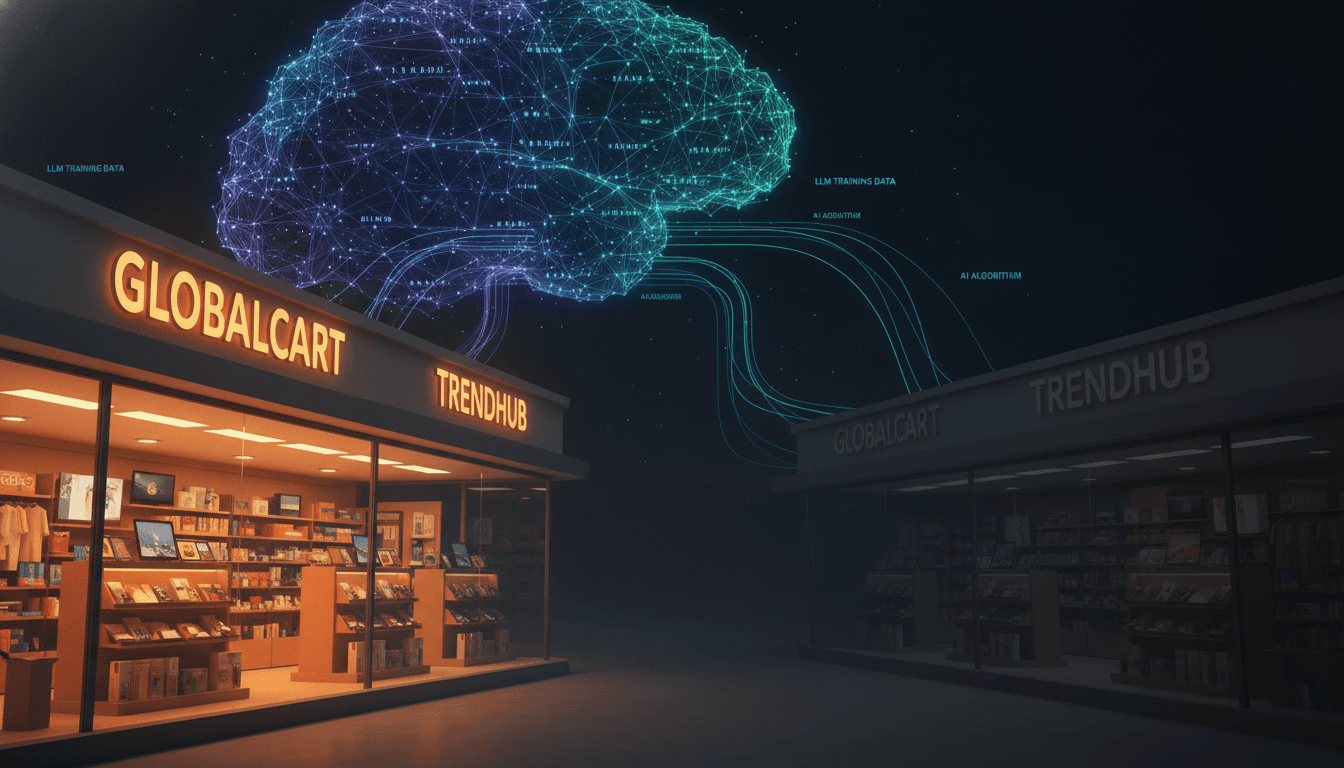
[IMG: Split-screen visualization showing a brand's polished website on one side and an empty AI chat response on the other, symbolizing the disconnect between digital presence and AI visibility]


---


## What Happens When the AI Has Never Heard of You?

A consumer opens ChatGPT and asks for the best running shoes under $150. The response arrives within seconds—confident, detailed, and completely devoid of any mention of the brand in question.

This scenario plays out millions of times daily. For most DTC and mid-market e-commerce brands, it represents a fundamental threat to growth trajectory. The brands that appear in these responses are almost certainly not DTC brands that launched in 2021, regardless of product strength, website ranking, or content marketing investment.

According to [Hexagon's analysis of over 50,000 AI-generated product recommendation queries](https://hexagon.ai) spanning 12 major e-commerce categories, approximately **80% of DTC and mid-market e-commerce brands have zero measurable presence** in AI-generated product recommendation outputs across ChatGPT, Perplexity, and Claude. This is not a content quality problem. It is not an SEO problem. It is a structural problem baked into how large language models are built, trained, and deployed.

The stakes are accelerating rapidly. [Salesforce's State of the Connected Customer Report (2024)](https://www.salesforce.com/resources/research-reports/state-of-the-connected-customer/) found that **58% of U.S. consumers** have used an AI assistant to research or discover products in the past 12 months, up from just 18% in 2022. This represents mainstream adoption, not a niche segment.

[Gartner projects](https://www.gartner.com/en/articles/gartner-predicts-2024) that traditional search engine volume will decline by **25% by 2026** as AI-powered answers replace conventional search results pages. For brands that remain invisible to AI systems, the compounding cost of that invisibility grows with every quarter.

Understanding why this gap exists requires examining the foundational architecture of how large language models learn about the world.


---


## The Training Data Architecture Problem

[IMG: Diagram illustrating the LLM training pipeline: data collection → filtering → training → deployment, with a timeline showing the 6–18 month lag between cutoff and public release]

### How LLMs Learn—and What They Miss

Large language models like GPT-4 and Claude operate fundamentally differently than search engines. They don't browse the internet in real time when answering a product question. Instead, they draw on **parametric memory**: knowledge encoded into their weights during a training process that concluded months or years before the conversation is happening.

As the [OpenAI GPT-4 Technical Report](https://openai.com/research/gpt-4) confirms, these models are trained on static datasets with fixed cutoff dates. Any brand authority, press coverage, or content published after that cutoff is entirely absent from the model's knowledge base unless retrieved via live search plugins.

GPT-4's primary training data has a knowledge cutoff of April 2023. Claude 3's cutoff is early 2024. Even models with more recent cutoffs typically carry a **6–18 month lag** between data collection and public deployment, according to [Epoch AI Research's analysis of model release timelines](https://epochai.org).

A brand doing everything right in 2024—earning press coverage, building backlinks, publishing authoritative content—may still be completely absent from a model that millions of consumers are actively using for product discovery today. The implications are stark and structural.

Here's how this temporal invisibility manifests: a company can execute flawlessly from a digital marketing perspective in 2024 and still be completely absent from a model trained on 2022 data. This isn't a content problem—it's an infrastructure problem that requires a completely different strategic response.

### The Citation Concentration Crisis

The training data problem is compounded by a severe concentration of which sources actually make it into LLM knowledge bases. The [Common Crawl Foundation](https://commoncrawl.org)—a foundational training source for most major LLMs—indexes approximately **3.4 billion web pages**. But the distribution is heavily skewed.

High-domain-authority publishers, Wikipedia, Reddit, and major news outlets dominate the dataset. The long tail of e-commerce brand websites is dramatically underrepresented, and brand-owned content is often actively filtered out to reduce promotional bias in model outputs.

[Hexagon's analysis of 50,000+ AI-generated recommendations](https://hexagon.ai) quantifies just how severe this concentration has become:

- Fewer than **500 web domains** account for over 70% of all brand citations in AI-generated product recommendations
- Dominant citation sources include major retailers (Amazon, Walmart, Best Buy), legacy media (Wirecutter, Consumer Reports), and top-tier publications (Forbes, Business Insider)
- DTC brands founded after 2020 face the steepest barriers because they had insufficient time to accumulate the editorial mentions and third-party reviews that LLM training datasets disproportionately weight

The authority signal hierarchy in LLM training data follows a predictable and unforgiving pattern. According to [research published on arXiv in 2023](https://arxiv.org), Wikipedia entries carry the highest weight, followed by major news outlet mentions, then aggregator review sites like Wirecutter and CNET, then Reddit and forum discussions. Brand-owned content ranks last—and is frequently filtered out entirely.

The irony of AI search is that it has recreated the early days of Google PageRank, but with a more severe penalty. At least with PageRank, brands could build links and see results within months. With LLM training cycles, the feedback loop is measured in years, creating a compounding disadvantage for brands that aren't thinking about this today.


---


## Key Insights: Why Traditional Marketing Playbooks Fall Short

[IMG: Side-by-side comparison graphic: "Traditional SEO Signals" (backlinks, on-page optimization, keyword targeting) vs. "AI Visibility Signals" (editorial mentions, training data presence, RAG optimization, third-party citations)]

### Why Traditional SEO Fails for AI Visibility

The instinct for most e-commerce marketing teams is to treat AI search visibility as an SEO problem with a new interface. That instinct is fundamentally misguided.

On-page optimization, keyword targeting, and even aggressive backlink building do not retroactively enter a deployed model's parametric memory. When AI assistants are asked product recommendation questions, they generate responses from training data rather than live search. This means even brands with excellent current SEO rankings may be completely absent from conversational AI responses.

As the [Stanford HAI Report on Generative AI and Information Retrieval (2024)](https://hai.stanford.edu) confirms, the disconnect is structural, not tactical. The [MIT Technology Review](https://www.technologyreview.com) stated it directly in 2024: "The SEO playbook is broken for AI search."

Here's how the pathways to genuine AI visibility differ from traditional search optimization:

- **Appearing in training data before the cutoff**: Building a third-party editorial footprint in high-authority publications, review sites, and aggregators that LLMs weight heavily
- **Being retrieved by real-time search-augmented models**: Optimizing for the citation algorithms used by tools like Perplexity that blend parametric memory with live retrieval
- **Being included in future model fine-tuning cycles**: Establishing the kind of authoritative, widely-cited digital presence that increases the probability of inclusion in the next generation of training datasets

The brands that will win in AI search are not necessarily those with the best products or even the best websites. They are the ones who understood early that LLMs learn from the broader digital conversation about a brand, not from the brand's own website. If that third-party conversation doesn't exist in the training data, the brand simply doesn't exist to the model.

### The Retrieval-Augmented Generation Distinction

Not all AI models operate purely from static training data. Tools like Perplexity AI use a hybrid architecture: a base LLM for reasoning combined with real-time web retrieval. According to [Perplexity AI's technical documentation](https://www.perplexity.ai), this retrieval-augmented generation (RAG) approach allows the model to surface more current information than a purely parametric system.

For e-commerce brands, this represents a genuine opportunity—but only a partial one. Perplexity's citation algorithm for determining which retrieved sources to surface still heavily favors domains with high existing authority scores. A mid-market DTC brand with strong on-site content but limited third-party editorial coverage faces a compounding disadvantage: invisible in training data *and* deprioritized in live retrieval.

The strategic implication is clear. Brands must pursue both tracks simultaneously:

- **Building domain authority** through third-party editorial coverage, review site presence, and forum discussion that feeds both training datasets and live retrieval ranking signals
- **Optimizing for AI retrieval patterns** by structuring content and metadata in ways that align with how RAG systems evaluate and cite sources

Neither approach alone is sufficient. Together, they create a multiplier effect that compounds over time.

### The Commercial Stakes Are Accelerating

The business case for treating AI visibility as a strategic priority rests on three converging data points. First, consumer adoption is already mainstream. [Salesforce's research](https://www.salesforce.com/resources/research-reports/state-of-the-connected-customer/) shows that 58% of U.S. consumers are already using AI assistants for product discovery, up from 18% just two years ago. This is approaching majority adoption.

Second, the conversion economics are compelling. [Forrester Research's "Conversational Commerce Effect" report (2024)](https://www.forrester.com) documents that consumers who discover a brand through an AI assistant recommendation convert at **2–3x the rate** of those arriving through paid social media advertising. The reason is straightforward: AI recommendations carry implicit third-party endorsement.

Third, the traffic shift is inevitable. [Gartner's 2024 predictions](https://www.gartner.com/en/articles/gartner-predicts-2024) project a 25% decline in traditional search volume by 2026 as AI answers replace click-through results pages. This is not speculation about distant futures. This is a projection based on current adoption trends and technological trajectory.

Looking ahead, the gap between AI-visible and AI-invisible brands is not static. Brands that establish LLM presence now benefit from compounding citation loops—more citations generate more authority signals, which increase the probability of appearing in future training datasets and live retrieval outputs. Brands that remain absent face an accelerating disadvantage as AI search adoption grows and organic traffic from traditional search engines continues to decline.

According to [Gartner's Emerging Technology Report on Generative Engine Optimization (2024)](https://www.gartner.com), this divergence is expected to widen materially through 2026. The window for establishing presence is open now. It will not remain open indefinitely.

[IMG: Line graph showing projected AI search adoption curve (2022–2026) alongside traditional search volume decline, with annotation marking the "AI visibility window" for e-commerce brands]


---


## Conclusion: The Window Is Open—But Not Indefinitely

The AI search training data gap is not a temporary anomaly that will resolve itself as AI technology matures. It is a structural feature of how large language models are built, and it systematically disadvantages the brands that have been most reliant on direct-to-consumer digital channels.

The concentration of AI citations among fewer than 500 domains, the 6–18 month deployment lags that make recent digital efforts invisible to current models, and the fundamental inadequacy of traditional SEO as an AI visibility strategy all point to the same conclusion: **the brands that act now will compound their advantage, and the brands that wait will compound their absence.**

The good news is that this is a solvable problem. It requires a different strategic framework than most e-commerce marketing teams are currently operating with, but it is absolutely achievable. Building the third-party editorial footprint, optimizing for retrieval-augmented systems, and proactively positioning brands within the sources that LLMs weight most heavily are all concrete, measurable objectives.

The first step is understanding exactly where a brand stands in the current AI visibility landscape—which models recognize it, in which categories, and against which competitors. From there, a systematic strategy for closing the gap becomes possible.

**The AI search era is not coming. It is already here, and 80% of e-commerce brands are missing from it.**


---


*Brands seeking to understand where they stand in AI-generated product recommendations—and what it takes to close the visibility gap—can explore solutions designed specifically for this challenge.* [**Learn how Hexagon can help.**](https://hexagon.ai)
H
Hexagon Team
Published June 12, 2026