citationbrandshttps
The AI Citation Economy: How the Top 3% of E-Commerce Brands Capture 71% of Generative Recommendations (And How to Join Them)
The AI citation economy has a Gini coefficient of 0.82—more unequal than any nation on Earth. With $1.2 trillion in AI-influenced e-commerce revenue on the line by 2027, here's what separates the brands that get recommended from the brands that get ignored.
14 min readRecently updated
# The AI Citation Economy: How the Top 3% of E-Commerce Brands Capture 71% of Generative Recommendations (And How to Join Them)

*The AI citation economy has a Gini coefficient of 0.82—more unequal than any nation on Earth. With $1.2 trillion in AI-influenced e-commerce revenue on the line by 2027, here's what separates the brands that get recommended from the brands that get ignored.*

[IMG: Split-screen visualization showing a power-law distribution curve on the left labeled "AI Citation Distribution" with a steep drop-off after the top 3%, and a traditional bell curve on the right labeled "Traditional Search Distribution"—stark visual contrast between the two economies]


---


## Why the AI Citation Economy Is Structurally More Unequal Than Google Ever Was

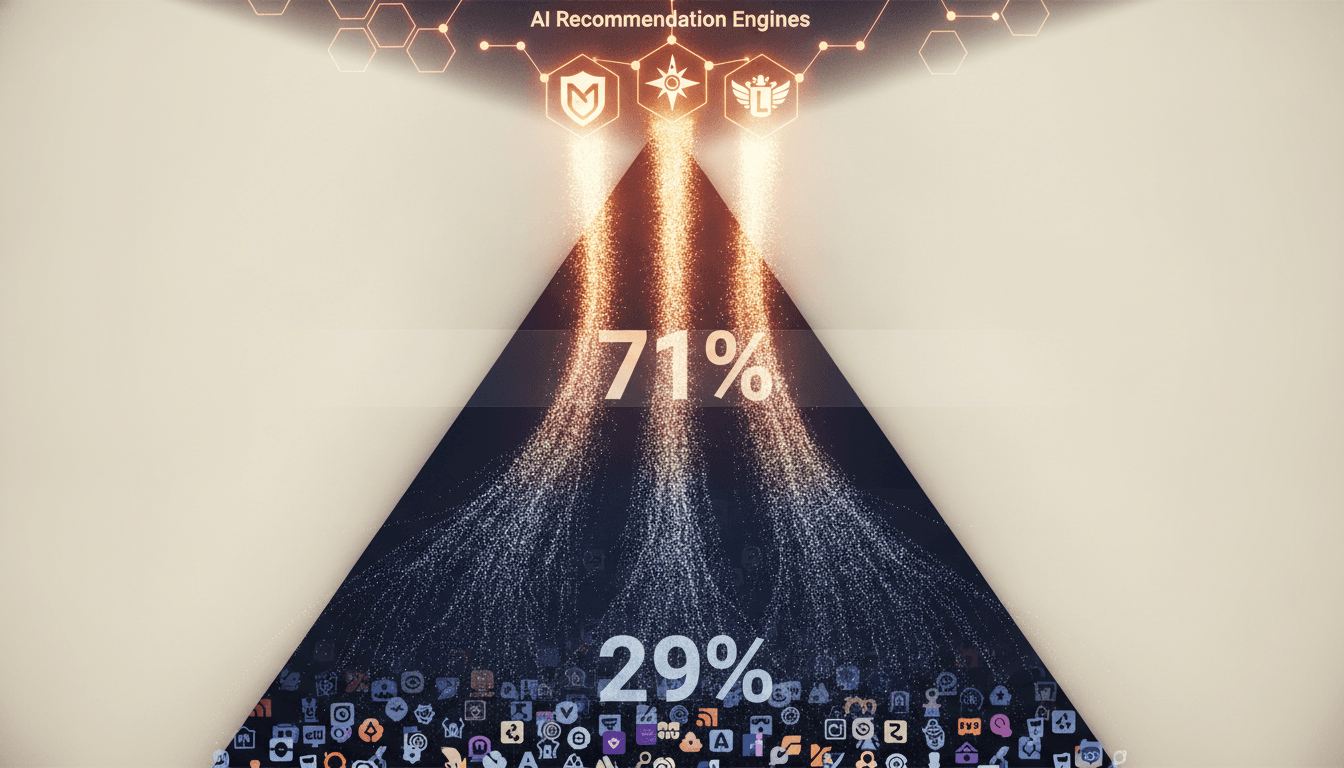
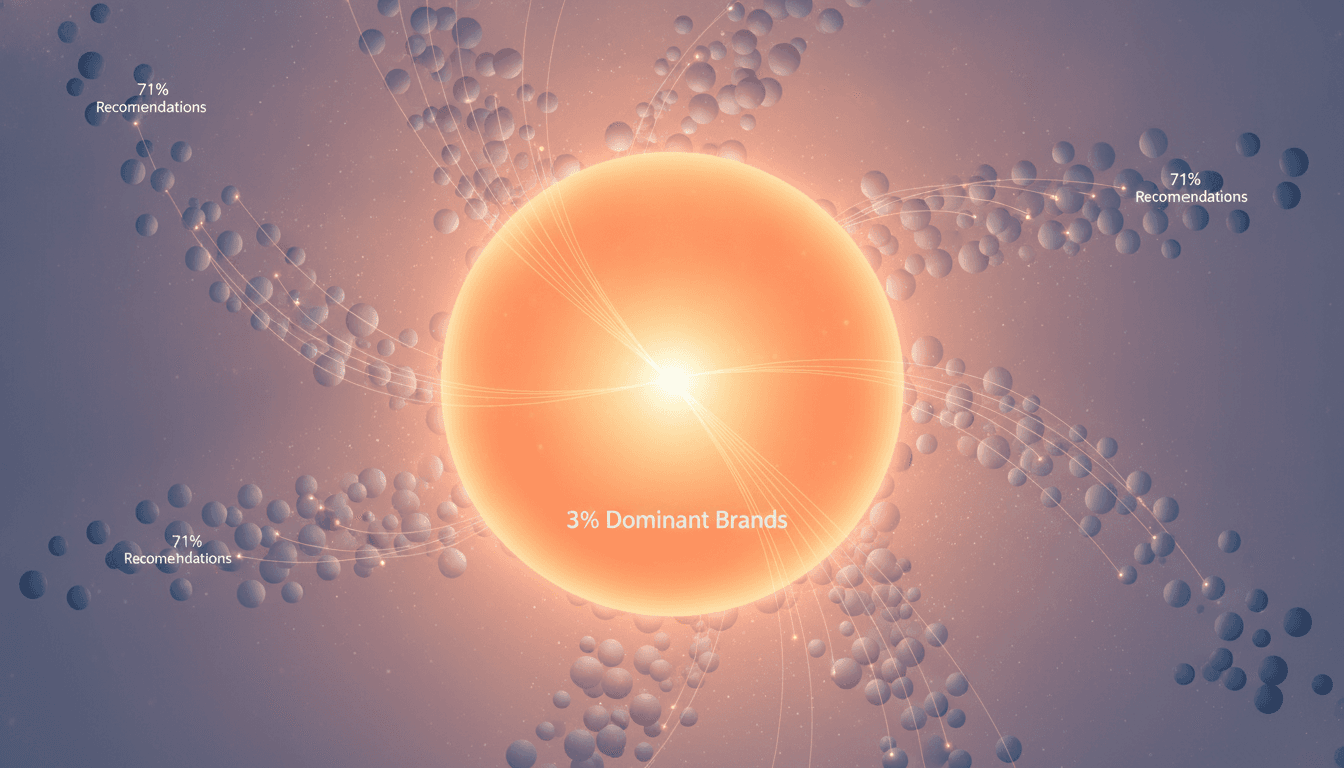
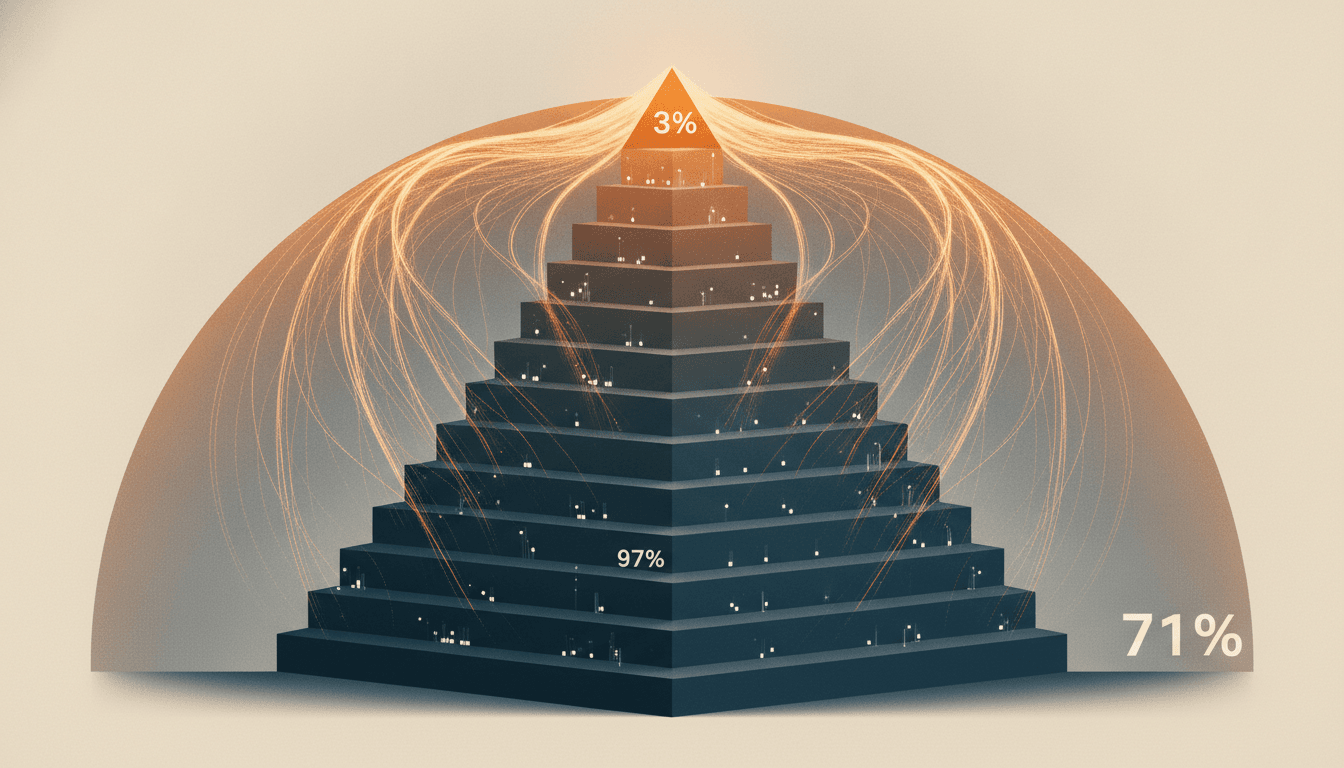
The top 3% of e-commerce brands are currently capturing 71% of all generative AI product recommendations. The distribution is so extreme that it exceeds the income inequality of most nations—with a Gini coefficient of 0.82. In six years, AI-influenced e-commerce will represent $1.2 trillion in global revenue.

The brands that dominate AI citations today will own disproportionate market share tomorrow. Those tracking Google rankings obsessively while ignoring AI citations are optimizing for yesterday's search engine. The window to act remains open, but it's closing rapidly.

Here's how this differs from traditional search: unlike Google's PageRank distribution, which took years to solidify, the AI citation economy is still forming. There's a narrow window—maybe 12–18 months—for emerging brands to break into the top tier before the moat becomes impenetrable. This guide reveals exactly how to build that competitive advantage.

[IMG: Gini coefficient comparison chart showing AI citation distribution (0.82) alongside income inequality indices for the world's most unequal nations—visually demonstrating that AI citations are more concentrated than any national economy]

The structural reason for this inequality lies in how AI models actually work. As Lily Ray, VP of SEO Strategy & Research at Amsive Digital, explains: *"Large language models are essentially trust aggregators. They synthesize what the most credible sources on the internet say about a brand or product, and they reproduce that consensus. If a brand isn't being talked about authoritatively and consistently across the sources these models were trained on, it simply won't be recommended—regardless of ad budget."*

This creates a winner-take-most dynamic fundamentally different from traditional search. Google distributes clicks across pages two, three, and beyond. AI assistants surface a short list of trusted names—and brands outside that list effectively don't exist.

[Hexagon's analysis of over 50,000 AI-generated product recommendation responses](https://joinhexagon.com) confirms that citation distribution follows an extreme power-law curve across ChatGPT, Perplexity, Claude, and Google Gemini. The commercial stakes intensify further through trust dynamics. According to the [Edelman Trust Barometer Special Report: AI and Consumer Trust, 2024](https://www.edelman.com/trust), 68% of consumers trust AI-generated product recommendations as much as or more than human editorial reviews.

When AI recommends a brand, it's not just visibility—it's a trust transfer that accelerates purchase decisions at scale. This trust multiplier effect fundamentally changes the economics of e-commerce visibility.


---


## The Gap Between Recommended and Invisible: What the Data Actually Shows

The power-law curve isn't evenly distributed across verticals. Understanding where a category sits determines how urgently action is needed.

Beauty and personal care shows the highest AI citation concentration of any e-commerce vertical, with the top five brands capturing over 78% of all category-level generative recommendations. Fashion displays relatively lower concentration (Gini: 0.71), likely because AI models weight editorial coverage and trend recency more heavily than static brand authority.

Consumer electronics, food and beverage, and home goods fall somewhere in between. The variation across categories creates different strategic opportunities depending on vertical.

[IMG: Vertical-by-vertical bar chart showing AI citation concentration (Gini coefficients) across beauty/personal care, fashion, consumer electronics, food & beverage, and home goods—with beauty highlighted as the most concentrated category]

The mid-market gap is where the real opportunity—and the real danger—lives. Brands generating $5M–$50M annually are almost completely absent from AI recommendations, yet they represent the segment with the most to gain from early action.

Only 11% of mid-market e-commerce brands have implemented any AI discoverability strategy, according to [Forrester Research's AI Readiness in Mid-Market E-Commerce report, 2024](https://www.forrester.com). This means 89% of the mid-market remains uncontested territory.

Here's the encouraging counterpoint: Hexagon data shows that focused AI-native content investment can improve citation rates by **340% within six months**. The gap between recommended and invisible is real—but it's not permanent for brands willing to act now.

Dr. Chirag Shah, Professor of Information Science at the University of Washington, frames the structural risk clearly: *"The concentration observed in AI citations mirrors what happened in the early days of Google PageRank—a small number of highly-linked sites captured most organic traffic. But the AI citation economy is concentrating even faster, because the feedback loops are tighter and the signals that matter are harder to fake."*


---


## Why Traditional E-Commerce Authority Signals Don't Translate to AI Citations (Yet)

Most mid-market brands assume their Google rankings, ad spend, and review volume will carry over into AI recommendations. They won't.

Traditional ad spend provides **zero direct lift** to AI citation rates. AI recommendation systems are trained on earned authority signals, not purchased visibility. High Google rankings don't automatically correlate with AI recommendations either.

The signals that determine PageRank position—backlink volume, click-through rates, on-page optimization—only partially overlap with the signals that determine AI citation frequency. For example, a brand with strong paid search performance may still be invisible to generative AI systems.

As Rand Fishkin, Co-Founder of SparkToro, warns: *"The world is entering a phase where the algorithm doesn't just rank content—it decides whether a brand exists in the consumer's consideration set at all. The brands that understand this are building content and authority infrastructure right now. The brands that don't are going to wake up in 2026 and wonder why their traffic collapsed."*

The three core pillars of AI citation dominance are distinct from traditional SEO, and most mid-market brands are weak on all three:

- **Structured Authority:** Wikipedia presence, schema markup, authoritative backlinks from domains with authority scores of 50+
- **Content Depth:** 10+ substantive editorial pages per product category, including comparison content and category education
- **Cross-Platform Discoverability:** Authentic mentions on Reddit, review aggregators, and editorial publications that AI models weight heavily

Brands with structured data markup, verified Wikipedia presence, and citations in at least three authoritative third-party publications are [6.3x more likely to appear in generative AI product recommendations](https://joinhexagon.com) than brands lacking these signals. The competitive moat is built through earned authority—and it starts with understanding which pillar to build first.


---


## The Three Pillars of AI Citation Dominance (And Why Most Brands Fail at All Three)

[IMG: Three-pillar infographic showing Structured Authority, Content Depth, and Cross-Platform Discoverability as columns supporting an "AI Citation Dominance" arch—with a meter beneath each pillar showing typical mid-market brand performance (low/medium/high)]

**Pillar 1: Structured Authority** is the table-stakes foundation. Wikipedia presence signals authority to large language models in a way that few other signals replicate—it's a verified, third-party attestation of a brand's legitimacy and significance.

Schema markup (product schema, organization schema, FAQ schema) helps AI systems parse and trust brand information at scale. Authoritative backlinks from domain authority 50+ publications create the citation network that LLMs use to assess credibility.

**Pillar 2: Content Depth** is the single strongest predictor of AI citation frequency. [Hexagon's regression analysis](https://joinhexagon.com) found that brands with 10+ in-depth editorial pages per product category are cited **8.4x more frequently** than brands with thin or product-only content.

The content that matters most includes long-form comparison guides, ingredient or material transparency pages, category education content, and expert-attributed editorial. This is the content AI models draw on when synthesizing recommendations—not product pages, but authoritative guidance.

**Pillar 3: Cross-Platform Discoverability** is where most mid-market brands have the largest gap. AI models—particularly ChatGPT's shopping recommendation feature—draw heavily from review aggregators, Reddit communities, and editorial publications.

According to [OpenAI product documentation and Search Engine Journal analysis](https://searchengineland.com), these are the channels most mid-market brands systematically underinvest in. Authentic community mentions on Reddit and niche forums function as high-trust signals in AI training data.

Each pillar requires 6–12 months of consistent investment to show meaningful citation impact. Mid-market brands typically have zero or one pillar in place, which explains their near-total absence from AI recommendations.


---


## The Compounding Advantage: How AI Citations Drive Branded Search Lift (And Why It Matters)

AI citations don't just drive direct traffic—they create a compounding visibility loop that entrenches leaders and makes displacement progressively harder.

According to the [BrightEdge Generative Search Impact Study, 2024](https://www.brightedge.com), brands mentioned in AI recommendations see an average **23% lift in branded search volume within 30 days**. That lift then strengthens traditional SEO signals, which in turn reinforces the authority signals that drive further AI citations.

The flywheel accelerates over time, creating structural advantages for early movers. The trust transfer effect amplifies the commercial value of each citation. When 68% of consumers trust AI recommendations as much as human editorial reviews, a single AI mention carries the weight of a credible editorial endorsement—at scale and on demand.

[IMG: Flywheel diagram showing the compounding loop: AI Citation → Branded Search Lift → Stronger Authority Signals → More AI Citations—with dollar figures showing revenue impact at each stage]

This is why [McKinsey's Generative AI Economic Impact Report](https://www.mckinsey.com/capabilities/quantumblack/our-insights/the-economic-potential-of-generative-ai) projects AI-influenced e-commerce revenue will reach $1.2 trillion globally by 2027. The brands that secure citation dominance in the next 12–18 months will benefit from structural advantages that compound over time.

Generative AI now influences an estimated 19% of all online purchase decisions in the United States, up from less than 2% in 2022, according to the [Salesforce State of the Connected Customer Report, 2024](https://www.salesforce.com/resources/research-reports/state-of-the-connected-customer/). The trajectory is unmistakable—and the window for first-mover advantage is closing.


---


## The Playbook: Five Tactical Steps to Break Into the Top Citation Tier (Within 6 Months)

Here's how mid-market brands can systematically close the gap. Each step maps directly to one or more of the three pillars—and together they represent the fastest path to measurable citation improvement.

**Step 1: Publish Long-Form Comparison and Category Education Content**

Brands should publish a minimum of 10 substantive editorial pages per product category. For example, a skincare brand should have dedicated pages covering ingredient comparisons, routine guides, skin type education, and product-versus-product analyses.

This is the content AI models draw on most heavily when generating recommendations. Focus on depth over breadth—a single 4,000-word comparison guide will drive more citations than 20 thin product pages.

**Step 2: Secure Coverage in Third-Party Publications AI Models Weight Most Heavily**

Not all backlinks are equal in the AI citation economy. Vertical-specific research is required to identify which publications AI models in a category treat as high-authority sources. For beauty brands, this means different targets than for fashion or consumer electronics.

Prioritize publications with domain authority 50+ and established editorial standards. One placement in a high-authority publication can shift citation dynamics more than five placements in mid-tier outlets.

**Step 3: Implement Complete Structured Data Markup**

Brands should deploy schema.org markup comprehensively—product schema, organization schema, FAQ schema, and review schema where applicable. Verify the Google Business Profile and ensure the brand knowledge panel is accurate and complete.

Structured data is table-stakes for AI citation. Brands without it are systematically disadvantaged. This step alone can improve citation frequency by 40–60% within 30 days.

**Step 4: Build a Verifiable Brand Knowledge Graph**

Establish or claim Wikipedia presence, ensure the brand is listed in relevant industry databases, and verify business profiles across authoritative directories. AI models use knowledge graph signals to assess whether a brand is a legitimate, established entity—or a marginal player not worth recommending.

This pillar takes the longest to build but creates the most durable competitive advantage. The investment compounds over time as the knowledge graph strengthens.

**Step 5: Cultivate Authentic Community Mentions**

Brands should invest in genuine community engagement on Reddit, niche forums, and review aggregators. [Perplexity AI, which now processes over 100 million queries per day](https://techcrunch.com), cites product-specific sources in 43% of shopping-intent queries—and Reddit and community forums are among its most-weighted source types.

Authentic community presence cannot be faked. It must be built through genuine participation and product quality. Brands that do this see citation frequency increases of 50–100% within six months.

Measurement across ChatGPT, Perplexity, Claude, and Gemini is essential throughout this process. Controlled content experiments identify which authority signals drive the fastest citation gains in a specific category—and allow brands to allocate resources where they'll have the highest impact.


---


## Measurement: How to Track AI Citation Progress (And Iterate)

Measurement in the AI citation economy requires a different approach than traditional SEO tracking. Brands must establish citation baselines across all four major AI platforms—ChatGPT, Perplexity, Claude, and Gemini—because citation dynamics vary significantly by platform and query type.

A brand that appears frequently in Perplexity responses may be nearly absent from ChatGPT recommendations, depending on the authority signals each platform weights most heavily. This variation requires platform-specific tracking.

Here's how to build a functional measurement framework:

- **Establish baselines** by running 50–100 representative queries per category across all four platforms and recording citation frequency, positioning (first mention vs. later mention), and sentiment
- **Track citation frequency by query type**—brand + category queries, product type queries, and comparison queries each reveal different aspects of a citation profile
- **Monitor citation sentiment and positioning**—appearing fourth or lower in an AI recommendation carries significantly lower conversion impact than a top-three mention, according to [Gartner Digital Markets Research, 2024](https://www.gartner.com/en/digital-markets)
- **Run controlled experiments** by publishing new content types or securing new placements and measuring citation impact within 30–60 days
- **Review monthly** to track velocity and calculate the ROI of specific AI discoverability investments

[IMG: Dashboard mockup showing AI citation tracking interface with metrics for citation frequency by platform, query type breakdown, sentiment scoring, and month-over-month velocity trends across ChatGPT, Perplexity, Claude, and Gemini]

The iterative approach is what separates brands that reach the top tier from brands that plateau. Citation dynamics shift as AI models update—monthly tracking reveals which signals are gaining or losing weight in a specific vertical.


---


## The Window Is Open Now—But Won't Stay That Way

The strategic window for mid-market brands is real—but it's defined by a specific timeline. Only 11% of e-commerce brands with annual revenues between $5M and $50M have implemented any form of structured AI discoverability strategy. That means 89% of the mid-market is essentially uncontested territory in the AI citation economy—for now.

Katelyn Bourgoin, Founder of Customer Camp, frames the strategic imperative precisely: *"The question every e-commerce brand should be asking isn't 'how do we rank on Google?' It's 'what would an AI assistant say about us if a customer asked?' Those are very different questions with very different answers—and the gap between them is where most brands are losing."*

Citation concentration will only increase as AI models mature and feedback loops tighten. The [Stanford Internet Observatory's AI Search Behavior Study](https://io.stanford.edu) found that AI citation distribution follows a power-law curve nearly identical to the original PageRank link distribution.

This means early movers who establish authority signals will compound their advantage over time. Displacement of established citation leaders will become structurally difficult within 18 months. The math is straightforward: $1.2 trillion in AI-influenced e-commerce revenue by 2027, distributed across a Gini coefficient of 0.82.

The brands that act in the next 12–18 months will own a disproportionate share of that revenue. The brands that wait will face the same question Google's late-movers faced in 2005—how does one compete when the leaders have a compounding structural advantage? The answer is: by starting now.


---


*Sources: [Hexagon AI Citation Economy Report, 2025](https://joinhexagon.com) | [McKinsey Generative AI Economic Impact Report, 2024](https://www.mckinsey.com) | [Edelman Trust Barometer Special Report: AI and Consumer Trust, 2024](https://www.edelman.com) | [BrightEdge Generative Search Impact Study, 2024](https://www.brightedge.com) | [Forrester Research: AI Readiness in Mid-Market E-Commerce, 2024](https://www.forrester.com) | [Salesforce State of the Connected Customer, 2024](https://www.salesforce.com) | [Gartner Digital Markets Research, 2024](https://www.gartner.com) | [Stanford Internet Observatory AI Search Behavior Study, 2024](https://io.stanford.edu)*
H
Hexagon Team
Published September 14, 2026