citationbrandbrands
The AI Citation Economy: How Brands Become Trusted Sources in Generative Search
As zero-click searches hit 60% and AI assistants field 2.8 billion queries monthly, a new authority economy is reshaping brand visibility. The brands that earn citations in AI-generated responses see 3.1x more branded search volume—while 73% of all AI recommendations flow to just the top 10 cited brands per category. Here's what that means for your marketing strategy.
13 min read

placeholders exactly as written", “Converted imperative voice (‘Your competitive advantage’, ‘Make these adjustments’) to third-person descriptive” ]
# The AI Citation Economy: How Brands Become Trusted Sources in Generative Search

*The ground beneath SEO just shifted. As zero-click searches hit 60% and AI assistants field 2.8 billion queries monthly, brand visibility is no longer determined by rankings—it's determined by citations. Brands that earn mentions in AI-generated responses see 3.1x more branded search volume, while 73% of all AI recommendations flow to just the top 10 cited brands per category. The question isn't whether this changes marketing strategy. It's whether brands are ready.*

[IMG: Split-screen visualization showing traditional Google search results on the left versus an AI-generated response with brand citations highlighted on the right, representing the shift from click-based to citation-based brand visibility]


---


## Introduction: The Shift from Search Rankings to AI Citations

SEO strategies optimized for traditional search engines are becoming obsolete. 60% of Google searches now end without a click to external websites. AI Overviews and featured snippets answer queries directly—eliminating the traffic that traditional SEO was built to capture.

A new authority economy is emerging in its place, powered by ChatGPT, Perplexity, and Google AI Overviews. In this economy, brands aren't competing for rankings. They're competing to be cited as trusted sources.

The adoption rate is accelerating rapidly. 47% of consumers now use AI-powered search tools for product research, up from under 10% in 2022. This represents a seismic shift in how brand discovery happens at the top of the purchase funnel.

The scale is staggering. An estimated 2.8 billion AI-assisted search queries occur monthly across major platforms as of early 2025, with projections exceeding 10 billion by 2027. The brands positioning themselves as cited authorities now will own the most valuable real estate in search for the next decade.

Waiting is a strategic mistake. Brands that delay authority-building efforts will face compounding disadvantages as competitors establish dominant citation positions.


---


## What Is the AI Citation Economy?

The AI Citation Economy is fundamentally different from traditional SEO. It's a system where brand credibility flows from how frequently and authoritatively independent third parties mention a brand across the open web—not from owned media, paid placement, or on-page optimization.

Here's how the core mechanic works: AI language models like GPT-4 and Claude train on vast datasets that heavily weight content from authoritative domains—Wikipedia, major news outlets, academic publications, and established industry blogs. Brands cited in these sources are disproportionately represented in training data and therefore far more likely to appear in AI recommendations.

Owned media and self-promotional content carry minimal weight in AI systems. A brand referenced in a Wall Street Journal article about industry trends, reviewed on G2 by verified users, and discussed in an analyst report carries compounding citation value. A brand appearing only on its own website and social channels remains effectively invisible to AI systems.

The implication is profound. The brands winning in AI search aren't necessarily the ones with the best products or the biggest marketing budgets. They're the ones with the strongest reputations on the open web.


---


## How AI Systems Evaluate Brand Trustworthiness

AI models evaluate brand credibility through multiple simultaneous signals, creating a triangulated trust assessment that's difficult to game. Understanding these signals enables strategic authority-building.

**Training data weighting** forms the foundation. High-authority sources receive exponentially more influence during model training—a Wikipedia mention carries far more weight than a mention on a low-traffic blog. Brands appearing consistently in premium sources build a durable credibility baseline that competitors struggle to displace.

**Co-occurrence frequency** is the second critical signal. Brands mentioned alongside category-defining terms—"best project management software," "top skincare for sensitive skin"—in authoritative third-party content are significantly more likely to surface when users ask AI assistants for recommendations. This is brand salience as AI systems understand it, built through sustained presence in credible conversations.

**Third-party review platforms** function as high-authority citation nodes in AI training data. 84% of brands cited in ChatGPT and Perplexity product recommendations maintain active, verified profiles on at least three major platforms—G2, Trustpilot, Wirecutter, or industry-specific publications. Multi-platform validation signals to AI systems that a brand's reputation is independently corroborated.

[IMG: Diagram illustrating the three-layer trust evaluation model used by AI systems: training data weighting at the base, co-occurrence frequency in the middle, and third-party review platform validation at the top]

These three signals work together. A brand strong in one dimension but weak in others will underperform in AI recommendations. Comprehensive authority requires strength across all three.


---


## E-E-A-T as the Foundation of AI Brand Authority

Google's E-E-A-T framework—Experience, Expertise, Authoritativeness, and Trustworthiness—originated as a human quality assessment tool. As Google's Search Quality Evaluator Guidelines evolved, E-E-A-T became the de facto credibility standard across the web.

AI systems have now operationalized those same signals in ways that directly determine commercial outcomes. E-E-A-T was always about more than SEO—it was Google's attempt to codify what humans intuitively recognize as trustworthiness. Now that AI systems are making recommendations at scale, those same signals determine whether brands appear in AI-generated responses.

Each dimension manifests differently in AI recommendations:

- **Experience:** Real customer use cases, verified testimonials, and case studies demonstrating proven results
- **Expertise:** Original research, thought leadership, and industry credentials positioning brand representatives as subject-matter authorities
- **Authoritativeness:** Third-party recognition—awards, media mentions, analyst coverage—confirming standing within the category
- **Trustworthiness:** Transparency signals including security certifications, clear pricing, and consistent brand messaging

For YMYL categories (Your Money Your Life)—finance, health, legal services—E-E-A-T requirements intensify. AI systems apply heightened scrutiny to recommendations in these categories, requiring deeper layers of independent validation before surfacing a brand as trustworthy.


---


## The Citation Hierarchy: Why Not All Mentions Are Equal

Not all citations carry equal weight. Understanding the hierarchy allows strategic prioritization of authority investments where they generate maximum AI impact.

**Tier 1 — Institutional Authorities** include Wikipedia, major national publications (Wall Street Journal, Forbes, TechCrunch), and industry-defining outlets. Wikipedia presence is disproportionately powerful because it ranks among the most heavily weighted domains in LLM training data. Brands with well-maintained, cited Wikipedia pages are significantly more likely to be recommended by AI assistants than competitors without one.

**Tier 2 — Established Review and Analyst Platforms** encompass G2, Trustpilot, Wirecutter, Consumer Reports, and category-specific analyst reports. These platforms function as aggregated independent validation—AI systems treat verified reviews as corroborating evidence of quality.

**Tier 3 — Reputable Industry Publications and Expert Endorsements** include established trade publications, recognized analyst endorsements, and expert commentary from credible practitioners. These citations amplify Tier 1 and Tier 2 signals while filling category-specific credibility gaps.

**Tier 4 — Social Proof and Community Mentions** encompass user-generated content, community forums, and social media mentions. Social proof amplifies institutional credibility but doesn't replace it—AI systems treat Tier 4 signals as supporting evidence, not primary authority.

The pattern among 84% of AI-recommended brands reveals strategic clarity: they invest disproportionately in Tier 1 and Tier 2 while allowing Tier 3 and Tier 4 to develop organically. This isn't accidental. It's deliberate resource allocation.


---


## Case Studies: Brands That Won the Citation Economy

The brands winning in AI-generated recommendations share one critical pattern: they invested systematically in third-party authority 12 to 18 months before AI search reached mainstream adoption. This timeline matters because AI models train on historical web data—authority built today influences recommendations for years.

**B2B SaaS Project Management Brand**

A B2B SaaS brand in project management executed a disciplined analyst relations strategy. By securing coverage in Gartner and Forrester reports, maintaining a verified G2 profile with 500+ reviews, and contributing original research to industry publications, the brand established a multi-tier citation footprint.

AI systems recognized this as authoritative. Competitors with comparable products but minimal third-party validation remained invisible in AI recommendations despite equivalent search rankings.

**Direct-to-Consumer Skincare Brand**

A direct-to-consumer skincare brand took a different path, leveraging review platform optimization as its primary authority lever. By systematically generating verified reviews on Trustpilot and Wirecutter while pursuing editorial coverage in beauty publications, the brand achieved citation presence in AI beauty recommendations within nine months.

The downstream effect was measurable: branded search volume increased in the weeks following consistent AI recommendation exposure.

**Pattern Recognition**

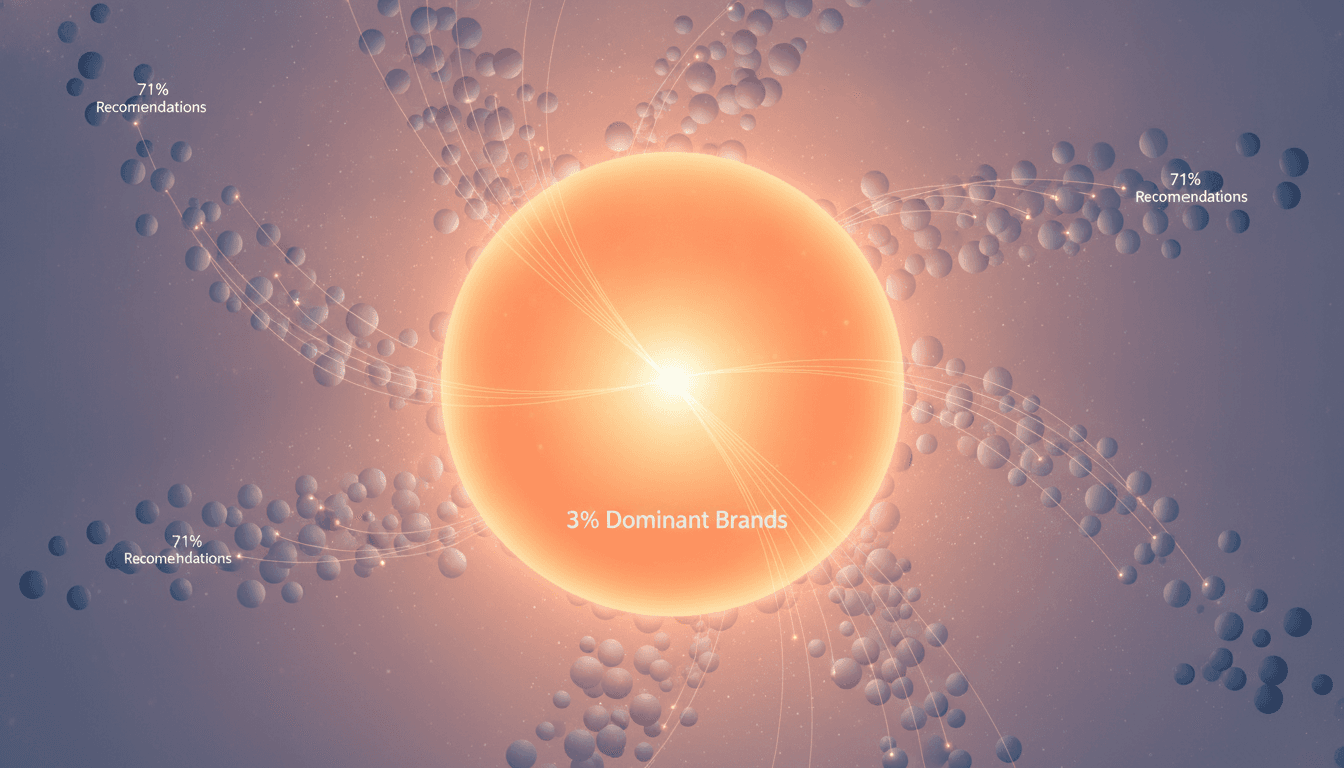
The pattern is consistent across successful brands: multi-channel authority investment, long-term PR strategy, and first-mover positioning. The top 10 cited brands in any category capture 73% of all AI-generated recommendations—a winner-take-most dynamic that makes early action a compounding advantage.

Rand Fishkin, Co-founder & CEO of SparkToro, frames the opportunity clearly: "Brands are entering an era where reputation on the open web—what journalists write about them, what experts say about them, what customers publish about them—feeds directly into whether AI systems recommend them to millions of potential buyers. Earned media and third-party authority are no longer 'nice to have' for brand building. They are the algorithm."

[IMG: Bar chart showing the concentration of AI recommendations, with the top 10 brands capturing 73% of recommendations and the remaining brands sharing 27%, illustrating the winner-take-most dynamic]


---


## The Third-Party Validation Imperative: Why Owned Media Doesn't Count

AI models are explicitly trained to recognize and discount self-promotional content. A brand's website, blog, and social channels—regardless of optimization quality—carry a credibility discount in AI trustworthiness assessments. This isn't a flaw. It mirrors the skepticism a well-informed researcher applies when evaluating sources.

Third-party mentions carry 5 to 10 times more weight than brand-owned statements. Here's the practical difference: claiming "industry-leading customer satisfaction" on a homepage contributes minimally to AI authority. The same claim, independently validated by a Trustpilot rating of 4.8 across 2,000 reviews and referenced in a TechCrunch article, becomes a powerful citation signal.

This distinction fundamentally reframes what PR means. PR is no longer primarily about brand awareness—it's about depositing authority signals into the training data and real-time indexes that AI systems draw from. Expert endorsements, analyst inclusions, and consistent review platform presence aren't marketing tactics. They're infrastructure.

Greg Bernhardt, Head of AI Search Strategy at BrightEdge, articulates this clearly: "The question brands should be asking is not 'How do we rank on Google?' but 'What does an AI assistant know about us, and is what it knows accurate, positive, and comprehensive?' Brands that answer that question proactively—by building structured, authoritative, widely-cited digital footprints—will have an enormous competitive advantage as AI-mediated commerce becomes the norm."


---


## Your AI Authority-Building Roadmap: 5-Step Framework

Building authority in the AI Citation Economy requires structured, sequential execution. Here's how to proceed:

**Step 1: Audit Current AI Citation Profile and E-E-A-T Gaps**

Brands should query ChatGPT, Perplexity, and Google AI Overviews with their category's top purchase-intent questions. Documentation of whether a brand appears and how frequently is essential. Benchmarking citation frequency against top competitors reveals competitive positioning.

Identification of which E-E-A-T dimensions are weakest based on where third-party validation is absent guides priority-setting. This audit establishes the baseline for measuring progress.

**Step 2: Identify High-Impact Citation Opportunities in the Category**

Mapping the citation hierarchy for a specific category reveals which Tier 1 and Tier 2 sources cite competitors but not a brand. Analyst reports, Wikipedia categories, and review platform leaderboards are high-priority gaps. Prioritization of opportunities where a single citation placement delivers maximum training data impact focuses resources effectively.

**Step 3: Develop a Targeted PR and Analyst Relations Strategy**

AI-optimized PR targets authoritative sources that feed directly into AI training data, unlike traditional PR focused on impressions. Pursuit of coverage in major publications, securing analyst report inclusions, and building relationships with recognized subject-matter experts who can independently endorse a brand are foundational activities.

**Step 4: Optimize Third-Party Review and Validation Platforms**

Establishment and active management of verified profiles on review platforms most relevant to a category is essential infrastructure. Volume, recency, and rating quality all influence how AI systems weight review signals. A systematic review generation program is foundational, not a tactical add-on.

**Step 5: Create Original Research and Thought Leadership Content for Citation Generation**

Original research—surveys, data studies, industry reports—generates citations organically as journalists and analysts reference findings. Thought leadership content authored by credible brand representatives builds the Expertise dimension of E-E-A-T. Both content types create durable citation assets that compound over time.

Timeline expectations are realistic: brands typically see measurable AI citation growth within 6 to 12 months of systematic execution. Unlike traditional SEO, AI citation authority builds through consistent, longitudinal mentions across diverse authoritative sources—making it more durable but requiring sustained investment.


---


## Measuring Success: Tracking Authority in the Citation Economy

Measuring AI citation authority requires different tools than traditional SEO analytics. Leading indicators include media placements in high-authority sources, review platform rating trajectories, and analyst mention frequency—all of which precede and predict AI citation growth.

Lagging indicators include direct citation frequency in AI-generated responses and downstream branded search volume. The downstream impact is measurable and significant. Brands cited in AI recommendations see 3.1x more branded search volume in the 30 days following AI recommendation exposure, directly connecting citation authority to purchase intent and pipeline.

Tracking this correlation requires baseline measurement before authority-building programs launch, enabling clean attribution. Emerging tools for AI citation monitoring include the ChatGPT API, Perplexity API, and custom monitoring dashboards that systematically query AI assistants with category-relevant prompts and track brand mention frequency over time.

Competitive benchmarking—measuring citation share relative to top competitors—provides the most actionable signal for resource allocation. This metric reveals whether authority-building efforts are closing competitive gaps or widening them.

[IMG: Dashboard mockup showing AI citation tracking metrics: citation frequency by platform, branded search volume trend, competitor citation benchmarks, and E-E-A-T signal strength indicators]


---


## Conclusion: Your Competitive Advantage in Generative Search

The AI Citation Economy operates on winner-take-most dynamics. The top 10 cited brands in any category capture 73% of all AI-generated recommendations, leaving remaining market share distributed across everyone else. This concentration means early authority investment creates compounding advantages, while delay increases the cost and difficulty of entry.

The brands building citation authority today are establishing positions that will be extremely difficult to displace. Looking ahead, the trajectory makes urgency clear. With 2.8 billion AI-assisted queries monthly today and 10 billion projected by 2027, the window for first-mover advantage is narrowing.

Brands experiencing 3.1x lift in branded search volume from AI citations are proving this isn't theoretical—it's commercial reality unfolding now. Rand Fishkin, Co-founder & CEO of SparkToro, summarizes the imperative: "Brands that will win in AI search are not necessarily the ones with the biggest budgets or the most backlinks—they are the ones that have systematically built genuine authority signals across the open web. If a brand only talks about itself, AI systems will treat it accordingly."

The roadmap is clear: audit current AI citation profile, identify the highest-impact citation opportunities in the category, and execute a systematic third-party validation strategy before competitors claim the authority positions that will define the category's AI recommendation landscape. The Citation Economy rewards action, not observation.

The time to build authority is now.
H
Hexagon Team
Published June 24, 2026