brandscitationbrand
The AI Citation Economy: How 2% of Brands Capture 80% of Generative Recommendations—And How to Become One of Them
A power-law distribution is quietly deciding which brands exist in the AI era—and which ones don't. Here's what separates the top 2% from the invisible 98%, and the 18-month playbook that's already moved 23 brands into the elite tier.
15 min read
---


# The AI Citation Economy: How 2% of Brands Capture 80% of Generative Recommendations—And How to Become One of Them

*A power-law distribution is quietly deciding which brands exist in the AI era—and which ones don't. Here's what separates the top 2% from the invisible 98%, and the 18-month playbook that's already moved 23 brands into the elite tier.*

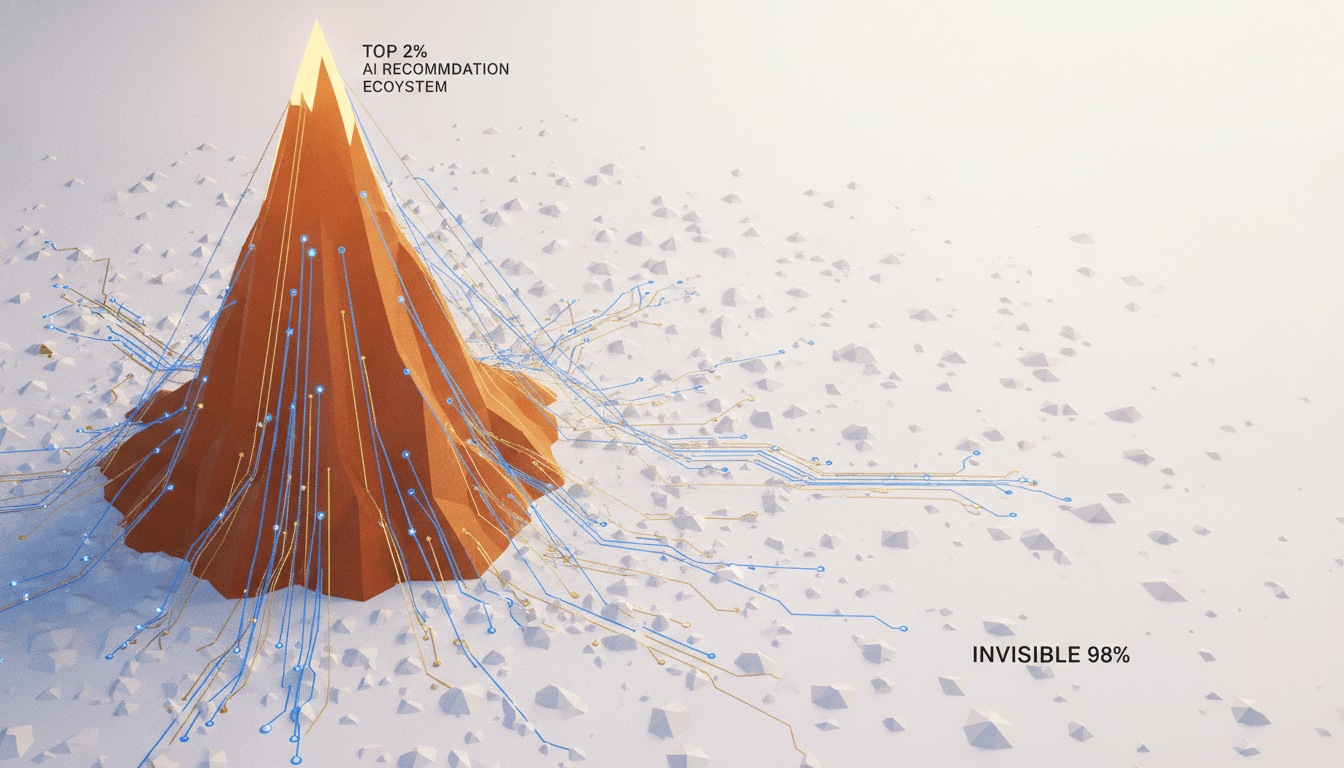
[IMG: Split visual showing a steep power-law curve with a small cluster of brands at the top capturing a massive share of AI recommendation volume, contrasted against a long tail of nearly invisible brands below]

Competitors of many brands are getting recommended by ChatGPT while others are not. This disparity is not because one product is worse than another—it is because different brands are playing by different rules.

While 98% of brands in any given category fight for scraps of AI visibility, the top 2% have engineered a system that captures 80% of all generative recommendations. This is not market chaos, nor is it complicated. However, the window to enter that tier is closing faster than most brands realize.


---


## The Power-Law Reality: Why 80% of AI Recommendations Flow to Just 2% of Brands

The concentration of AI recommendations is not a market inefficiency waiting to be corrected. It is a structural feature of how generative systems work—and understanding it is the prerequisite for disrupting it.

According to the [Hexagon AI Citation Index](https://joinhexagon.com), an analysis of 50,000+ verified AI citations across major e-commerce verticals confirms that citation distribution follows a strict power-law curve. In the beauty category, the top 10 brands collectively account for **78% of all AI recommendations** made across ChatGPT, Perplexity, Claude, and Google AI Overviews.

The pattern holds across fashion (81% concentration), home goods (76%), and food & beverage (74%). This mirrors the citation dynamics of academic publishing, where a small number of papers and journals accumulate the vast majority of references. AI systems are trained on the same internet that humans have already ranked through links, mentions, and editorial coverage.

The rich get richer, and they do so at scale. The Pareto curve is intensifying, not flattening, as models increasingly weight established authority signals with each training cycle.

The channel stakes are substantial. [BrightEdge's analysis](https://www.brightedge.com) of over 10 million keywords found that AI Overviews now appear in **47% of all product-related Google searches** in the United States. Brands absent from those summaries lose an estimated **34% of potential click-through** on those queries, as user attention is captured by the AI-generated answer before reaching organic listings.

For most brands, this is already a primary discovery channel—not an emerging one. Understanding where a brand sits on this distribution curve is not an academic exercise. It is the first strategic decision that determines whether every subsequent marketing dollar compounds or evaporates.


---


## The 15–20 Meta-Characteristics That Define the Top-Cited 2%

The brands holding elite citation positions share a specific, measurable set of attributes. These are not vague brand sentiment signals. They are data-backed characteristics that AI systems demonstrably weight in their recommendation outputs.

According to the [Hexagon GEO Signal Weighting Study](https://joinhexagon.com), the single strongest predictor of AI citation frequency is **editorial referring domain count**—specifically, unique editorial outlets that have independently covered the brand, excluding press release syndication networks like PR Newswire and Business Wire. The threshold effect is pronounced: brands with **100+ unique editorial referring domains are 6.3x more likely** to appear in AI-generated "best of" lists than brands with fewer than 20, even when controlling for revenue and market share.

E-E-A-T signal density is the second most powerful lever. Brands that explicitly demonstrate all four dimensions—Experience, Expertise, Authoritativeness, and Trustworthiness—through structured content, founder credentials, clinical or third-party testing, and transparent sourcing are **4.1x more likely** to receive AI recommendations than brands demonstrating only one or two dimensions.

Here's how that translates in practice:

- **Experience**: Founder thought-leadership content, origin story documentation, and use-case depth
- **Expertise**: Published research citations, dermatologist or specialist endorsements, ingredient-level authority content
- **Authoritativeness**: Wikipedia or Wikidata presence, coverage in category-leading editorial outlets, peer-reviewed study citations
- **Trustworthiness**: Verified review ecosystems with a minimum 4.2-star aggregate score across 3+ platforms, transparent sourcing disclosures, consistent NAP signals across directories

The complete profile of a top-cited brand also includes: domain age of 5+ years, active Wikipedia presence, structured product schema markup, a verified Google Business Profile, and content published at a cadence of at least four substantive articles per month.

The median age of brands in the top citation tier is **11 years**, compared to 3.2 years for brands receiving fewer than five citations per month. That gap is real—but it is not destiny. Hexagon identified **23 brands founded after 2018** that have already broken into the top citation tier, proving that strategic investment can compress what traditionally took a decade into 18 months.


---


## Why Paid Social, Influencers, and Traditional SEO Don't Move the Needle

The currency of the AI citation economy is **third-party epistemic authority**, not paid reach. This distinction is the most important structural insight for brands currently allocating marketing budgets along traditional lines.

According to Rand Fishkin, Co-founder & CEO of SparkToro, "The brands winning in AI search aren't necessarily the biggest or the oldest—they're the ones that have built the deepest webs of third-party credibility. AI systems are essentially doing what a very diligent, very well-read consumer would do: they're asking 'who else vouches for this brand?' and the answer has to come from sources the AI already trusts. That's a fundamentally different game than buying keywords."

Paid social spend, influencer investment, and traditional SEO budget show **low correlation with AI citation frequency**. AI assistants do not synthesize recommendations from ad impressions or follower counts. They synthesize from their training data plus a curated set of high-authority retrieval sources: Reddit, Wirecutter, Consumer Reports, major review aggregators, and category-leading editorial outlets.

Brands absent from these specific nodes are statistically near-invisible to generative engines, regardless of paid media investment. This creates a reallocation opportunity for forward-thinking brands. The compounding effect of earned authority means that each AI citation increases the probability of future citations by an estimated **12–18%**, because AI training pipelines weight sources that are themselves frequently cited.

Early movers who redirect budget from low-ROI paid channels to high-ROI earned media programs are not just winning today—they are building an advantage that grows harder to overcome with each passing quarter.

[IMG: Bar chart comparing ROI correlation of paid social, influencer spend, traditional SEO, and earned editorial coverage against AI citation frequency—showing earned media as the clear leader]


---


## Citation Benchmarks by Category: Understanding the Competitive Landscape

Not all categories are equally contested in the AI citation economy. Understanding the baseline citation rate in a vertical is essential for realistic goal-setting and competitive positioning.

According to the [Hexagon Category Benchmarking Report](https://joinhexagon.com), average monthly AI citation rates per brand vary significantly by vertical:

- **Beauty & Skincare**: 12 citations/brand/month
- **Fashion & Apparel**: 8 citations/brand/month
- **Home Goods**: 7 citations/brand/month
- **Food & Beverage**: 6 citations/brand/month

Beauty brands benefit from a particularly rich editorial ecosystem—Allure, Byrdie, Vogue Beauty, Into The Gloss—combined with dermatologist review content and ingredient-focused community forums that AI systems index heavily. Food and beverage brands face the lowest baseline citation rates due to thinner editorial infrastructure and higher SKU fragmentation, which makes comparative "best of" content harder to produce at scale.

Fashion and home goods occupy the middle range, with moderately dense editorial ecosystems and established review infrastructure. Competitive dynamics within each category differ significantly. A displacement strategy that works in beauty may require substantial adaptation in food and beverage.

Category-specific intelligence is not optional; it is the foundation of a realistic competitive plan. Identifying who currently holds the top citation positions in a vertical is the first step toward displacement. The power-law distribution within each category has a specific shape, and knowing where the concentration points are reveals exactly which editorial outlets, community platforms, and credibility signals are driving the top brands' authority.


---


## The Authority Compounding Effect: Why Time Is Critical

The compounding dynamics of AI citation authority are what make urgency real—and what make early action disproportionately valuable. Each citation in a high-authority source increases the probability of subsequent citations by an estimated **12–18%**, because AI training pipelines weight sources that are themselves frequently cited. This creates a self-reinforcing loop that mirrors academic citation networks.

According to Benedict Evans, independent technology analyst and former partner at Andreessen Horowitz, "We're watching the emergence of a new kind of brand moat—not distribution, not manufacturing, not even product quality, but epistemic authority. The brands that AI systems have learned to trust become the default recommendation for millions of queries. And once that trust is established in the model's weights, it compounds in a way that's very hard for competitors to disrupt without a multi-year investment."

The median brand age of 11 years in the top citation tier reflects decades of accumulated editorial mentions, community presence, and third-party validation. Brands that delay generative engine optimization (GEO) investment are not just missing citations today—they are ceding the compounding base that will determine their visibility position two and three years from now.

The window for emerging brands to enter the elite tier through strategic investment is still open—but it is narrowing. The **23 brands founded after 2018** that have already broken into the top citation tier did so by moving aggressively in their first two years. Each quarter of delay reduces future compounding potential, because the brands already accumulating citations are simultaneously pulling further ahead.

An 18-month roadmap is realistic for emerging brands with focused investment. Waiting another 18 months is not.


---


## The Fast-Mover Playbook: How 23 Brands Founded After 2018 Broke Into the Elite Tier

The brands that have beaten the age curve share a specific, replicable playbook. It is not theoretical. It is the documented pattern of 23 companies that achieved top-tier citation status despite being founded after 2018—across beauty, fashion, home, and food verticals.

Here's how the playbook breaks down across four strategic pillars:

**1. Aggressive Earned Media Campaigns**

Fast movers prioritized placements in high-authority editorial outlets from day one—not press release syndication, but genuine editorial coverage in the outlets that AI systems index as trusted sources. Building 100+ unique editorial referring domains was treated as a primary business metric, not a nice-to-have. This required sustained, strategic outreach and compelling stories that editors wanted to tell.

**2. Structured Reddit Community Building**

Reddit has emerged as a disproportionately influential source node for AI recommendations. According to the Hexagon AI Citation Index, brands with active organic Reddit presence—defined as 50+ brand mentions in relevant subreddits over 12 months—receive **2.8x more AI citations** than brands with minimal Reddit footprint. Fast movers invested in authentic community participation, answering questions, and building genuine relationships rather than astroturfing.

**3. Clinical and Third-Party Product Validation**

Brands that invested in peer-reviewed or third-party study citations referencing their products established Authoritativeness and Trustworthiness signals that AI systems heavily weight. For example, beauty brands pursued dermatologist endorsements and clinical efficacy studies. Food brands pursued registered dietitian validation and third-party certifications.

This approach converted product claims into verifiable authority. For example, a skincare brand's investment in a published dermatological study demonstrating ingredient efficacy creates an authority signal that AI systems recognize and weight accordingly.

**4. Founder Thought-Leadership Content**

Establishing the CEO or founder with a public thought-leadership footprint—through bylined articles, podcast appearances, and LinkedIn authority content—created Experience and Expertise signals that lifted the brand's overall E-E-A-T profile. AI systems surface founders as credibility proxies for the brands they lead, making founder visibility a brand visibility lever.

According to the Seer Interactive Research Team, "Generative engine optimization is not SEO with a new coat of paint. The signals that matter—editorial density, community authenticity, structured data completeness, founder authority—are signals that most DTC brands have never been asked to produce at scale. The brands that recognize this early and rebuild their content and PR architecture accordingly will have a 3-to-5 year head start that will be very difficult to overcome."

This playbook is category-agnostic and time-sensitive. Early execution compounds faster than late execution—each quarter of delay reduces the future compounding potential of every earned media placement, Reddit mention, and clinical citation.


---


## Measurement and Optimization: The GEO Framework Brands Need

AI citation performance requires entirely new measurement infrastructure. Traditional SEO metrics—organic traffic, keyword rankings, domain authority—have **low correlation with AI citation frequency** and will not reveal where a brand stands in the power-law distribution that actually determines AI visibility.

[IMG: Dashboard mockup showing GEO measurement framework with AI citation tracking across ChatGPT, Perplexity, Claude, and Google AI Overviews, alongside competitive citation share metrics]

The foundation of a GEO measurement framework is **systematic AI query monitoring** across platforms. Brands need structured processes for querying ChatGPT, Perplexity, Claude, and Google AI Overviews with the category and product queries their target customers are actually using—and tracking citation frequency, position, and context over time.

According to Lily Ray, VP of SEO Strategy & Research at Amsive Digital, "When we look at which brands get surfaced by large language models in product recommendation contexts, the pattern is striking and consistent across categories: it's not the brands with the most Instagram followers, it's not the brands with the highest paid search budgets—it's the brands that the broader information ecosystem has independently decided are worth talking about."

**Citation source attribution analysis** is the next layer. By identifying which editorial outlets, community platforms, and credibility signals are driving recommendations for top-cited competitors, brands can prioritize the specific nodes where investment will generate the highest citation return. Not all editorial coverage is equally weighted by AI systems—understanding which sources actually move the needle is the difference between efficient and wasted PR spend.

**Competitive citation share tracking** closes the loop. Knowing a brand's current position within its vertical's power-law distribution—and tracking movement over time—transforms GEO from a vague aspiration into a measurable business objective. Iterative content and PR optimization tied to citation outcomes, not traditional traffic metrics, is the path to moving up the distribution.


---


## The Generative Engine Optimization (GEO) Imperative: Why This Matters Now

The scale of the AI recommendation channel has crossed the threshold from emerging tactic to core strategic priority. [BrightEdge's analysis](https://www.brightedge.com) confirms that AI Overviews now appear in **47% of all product-related Google searches** in the United States—meaning a brand's absence from AI-generated summaries represents a potential visibility gap in nearly half of all relevant consumer search moments. Brands not featured lose an estimated **34% of potential click-through** on those queries.

The ChatGPT channel alone processed an estimated **10 million product recommendation queries per day** in 2024, with that figure projected to reach **35 million per day by end of 2025** as shopping integrations deepen, according to [Similarweb's Digital Trends Report](https://www.similarweb.com). For most DTC brands, this represents traffic potential comparable to mid-tier paid search campaigns—except the brands capturing that traffic are doing so through earned authority, not ongoing ad spend.

The competitive landscape is still forming. The top 2% has not yet fully consolidated its position in every vertical and every subcategory. Brands that move now—building editorial referring domains, establishing Reddit community presence, investing in clinical validation, and publishing at consistent cadence—can still break into the elite tier before the compounding advantages of current leaders become insurmountable.

Brands treating GEO as optional are not just missing a channel. They are ceding a discovery surface that will rival paid search in consumer influence within 24 months. The 18-month window is not a marketing metaphor. It is the documented timeline in which 23 brands have already made the move from the invisible 98% to the cited 2%.

The question is not whether a brand needs a GEO strategy. The question is whether that strategy is built now—or whether the brand will spend the next three years trying to overcome the compounding authority of competitors that did.


---


## Conclusion: The Compounding Clock Is Running

The AI citation economy has already sorted brands into two groups: those the models recommend, and those that don't exist in AI's world. The distribution is steep, the compounding is real, and the structural advantages of early movers grow with every training cycle.

The brands in the top 2% are not there by accident. They built specific, measurable signals—editorial authority, community presence, E-E-A-T density, structured data completeness—that AI systems are designed to weight. And they did it before most competitors understood the game had changed.

For brands still in the 98%, the playbook is documented, the timeline is clear, and the window is open. But it will not stay open indefinitely. Every quarter of delay is a quarter of compounding authority ceded to faster movers.

The next step is understanding where a brand stands in its category's citation distribution and what it will take to move into the top tier.

[**Schedule a GEO Strategy Audit**](https://calendly.com/ramon-joinhexagon/30min)
H
Hexagon Team
Published June 22, 2026