How to Use Hexagon’s AI Competitive Analysis to Outrank Rivals in AI Shopping Results
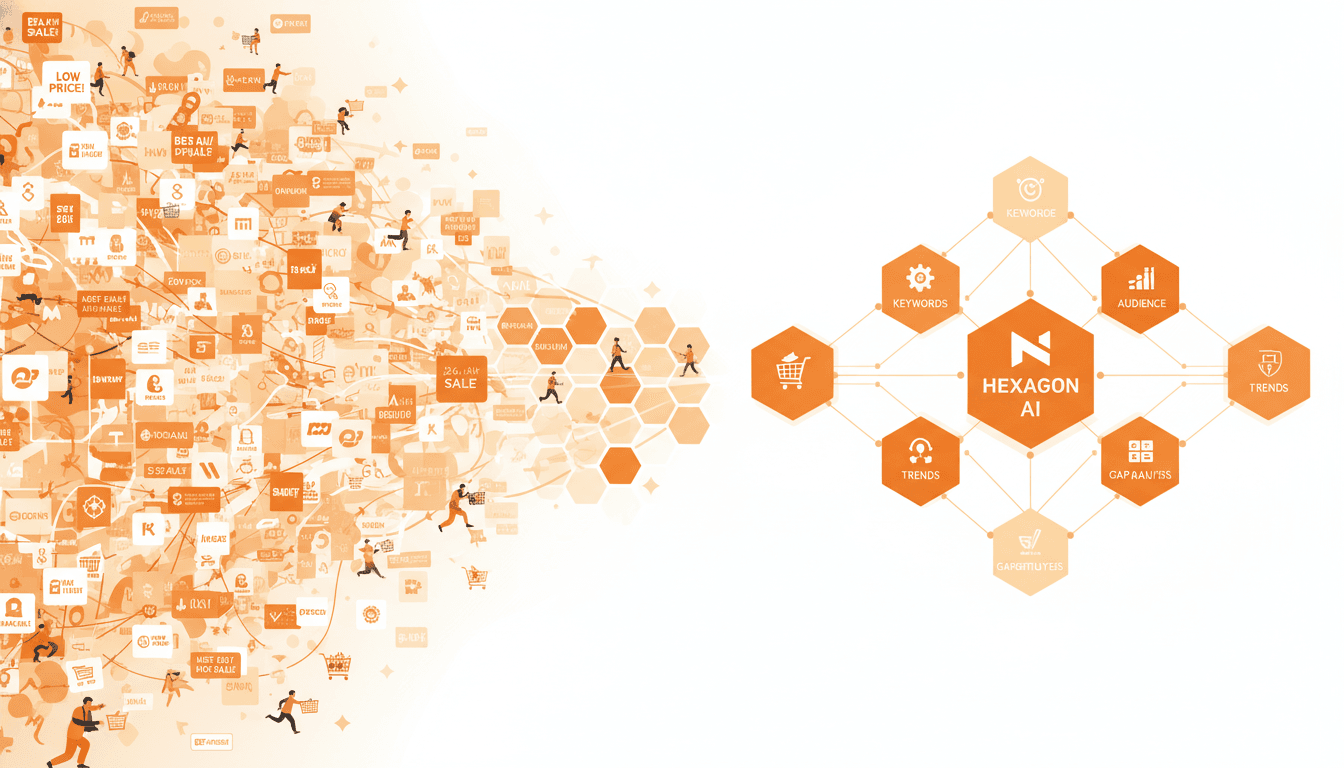
AI-powered product recommendations are rewriting the rules of e-commerce. Learn how Hexagon’s competitive analysis platform uncovers hidden AI keyword opportunities and actionable insights to help your brand dominate AI-driven shopping results.
How to Use Hexagon’s AI Competitive Analysis to Outrank Rivals in AI Shopping Results
AI-powered product recommendations are revolutionizing e-commerce. Discover how Hexagon’s competitive analysis platform uncovers hidden AI keyword opportunities and delivers actionable insights to help your brand dominate AI-driven shopping results.
In today’s rapidly evolving e-commerce landscape, 60% of shoppers rely on AI assistants and search tools to discover products (Salesforce State of Commerce Report). This shift means that traditional SEO strategies alone no longer guarantee product visibility. AI-powered recommendations have fundamentally changed how customers find and purchase products, demanding an entirely new approach to competitive analysis.
Hexagon’s AI Competitive Analysis platform equips brands with actionable, data-driven insights, revealing hidden AI keyword opportunities and empowering you to outrank competitors in AI shopping results.
Ready to surpass your rivals in AI shopping? Book a personalized demo with Hexagon’s AI competitive analysis experts and unlock your brand’s hidden potential today.
Understanding AI-Powered Product Recommendations and Their Impact on E-commerce Visibility
AI-driven product recommendation algorithms are reshaping how online shoppers engage with digital storefronts. Unlike traditional search engines that depend on static keyword matching and basic ranking factors, AI-powered systems dynamically analyze a complex array of signals—from content quality and review sentiment to topical relevance and user intent (OpenAI Research: AI Model Interpretability, 2024).
For instance, AI shopping assistants such as ChatGPT or Perplexity don’t just parse product titles and descriptions; they also weigh customer reviews, real-time trends, and contextual cues from shopper conversations. As a result, the same product query can produce vastly different recommendations based on the AI’s interpretation.
- 56% of AI-generated shopping recommendations differ from traditional e-commerce search results (Forrester Research: The New AI Shopping Funnel, 2024).
- Over 60% of online shoppers now use AI assistants or search tools for product discovery (Salesforce State of Commerce Report).
The implications are clear: relying solely on established SEO tactics is no longer sufficient to maintain visibility. Success now depends on understanding how AI shopping recommendations influence buyer journeys and product discovery patterns.
“AI-driven shopping recommendations are rewriting the rules of product discovery. Brands need to understand not just where they rank, but why the algorithm made that choice.” — Rohit Goyal, VP, AI Product Strategy, Forrester
Looking ahead, brands that embrace these AI-driven shifts will be best positioned to capture buyer attention and boost conversions in the evolving e-commerce funnel.
[IMG: Illustration of AI-powered product recommendation flow vs. traditional e-commerce search results]
How Hexagon’s Platform Delivers Actionable Competitive Intelligence for AI Shopping Assistants
Hexagon’s AI Competitive Analysis platform is designed specifically for the new era of AI-driven e-commerce. Moving beyond legacy search rankings, Hexagon offers brands deep visibility into how their products—and those of their competitors—perform across leading AI shopping assistants like ChatGPT, Perplexity, and Claude.
Here’s how Hexagon equips brands with unmatched competitive intelligence:
- Aggregates and analyzes AI search performance data for your products and top competitors across multiple AI platforms.
- Identifies untapped AI keyword opportunities by benchmarking portfolio visibility against emerging search trends and recommendation signals.
- Provides detailed competitor insights, revealing not only which products are recommended but also why AI models prioritize them (McKinsey & Company: AI in E-Commerce 2024).
Hexagon’s recent analysis found that 80% of e-commerce portfolios have untapped AI keyword opportunities (Hexagon Product Benchmark Report, 2024), meaning most brands miss critical terms and content attributes that drive AI shopping visibility.
“Competitive advantage in the AI era comes from decoding the black box of AI recommendations—Hexagon’s platform gives brands that X-ray vision.” — Lisa Tran, Director of Digital Commerce, Hexagon
By leveraging Hexagon’s AI competitor insights, brands gain the clarity needed to identify—and act on—opportunities invisible to traditional SEO and analytics tools.
[IMG: Screenshot of Hexagon dashboard showing AI search performance vs. competitors]
Step-by-Step Guide to Analyzing Competitor AI Search Performance Using Hexagon
To fully harness AI-driven shopping visibility, brands must systematically monitor and benchmark their position against competitors across AI recommendation engines. Hexagon’s platform offers a streamlined, actionable workflow to simplify this process.
Follow these steps to get started:
1. Set Up Your Hexagon Dashboard
- Integrate your product catalog along with main competitors’ profiles into Hexagon.
- Connect AI shopping assistant data sources such as ChatGPT, Perplexity, and Claude for unified tracking.
- Customize your dashboard to focus on key product lines, categories, or markets.
2. Monitor Competitor AI Search Rankings
- Track where your products and competitors’ products appear in AI-generated shopping recommendations.
- Visualize shifts in ranking positions, frequency of appearance, and recommendation context over time.
- Identify which competitors consistently gain favor from different AI models.
3. Track Competitor Product Visibility and Recommendation Positioning
- Analyze product attributes (e.g., keywords, images, reviews) that correlate with top recommendations.
- Pinpoint content strategies and pricing tactics competitors use to capture AI visibility.
- Map changes in competitor recommendation rates following product updates or promotional campaigns.
4. Leverage Keyword Gap and Content Gap Analysis Tools
- Use Hexagon’s keyword gap analysis to identify missing or underutilized search terms in your listings compared to competitors.
- Deploy content gap analysis to benchmark product descriptions, images, and metadata for completeness and AI relevance.
- Receive automated recommendations prioritizing keywords and content attributes for optimization.
5. Take Action on Insights
- Build prioritized optimization lists based on gap analyses.
- Assign tasks to content and merchandising teams directly within Hexagon.
- Set up real-time alerts for significant ranking or recommendation changes.
[IMG: Workflow diagram of Hexagon’s competitor AI search performance analysis process]
By following these steps, brands can systematically close the visibility gap and ensure their products are prioritized by AI shopping assistants.
Ready to outrank your rivals in AI shopping results? Book a personalized demo with Hexagon’s AI competitive analysis experts to unlock your brand’s hidden opportunities today.
Identifying Keyword and Content Gaps in AI Recommendation Algorithms
AI recommendation algorithms prioritize a complex mix of keywords, content attributes, and contextual relevance when surfacing products to shoppers. Unlike traditional e-commerce search engines that may favor exact keyword matches, AI models weigh factors such as review sentiment, content freshness, and user intent (OpenAI Research: AI Model Interpretability, 2024).
Hexagon’s data-driven approach simplifies uncovering which keywords and content signals are missing or underutilized in your product listings compared to competitors.
Brands can leverage Hexagon to close these gaps by:
- Analyzing AI keyword prioritization: Hexagon reveals which keywords AI models associate with high-performing competitor products.
- Spotting missing content signals: Identify gaps in descriptions, images, and metadata that limit your AI recommendation potential.
- Dynamically tracking emerging AI keyword trends: Brands using AI-driven content optimization pipelines capture new keyword trends up to 2x faster than competitors (Hexagon Customer Results, 2024).
For example, Hexagon’s content gap analysis may reveal that a competitor consistently ranks higher in AI shopping assistants due to more detailed product attributes or richer user-generated content.
Brands that act swiftly to fill these content and keyword gaps experience measurable lifts in recommendation rates and overall shopping visibility.
[IMG: Visualization comparing keyword and content gaps between brand and top competitor]
Optimizing Product Listings, Content, and Attributes to Improve AI-Driven Recommendations
Maximizing visibility in AI-powered shopping environments requires brands to go beyond basic product listing optimization. The most successful brands align every element of their content and attributes with the unique signals AI recommendation engines consider.
Hexagon’s competitive insights can power your optimization strategy in these ways:
- Product Titles and Descriptions: Integrate high-priority AI keywords identified through Hexagon’s gap analysis. Keep copy concise, relevant, and context-rich to match AI parsing models.
- Images and Visual Content: Use high-quality, diverse images that conform to AI models’ preferred formats and highlight key product features.
- Metadata and Structured Data: Ensure all product metadata fields—such as brand, material, size, and color—are fully completed and optimized for AI interpretability.
Brands leveraging Hexagon’s competitor insights to refine product descriptions and images often see faster improvements in AI search rankings.
- Brands using AI competitor analysis tools experience an average 22% improvement in AI search rankings (Hexagon Internal Analytics, 2024).
- Incorporate competitor learnings: Hexagon reveals which specific attributes or content types drive higher recommendation rates for your rivals, enabling you to fine-tune your own content.
- Align product attributes: Update product features, specifications, and even pricing strategies to match signals favored by AI models (Forrester Research: The New AI Shopping Funnel, 2024).
“Traditional SEO is no longer enough; brands must now optimize for the unique signals AI models use to recommend products.” — Alison Chen, Head of AI Partnerships, Shopify
Moving forward, continuous optimization based on real-time AI insights is crucial for maintaining and improving shopping recommendation rankings.
[IMG: Before-and-after example of a product listing optimized for AI recommendations]
Case Studies: Brands That Successfully Outranked Rivals Using Hexagon’s AI Competitive Analysis
Real-world examples demonstrate the transformative power of Hexagon’s AI competitive analysis platform.
Case Study 1: Fashion Retailer Captures Seasonal Trends
A leading fashion brand struggled to appear in top AI-generated recommendations for trending seasonal apparel. Using Hexagon, the team:
- Discovered untapped AI keywords linked to “summer linen dresses” and “lightweight travel wear.”
- Optimized product titles, descriptions, and attributes to align with these emerging trends.
- Monitored competitor movements and adapted content in real time.
Case Study 2: Electronics Brand Fills Content Gaps
An electronics retailer found its flagship headphones consistently outranked by a competitor in AI shopping assistants. Through Hexagon’s content gap analysis, the brand:
- Identified missing technical attributes and insufficient user-generated content.
- Enhanced product listings with detailed specs, customer reviews, and high-quality images.
- Monitored weekly improvements in AI recommendation positioning.
Case Study 3: Beauty Brand Responds to Real-Time AI Shifts
A beauty products company faced fluctuating AI rankings after a major algorithm update. Using Hexagon’s real-time alerts, the team:
- Quickly identified impacted product lines.
- Adjusted content and pricing strategies within days.
- Maintained top recommendation positions amid market volatility.
These examples highlight how Hexagon enables brands to transform AI visibility gaps into measurable growth—both in rankings and revenue.
[IMG: Collage of case study results—charts showing improved AI ranking positions and sales data]
Ongoing Monitoring and Agile Response to Changes in AI Algorithm Priorities
AI-generated product recommendations update far more frequently than traditional SEO or marketplace rankings (Digital Commerce 360, 2024). This reality makes ongoing monitoring and agile adjustments essential to staying competitive.
Hexagon’s platform supports continuous, real-time tracking of AI algorithm updates and competitor moves. Here’s how brands maintain their edge:
- Real-time alerts: Instant notifications for significant shifts in AI recommendation rankings or competitor actions.
- Dynamic content adjustments: Rapid updates to product listings and attributes based on fresh insights from AI assistant behavior.
- Continuous benchmarking: Regular comparisons of your product visibility against top competitors to ensure sustained performance.
“The ability to track and adapt to AI-driven recommendation shifts in real time is now mission-critical for competitive intelligence teams.” — Jacob Feldman, Lead Analyst, Gartner Digital Commerce
Best practices include scheduling weekly or monthly review cycles, leveraging Hexagon’s automated reporting, and integrating findings into content and merchandising workflows. This agile approach keeps your brand front and center in the fast-moving AI shopping landscape.
[IMG: Dashboard view of Hexagon’s real-time AI recommendation monitoring system]
Integrating AI Competitive Insights into Broader E-commerce and Digital Marketing Strategies
To maximize impact, AI competitive analysis should be integrated seamlessly with your broader digital marketing stack.
Leading brands combine AI-driven data with core marketing strategies in these ways:
- SEO and Content Marketing: Use AI keyword and content gap insights to enrich organic and paid content, aligning with both traditional and AI-driven search engines.
- PPC and Promotional Campaigns: Target untapped AI keywords in ad copy and bidding strategies to expand reach.
- Brand Positioning and Customer Experience: Tailor messaging and product attributes to match the context and tone preferred by AI shopping assistants.
For example, Hexagon’s platform informs product development by highlighting features or price points prioritized in AI recommendations. These insights also guide promotional timing, campaign focus, and inventory decisions to maximize ROI.
Looking forward, brands that embed AI competitive intelligence across every facet of their digital commerce strategy will be best positioned for sustained growth and market leadership.
[IMG: Flowchart showing integration of Hexagon insights with SEO, PPC, and content marketing workflows]
Conclusion
AI-powered shopping recommendations are rapidly reshaping e-commerce. Traditional SEO alone is no longer enough—brands must understand and act on the unique signals driving AI product visibility.
Hexagon’s AI Competitive Analysis platform delivers the data, insights, and actionable workflows needed to outpace rivals, capture untapped keyword opportunities, and fuel sustained growth. Whether optimizing content, benchmarking competitors, or responding to real-time AI shifts, Hexagon gives brands the X-ray vision required to win in today’s dynamic digital marketplace.
Ready to outrank your rivals in AI shopping results? Book a personalized demo with Hexagon’s AI competitive analysis experts and unlock your brand’s hidden opportunities today.
[IMG: Closing visual—brand team celebrating improved AI shopping rankings with Hexagon dashboard in background]
Hexagon Team
Published April 3, 2026