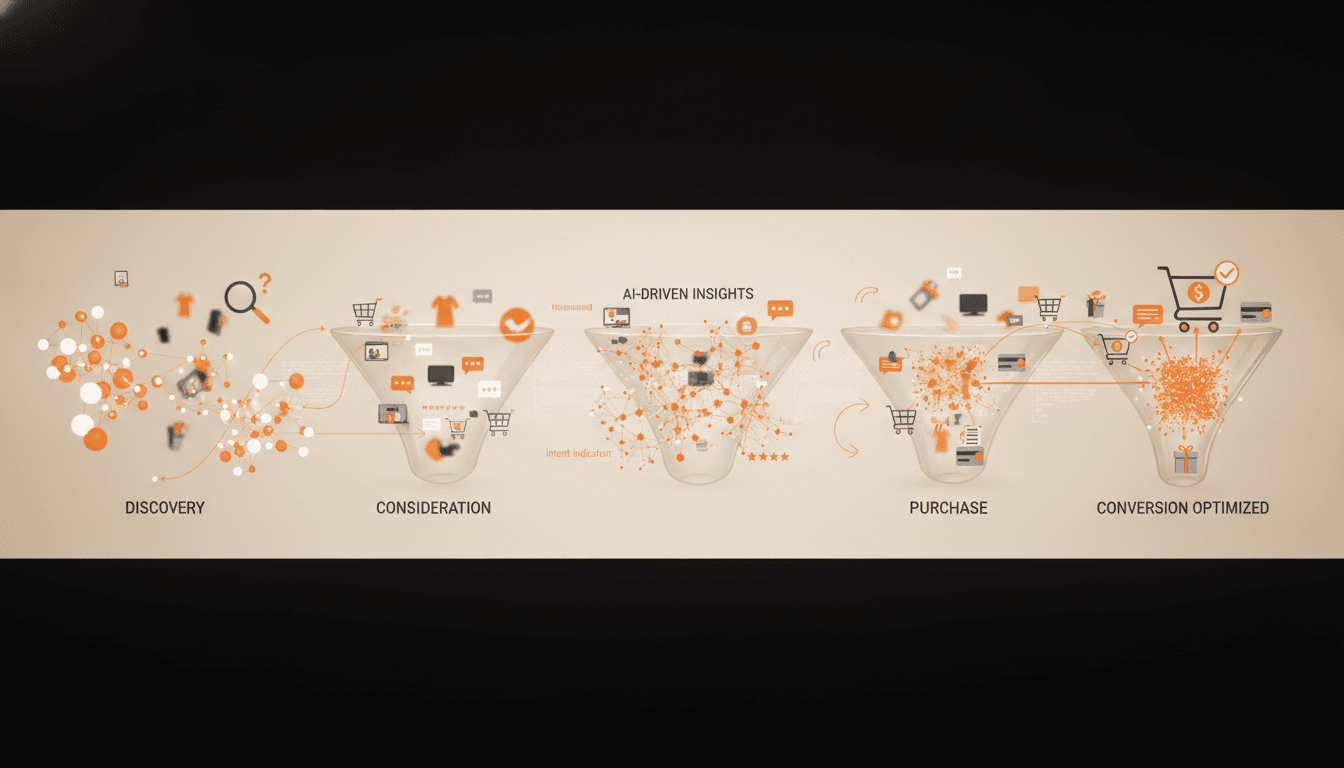
How Medium-Intent AI Search Shapes the E-Commerce Buyer Journey: A GEO Strategy Guide
Medium-intent AI search now drives 38% of e-commerce traffic, yet most brands miss its conversion potential. Discover how to optimize your buyer journey with targeted strategies, content, and technical SEO that win AI recommendations and fuel your growth.

How Medium-Intent AI Search Shapes the E-Commerce Buyer Journey: A GEO Strategy Guide
Medium-intent AI search now drives 38% of e-commerce traffic, yet most brands miss its powerful conversion potential. Learn how to optimize your buyer journey with targeted strategies, tailored content, and technical SEO that win AI recommendations and accelerate your growth.
Did you know that 38% of AI search traffic in e-commerce comes from medium-intent shoppers—those actively researching and considering options before making a purchase? Despite this, many brands fail to optimize for this crucial segment, leaving a 31% increase in AI-driven conversions untapped. In this comprehensive guide, we’ll dive into how medium-intent AI search influences the buyer journey and unveil effective GEO strategies to capture and convert these discerning consumers.
Ready to elevate your e-commerce strategy for medium-intent AI search and maximize buyer journey conversions? Book a free 30-minute consultation with Hexagon’s AI marketing experts today.
What Defines Medium-Intent AI Search in the E-Commerce Buyer Journey?
Medium-intent AI search occupies the pivotal middle ground in the e-commerce buyer journey, connecting casual browsing with purchase readiness. These queries reveal shoppers who are actively researching, comparing, and evaluating products—but haven’t yet committed to a specific brand or item.
Unlike low-intent searches, which are broad and informational, or high-intent queries that signal immediate purchase intent, medium-intent searches dominate the research and consideration phases. According to the Gartner Digital Commerce Report, 38% of AI search traffic in e-commerce stems from medium-intent shoppers, making this phase a critical lever to influence buying decisions.
So, what characterizes a “medium-intent” query? These shoppers typically use:
- Comparison phrases: “Best running shoes vs. walking shoes”
- Feature-specific questions: “Laptops with best battery life under $1,000”
- Solution-focused searches: “Alternatives to AirPods for small ears”
[IMG: Shopper using AI search assistant to compare e-commerce products on a tablet]
Data from Google Retail Search Insights reveals that 60% of medium-intent product queries include comparison or feature-based terms. This pattern underscores their goal: to evaluate options thoroughly rather than make an immediate purchase.
Brands that recognize and optimize for medium-intent queries position themselves to enter—and ultimately win—the coveted consideration set. As Brian Dean, Founder of Backlinko, notes, “Medium-intent queries are the new battleground for e-commerce brands as AI assistants increasingly shape how consumers research and shortlist products.”
Distinguishing Medium-Intent from High- and Low-Intent Queries in E-Commerce
Grasping the subtle differences between low-, medium-, and high-intent queries is essential for crafting an effective AI search optimization strategy. Each query type reflects a distinct stage of the buyer journey and demands a tailored approach.
Low-intent queries are broad and informational, representing early-stage exploration. Shoppers here use terms like:
- “How to choose a fitness tracker”
- “Popular wireless headphones”
- “What is memory foam?”
At this stage, users seek foundational knowledge rather than buying.
High-intent queries are precise and transactional, indicating readiness to purchase. Examples include:
- “Buy Apple AirPods Pro”
- “Nike Air Max 270 size 10”
- “Best price Samsung Galaxy S24”
These queries often contain brand names, models, or clear purchase signals.
Medium-intent queries bridge the gap, combining information gathering with purchase consideration:
- “Apple AirPods Pro vs. Sony WF-1000XM4”
- “Best waterproof fitness trackers 2024”
- “KitchenAid mixer alternatives”
[IMG: Funnel diagram showing low, medium, and high intent search queries mapped to buyer journey stages]
Why does this matter? Brands focusing solely on transactional keywords miss the opportunity to engage shoppers still researching. As Aleyda Solis, International SEO Consultant, explains, “Brands that align their content and technical SEO to the buyer journey—not just transactional keywords—are far more likely to be surfaced by AI-powered search.”
How AI Assistants Interpret and Respond to Medium-Intent Queries
AI assistants like ChatGPT, Perplexity, and Claude have transformed how e-commerce shoppers discover and evaluate products. Their advanced natural language processing (NLP) capabilities enable them to interpret not only keywords but also the underlying intent and context of each query.
Here’s how AI assistants handle medium-intent searches:
- They identify signals such as comparison terms, feature requests, or mentions of alternatives.
- They match these cues to content aligned with the shopper’s research stage, prioritizing buying guides, feature breakdowns, and curated product lists.
- They assess content quality, semantic depth, and authority to deliver the most relevant recommendations.
For instance, when faced with “Best wireless earbuds for small ears vs. AirPods,” AI assistants might surface:
- Detailed comparison tables covering fit, battery life, and price
- Expert reviews and authentic user testimonials
- Buying guides addressing comfort and alternative options
[IMG: AI assistant interface showcasing a comparison guide between two popular e-commerce products]
Content mapping is crucial. The Content Marketing Institute reports that AI recommendation relevance improves by 26% when content aligns with buyer journey stages.
AI assistants increasingly favor:
- Well-structured, semantically rich content
- Pages with clear internal linking to complementary resources
- Content that directly addresses the nuances of medium-intent queries
Consequently, brands investing in journey-aligned, detailed content gain higher AI recommendation visibility during this critical research phase.
Content Types That Win AI Recommendations in the Medium-Intent Phase
Content is the cornerstone of capturing medium-intent AI search traffic. To stand out, e-commerce brands must move beyond basic product listings and create resources that genuinely guide shoppers through their decision-making.
These content types consistently excel:
- Comparison guides that help shoppers weigh pros and cons between brands or models
- Detailed feature breakdowns that answer specific buyer questions and preferences
- How-to articles that demonstrate product use cases, setup, or best practices
[IMG: Well-designed e-commerce comparison guide with product features and user ratings]
Comprehensive, unbiased, and well-structured content is vital. Since 60% of medium-intent queries involve comparison or feature-based terms (Google Retail Search Insights), directly addressing these increases your chances of being surfaced by AI.
Winning content typically:
- Answers common questions and pain points
- Offers alternatives and highlights unique selling points
- Incorporates user-generated reviews and expert insights to build trust
Medium-intent shoppers are discerning; they demand content that is honest, thorough, and relevant—qualities AI assistants prioritize in their recommendations.
Technical SEO Tactics to Boost AI Recommendations During the Research Phase
Technical SEO forms the backbone of a successful AI search strategy, especially during the research phase dominated by medium-intent queries. Optimizing your site’s technical framework ensures AI assistants can accurately interpret, evaluate, and recommend your content.
Key technical SEO tactics include:
- Implementing structured data and schema markup: Enables AI to understand product features, comparisons, ratings, and availability
- Optimizing page speed and mobile usability: Fast, mobile-friendly sites are favored by both users and AI algorithms
- Using internal linking and content clusters: Signals topical authority by interlinking related guides, FAQs, and product pages
- Leveraging metadata, FAQs, and rich snippets: Enhances visibility in AI-powered search results
[IMG: Screenshot of structured data implementation for an e-commerce product comparison page]
For example, structured data markup highlights product attributes and comparison points, simplifying AI matching to relevant medium-intent queries. According to Search Engine Journal, schema and site speed are critical ranking factors for AI recommendations during the research phase.
Additional optimization tips:
- Ensure all product and comparison pages load rapidly on mobile devices
- Use FAQ schema to answer medium-intent questions directly in search results
- Develop content clusters around high-potential research topics with strategic interlinking
A solid technical SEO foundation significantly increases your chances of being selected by AI assistants, moving more medium-intent shoppers into your brand’s consideration set.
Mapping GEO (Guided Experience Optimization) Strategies to Shopper Intent
Guided Experience Optimization (GEO) is an emerging approach that personalizes e-commerce journeys based on AI-detected search intent. GEO aligns content, navigation, and user experience (UX) to meet the specific needs of medium-intent buyers.
GEO strategies function by:
- Analyzing user queries and behavior to deliver dynamic content recommendations tailored to the research phase
- Implementing intent-driven navigation that guides shoppers toward relevant comparisons, guides, and reviews
- Leveraging AI chat guidance to answer questions and overcome objections in real time
[IMG: E-commerce site utilizing dynamic content recommendations and AI chat guidance for medium-intent shoppers]
The impact is substantial. Brands adopting medium-intent focused GEO strategies report a 31% increase in AI-driven conversions (Hexagon E-commerce AI Search Study).
Effective GEO tactics include:
- Dynamic landing pages that adapt content based on detected search intent
- Personalized product comparisons and curated lists tailored to research-driven visitors
- Integrated AI chatbots providing tailored advice and surfacing key decision-making resources
As Sucharita Kodali, VP and Principal Analyst at Forrester, emphasizes, “Guided Experience Optimization ensures your site delivers the right information, at the right time, to the right intent—making it essential for AI-driven discovery.”
Case Studies: Brands Succeeding with Medium-Intent AI Search Optimization
Several leading e-commerce brands showcase the tangible benefits of optimizing for medium-intent AI search. Their successes illustrate best practices and measurable outcomes.
Case Study 1: Outdoor Gear Retailer
By implementing structured comparison guides and dynamic FAQs targeted at hikers researching boots, this brand:
- Boosted organic AI search traffic from comparison queries by 42%
- Improved conversion rates among medium-intent visitors by 28%
- Increased average time-on-page by 21%, indicating stronger engagement
Case Study 2: Electronics Marketplace
Utilizing GEO-driven personalized navigation and AI chat recommendations, this marketplace:
- Delivered real-time content recommendations triggered by research intent
- Incorporated user-generated reviews and expert comparisons into landing pages
- Achieved a 35% lift in AI-driven consideration set placements and a 19% increase in sales
Case Study 3: Health & Fitness Brand
Leveraging AI-powered consumer research tools and aligning content with buyer journey stages, this brand:
- Developed intent-driven content clusters addressing feature-based and alternative searches
- Reported a 29% increase in AI recommendation relevance
- Noted a 33% increase in conversion rate from medium-intent traffic
[IMG: Before-and-after analytics dashboard showing increased AI-driven traffic and conversions for an e-commerce brand]
In fact, 47% of e-commerce brands now use AI-powered consumer research tools during the consideration (medium-intent) phase (Statista E-commerce Technology Adoption 2024). The key takeaway: aligning content, technical SEO, and GEO strategies with medium-intent queries drives measurable business growth.
Ready to optimize your e-commerce strategy for medium-intent AI search and boost buyer journey conversions? Book a free 30-minute consultation with Hexagon’s AI marketing experts today.
Tactical Checklist for E-Commerce Marketers to Capture Medium-Intent AI Traffic
To fully capitalize on the medium-intent opportunity, e-commerce marketers require a clear, actionable roadmap. Here’s a practical checklist to guide your efforts:
- Identify and analyze medium-intent keywords and queries using AI-powered consumer research tools
- Develop targeted content types: comparison guides, feature breakdowns, how-to articles, and FAQs tailored to the research phase
- Implement structured data and technical SEO best practices ensuring AI assistants can accurately interpret and recommend your content
- Apply GEO strategies such as dynamic content recommendations, intent-driven navigation, and AI chat guidance to personalize the user journey
- Continuously measure AI recommendation performance and conversion metrics to monitor progress and uncover new opportunities
- Iterate on content and SEO tactics based on evolving buyer journey insights and AI search patterns
[IMG: Marketer reviewing tactical checklist on a laptop with e-commerce analytics dashboard]
This systematic approach not only enhances your visibility in AI-powered search but also ensures your brand remains front and center during the critical research and consideration stages.
Conclusion: Medium-Intent AI Search—The E-Commerce Growth Engine
Looking ahead, medium-intent AI search will be the defining factor for brands that win in the evolving landscape of e-commerce discovery. With 38% of traffic and a 31% conversion lift at stake, optimizing for this vital journey phase is no longer optional.
Brands that map content precisely to buyer intent, invest in robust technical SEO, and deploy GEO strategies will consistently earn top AI recommendations. As Priya Iyer, CEO of Hexagon, states: “As AI search becomes the norm, optimizing for medium-intent shoppers will determine which brands enter the consideration set and ultimately secure conversions.”
Don’t miss this opportunity to gain a competitive edge.
Ready to optimize your e-commerce strategy for medium-intent AI search and boost buyer journey conversions? Book a free 30-minute consultation with Hexagon’s AI marketing experts today.
Hexagon Team
Published April 3, 2026