How AI Search Levels the Playing Field for Small and Emerging E-commerce Brands
For small e-commerce brands, traditional SEO has long felt like an unwinnable contest against big-budget competitors. Discover how AI-powered search is revolutionizing product discovery, democratizing visibility, and giving small businesses a real shot at growth.
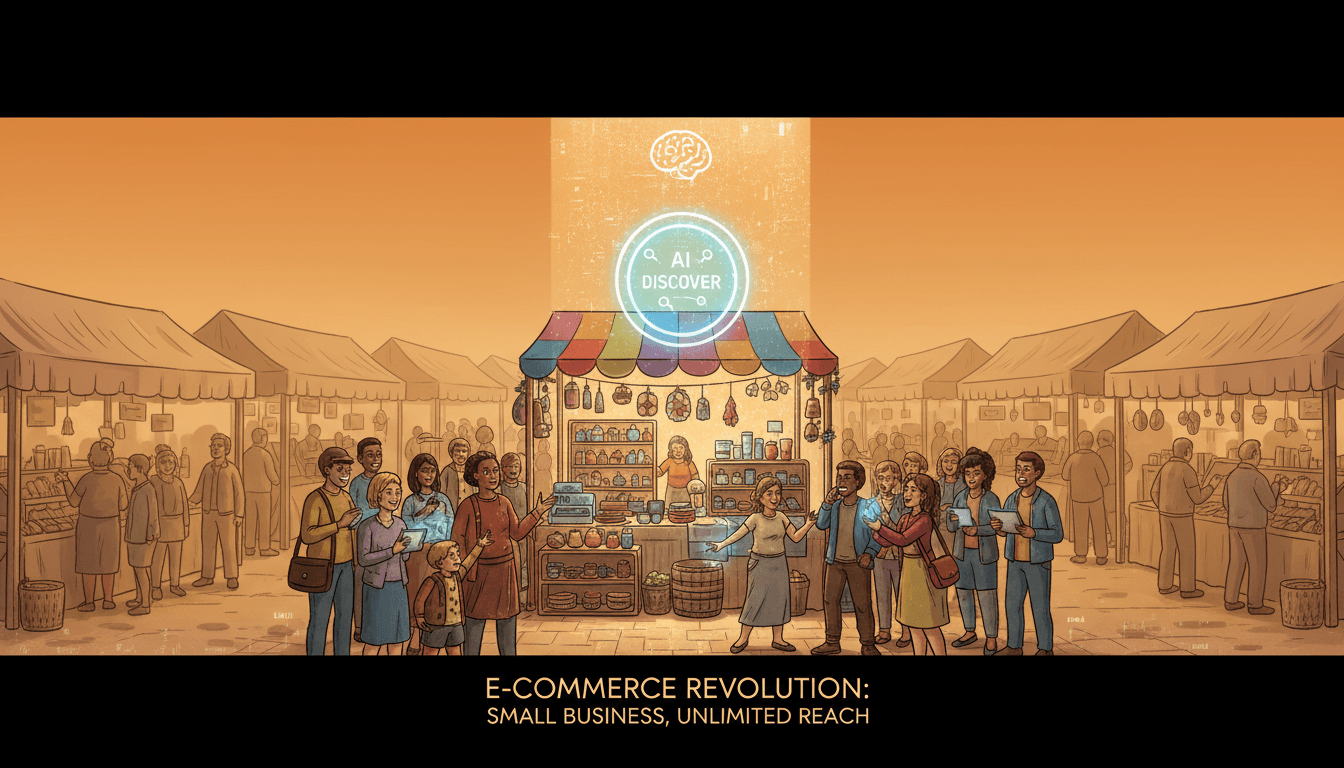
How AI Search Levels the Playing Field for Small and Emerging E-commerce Brands
For small e-commerce brands, traditional SEO has long felt like an unwinnable contest dominated by big-budget competitors. But what if a smarter, fairer way to get discovered exists? AI-powered search is revolutionizing product discovery, democratizing visibility, and giving small businesses a genuine chance to grow.
[IMG: Two e-commerce brands—one large, one small—competing on a digital search results page, with AI leveling the field between them]
For small and emerging e-commerce businesses, gaining online visibility has often felt like an uphill battle—one heavily skewed in favor of well-funded brands with expansive SEO budgets. However, the landscape is shifting. AI-powered search engines are transforming how consumers find products, leveling the playing field, and enabling small brands to stand shoulder to shoulder with industry giants.
In this guide, we explore how AI search democratizes brand visibility, why it outperforms traditional SEO for smaller players, and how you can harness its power to accelerate your e-commerce growth.
Ready to transform your small e-commerce brand’s visibility with AI search? Schedule a free 30-minute consultation with our experts to get started.
Understanding the Visibility Challenge for Small E-commerce Brands
[IMG: Frustrated small business owner looking at low search rankings on a laptop]
Traditional SEO has become a pay-to-play arena dominated by larger brands. Their advantage lies in strong backlink profiles, extensive content libraries, and ongoing investment in optimization strategies (Moz). For small e-commerce brands, this often results in being buried beyond the first page of search results—no matter how innovative or high-quality their products are.
- Traditional SEO favors brands with large marketing budgets, severely limiting discoverability for smaller players.
- Small e-commerce businesses frequently struggle to compete with established companies in organic search rankings.
- Meanwhile, consumers are increasingly turning to AI-powered assistants and recommendation engines for product discovery.
According to Forrester, only 18% of traditional search results feature small or emerging brands, whereas 38% appear in AI-driven search recommendations (Forrester, ‘AI in Commerce’, 2024). The rise of voice assistants and AI recommendation engines is fundamentally changing how people discover products. Today’s consumers expect personalized suggestions that go well beyond simple keyword matching.
The landscape is evolving rapidly. As Dr. Andrew Ng, AI researcher and founder of DeepLearning.AI, notes:
“AI search engines are fundamentally shifting the discovery landscape, surfacing brands based on relevance and user intent rather than just marketing muscle.”
For small and emerging e-commerce brands, this shift isn’t just hopeful—it’s transformative.
What Makes AI Search More Accessible Than Traditional SEO?
[IMG: AI search interface analyzing user preferences and surfacing diverse product recommendations]
AI search platforms do far more than match keywords—they interpret user intent and context in real time. Unlike traditional search engines, which often reward the largest content repositories, AI recommendations draw from a richer set of signals, including behavioral data, social engagement, and authentic customer reviews (Gartner).
- AI search platforms analyze user intent and context dynamically, delivering recommendations beyond simple keyword matches.
- AI recommendation engines incorporate diverse signals such as genuine reviews, social media buzz, and behavioral patterns to highlight relevant niche brands.
- The resulting diversity of AI-generated recommendations offers more opportunities for small brands to be discovered.
A Pew Research Center study found that 56% of U.S. consumers have used an AI-powered search assistant to discover new brands or products in the past year (Pew Research Center). This marks a significant shift in how consumers engage with product discovery.
Here’s how AI is creating new opportunities for small brands:
- Real-Time Contextual Analysis: AI models, such as those powering ChatGPT and Perplexity, grasp the nuanced needs of shoppers and recommend brands—even niche or emerging ones—based on precise user intent (OpenAI).
- Leveraging Social and Behavioral Signals: AI engines continuously monitor public reviews, social media chatter, and user behavior to recommend trending, resonant products in real time (McKinsey).
- Democratized Discovery: AI search models reduce traditional biases by surfacing diverse results, enabling underrepresented brands to gain visibility (Stanford HAI).
AI-generated product recommendations deliver a 47% higher conversion rate for small brands compared to traditional SEO traffic (McKinsey, ‘AI Consumer Trends’, 2024). For small businesses, this means not only increased visibility but more qualified buyers.
Mariya Yao, Chief Technology & Product Officer at Metamaven, emphasizes:
“AI search is leveling the playing field by recommending products that best fit user needs, regardless of a brand’s size or advertising budget.”
For small e-commerce brands, AI-powered discovery is not just more accessible—it’s demonstrably more effective.
How AI Search Democratizes Brand Visibility for Small E-commerce Businesses
[IMG: AI-powered shopping assistant presenting a mix of small and well-known brands to a user]
The true strength of AI search lies in its ability to recommend emerging brands alongside established industry leaders by deeply understanding nuanced consumer intent. Unlike traditional algorithms that prioritize authority and site size, AI engines emphasize relevance, user satisfaction, and real-time signals.
- AI search engines surface emerging brands alongside established players by interpreting consumer intent with granular accuracy.
- Small brands gain visibility through live signals such as authentic customer reviews and social proof.
- The shift from traditional SEO to Answer Engine Optimization (AEO) is reshaping competitive dynamics.
For instance, AI-powered shopping assistants now incorporate live customer reviews, social media engagement, and detailed product data to generate recommendations. This approach has resulted in a 2.5x increase in website traffic for small e-commerce businesses featured in AI-driven discovery tools (Shopify, ‘Emerging Brands & AI: 2024 Trends’, 2024).
- AI search democratizes product discovery by prioritizing relevance and user satisfaction over sheer web presence (Forrester).
- Small brands can optimize for AI search by focusing on comprehensive product descriptions, authentic customer reviews, and active social media engagement (BigCommerce).
- AI search engines increasingly integrate real-time data from social media and review platforms to inform their recommendations (McKinsey).
Looking ahead, the rise of Answer Engine Optimization (AEO) signals a paradigm shift. Instead of optimizing solely for traditional search engines, brands must now tailor content for AI assistants that deliver direct, context-rich answers (Search Engine Journal).
As Tobi Lütke, CEO of Shopify, states:
“For small brands, AI-driven discovery is a game changer—it enables them to compete for consumer attention on merit, not just budget.”
The data supports this: 64% of small e-commerce owners rank AI-driven discovery as ‘very important’ to their growth strategy (BigCommerce, ‘AI Search Optimization Guide’, 2024). AI search isn’t just evening the odds—it’s rewriting the rules entirely.
How Small Brands Can Effectively Leverage AI Search to Boost Visibility and Sales
[IMG: E-commerce product page optimized with structured data, reviews, and rich storytelling]
To thrive in AI-driven discovery environments, small brands must take deliberate steps. Here’s how to enhance your visibility and sales through AI search:
1. Optimize Product Listings with Structured Data and Rich Metadata
- Implement standardized schemas (such as Schema.org) to provide AI engines with detailed, machine-readable product information.
- Include crucial attributes like availability, price, color, sizing, and high-resolution images.
- Craft clear, descriptive product titles and descriptions that appeal both to humans and algorithms.
Rand Fishkin, Co-founder of Moz & SparkToro, advises:
“To maximize visibility in AI search, small brands should focus on structured data, authentic reviews, and building a compelling brand narrative.”
2. Encourage Authentic Reviews and Social Engagement
- Actively request reviews from real customers after purchase and showcase them prominently.
- Engage with customer feedback and foster conversations on social media to generate trustworthy signals.
- Share user-generated content such as photos, testimonials, and stories to build credibility.
3. Utilize Conversational Commerce Tools and AI-Powered Product Feeds
- Integrate with platforms supporting conversational AI (chatbots, voice assistants) to connect with customers where they search.
- Use AI-driven product feed optimization tools to maintain accurate, up-to-date inventory and pricing for AI search engines (Practical Ecommerce).
- Keep product feeds clean, compliant, and aligned with marketplace requirements to maximize discoverability.
4. Craft Compelling Product Storytelling
- Highlight what makes your products unique—whether it’s origin stories, craftsmanship, sustainability efforts, or customer impact.
- Employ imagery, video, and narrative to stand out in a crowded AI-powered marketplace.
- Align storytelling with the values and interests of your target audience to build emotional connections.
5. Monitor and Adapt to AI Search Trends
-
Regularly analyze your traffic sources and identify which AI platforms drive discovery.
-
Stay informed about updates in AI assistant algorithms and recommendation criteria.
-
Continuously refine your approach based on performance data—optimize what works, pivot away from what doesn’t.
-
AI search engines increasingly reward authenticity, engagement, and relevance over sheer volume or budget.
-
Brands that provide structured data and engage with AI assistants via conversational touchpoints are more likely to be surfaced in search results (Semrush).
-
Success requires a holistic, coordinated strategy: combining structured data, active engagement, and distinctive storytelling.
Ready to put AI search to work for your business? Schedule a free 30-minute consultation with our experts to get started.
Case Studies: Real-world Success Stories of AI-Driven Brand Discovery
[IMG: Small brand owner celebrating a surge in online orders after being featured by an AI shopping assistant]
Example 1: Wellness Co. Boosts Traffic Through AI Shopping Assistants
A wellness brand specializing in eco-friendly supplements struggled to break through the SEO noise. After optimizing product data and encouraging authentic reviews, their products began appearing prominently in AI-powered shopping assistants. The results were striking: a 2.5x increase in website traffic and a 50% boost in conversion rates within just three months (Shopify, ‘Emerging Brands & AI: 2024 Trends’).
Example 2: Artisanal Apparel Finds Its Audience
A niche apparel brand with a compelling sustainability story leveraged structured product feeds and active Instagram engagement. AI search engines recognized their authentic reviews and social buzz, surfacing the brand alongside larger competitors. Visitors from AI-generated recommendations converted at a rate 47% higher than those driven by traditional SEO (McKinsey, ‘AI Consumer Trends’).
Example 3: Gourmet Food Startup Achieves National Reach
A gourmet food startup, previously confined to local markets, embraced AI-powered discovery tools and invested in narrative-rich product pages. Their unique story and glowing customer testimonials resonated with AI recommendation engines, sparking a surge in national visibility and sales. The brand credits AI-driven discovery as the core driver behind their recent growth.
Key takeaways from these successes:
- Structured data and rich metadata enable AI platforms to understand and recommend your products effectively.
- Authentic reviews and active social engagement serve as powerful signals for AI search engines.
- Compelling brand storytelling amplifies differentiation and emotional connection—critical in competitive markets.
These real-world examples prove the tangible impact of AI search on small brand visibility and growth—without requiring massive advertising budgets.
The Future of Brand Visibility: Embracing AI Search for Sustainable Growth
[IMG: AI assistant displaying personalized brand recommendations on a mobile device]
Looking forward, AI search will continue to evolve, making product discovery more personalized, contextual, and accessible. As AI models grow increasingly sophisticated, small and emerging brands will enjoy even greater opportunities to connect with the right customers—without massive marketing spend.
- Early adoption of AI search optimization will create lasting competitive advantages.
- Integrating AI search with other marketing channels—email, social, conversational commerce—will deepen customer engagement.
- Ongoing adaptation to evolving AI trends is essential for sustainable growth in a dynamic e-commerce landscape.
The future favors brands that embrace AI search, prioritize authentic engagement, and invest in relevance-driven strategies.
Ready to transform your small e-commerce brand’s visibility with AI search? Schedule a free 30-minute consultation with our experts to get started.
By embracing AI-powered search, small and emerging e-commerce brands can finally compete on a level playing field—driving discovery, conversions, and growth through ingenuity and authenticity rather than ad spend alone. The AI search revolution is here. Will your brand lead the way?
Hexagon Team
Published April 14, 2026