productcontentsearch
How AI Search Engines Work: A Technical Overview for E-Commerce Marketers
AI crawlers now account for 18% of all web traffic—and they're reading your product pages completely differently than Google does. Here's the technical survival guide for e-commerce marketers who've mastered traditional SEO but haven't yet prepared for the AI search era.
13 min read

---


# How AI Search Engines Work: A Technical Overview for E-Commerce Marketers

*Product pages are being read by AI crawlers that operate independently of Google rankings. Right now, 40% of e-commerce sites are completely invisible to them.*

[IMG: Split-screen visualization showing a traditional Google search results page on the left versus an AI-generated answer panel on the right, with product cards and citations highlighted]

## The Shift That's Already Underway

In 2022, GPTBot did not exist. Today, AI crawlers account for [18% of all web crawler traffic](https://radar.cloudflare.com)—a staggering increase from near-zero just two years ago. What matters more than the traffic percentage is this: these crawlers read websites completely differently than Google does.

E-commerce brands have spent years perfecting keyword strategies and building backlink profiles. A parallel indexing system has emerged that ignores keyword density and domain authority entirely. It evaluates whether product pages are machine-readable, whether data is fresh, and whether brands are authoritative enough to cite in synthesized answers.

The problem is stark: 40% of e-commerce product pages are effectively invisible to AI crawlers right now. The opportunity is equally stark: most competitors have not noticed yet.


---


## The AI Search Landscape: Why These Crawlers Play by Different Rules

GPTBot (OpenAI), CCBot (Common Crawl), PerplexityBot, and Google-Extended are not all built the same way. However, they share a fundamental difference from traditional search bots. While Googlebot crawls pages to build a ranked index, AI crawlers harvest content for model training and real-time retrieval pipelines.

Consider the practical difference: Googlebot evaluates a page to determine where it ranks among competitors. AI crawlers evaluate a page to determine whether it can be reliably cited in a synthesized answer. That shift—from *ranking* to *retrieval*—is architectural, not incremental.

Traditional SEO metrics are poor predictors of AI search inclusion. Keyword density, backlink volume, and meta tag optimization do not translate to AI visibility. Instead, AI language models process web content as semantic tokens, evaluating conceptual relationships and topical authority rather than keyword frequency.

As SEO strategist Eli Schwartz notes: "The shift from keyword-based retrieval to semantic, entity-aware retrieval is not incremental—it's architectural. Marketers who treat AI search as 'SEO with a new coat of paint' will find themselves systematically excluded from the answers their customers are receiving."

[IMG: Infographic comparing Googlebot vs. GPTBot crawling behavior, with arrows showing "ranking index" vs. "retrieval pipeline" as the respective outputs]


---


## How RAG Architecture Works: The Bridge Between Content and AI Answers

Most AI search engines—including Perplexity, Google AI Overviews, and ChatGPT's browsing mode—use **Retrieval-Augmented Generation (RAG)**. This architecture combines a live retrieval layer that fetches current web content with an LLM's pre-trained knowledge to generate synthesized answers.

The pipeline operates in straightforward steps: an AI crawler indexes a product page, stores it in a retrieval database, and when a user asks a relevant question, the system retrieves that content and feeds it to a large language model. The LLM synthesizes the retrieved content into a natural language answer—and critically, it cites sources.

This dual requirement is where many e-commerce brands fall short. Content must be both discoverable by the crawler *and* citable by the model. As Andrej Karpathy, former Director of AI at Tesla and former OpenAI researcher, explains: "Large language models don't read a page the way a human does—they tokenize it, embed it, and compare it against millions of other representations. What wins isn't the page with the most keywords; it's the page whose concepts cluster most coherently around the user's intent."

Content freshness and factual accuracy are critical inputs to RAG systems. AI systems like Perplexity use real-time retrieval and actively deprioritize pages with stale product information. For e-commerce brands, this means optimizing simultaneously for machine comprehension and human-readable quality.


---


## The JavaScript Problem: Why 40% of E-Commerce Sites Are Invisible to AI

Approximately [40% of e-commerce product pages](https://ahrefs.com) are effectively unreadable by AI crawlers due to JavaScript-dependent rendering, dynamic content loading, or crawler-blocking configurations. This represents the most urgent technical vulnerability in e-commerce AI search readiness.

AI crawlers cannot reliably process JavaScript-rendered content. Unlike modern browsers, which execute JavaScript to assemble a fully rendered page, AI crawlers execute JavaScript at a fraction of the speed and capability—or skip it entirely. Dynamic content loading, lazy-loading product images, client-side pricing updates, and review widgets rendered via JavaScript are effectively invisible to AI indexing pipelines.

For example, consider a common scenario: a product page loads the price via JavaScript after the initial HTML renders. A human visitor sees the price immediately. An AI crawler sees a blank field and moves on.

Server-side rendering (SSR) or static HTML is the solution. Static HTML or server-rendered content is indexed **3x faster** by AI crawlers than client-rendered equivalents. This is foundational infrastructure, not a nice-to-have optimization.

This is a technical debt issue that traditional SEO largely did not expose. Google invested heavily in JavaScript rendering capabilities over the past decade, masking the problem for many e-commerce teams. AI crawlers have not made the same investment, and they do not plan to.


---


## Structured Data: The Highest-Leverage Technical Optimization for AI Search

If server-side rendering is the foundation, structured data is the force multiplier. [68% of AI-generated product recommendations](https://joinhexagon.com) in ChatGPT and Perplexity responses cite sources that include Schema.org structured data markup. Structured data pages represent a minority of total indexed content, creating an asymmetry that represents one of the clearest competitive opportunities in AI search today.

Schema.org markup for **Product, Review, Offer, FAQ, and BreadcrumbList** schemas provides machine-readable context that LLMs can parse with high confidence. When an AI system retrieves a product page, structured data tells it exactly what the product is, what it costs, how it is rated, and whether it is in stock—without requiring the model to infer that information from unstructured prose.

Here's how structured data changes the citation equation: an LLM evaluating two competing product pages will consistently favor the one where price, availability, and ratings are explicitly declared in machine-readable format. As Lily Ray, VP of SEO Strategy at Amsive Digital, observes: "We're seeing a fundamental decoupling of 'crawled' and 'cited.' A page can be crawled by every AI bot on the internet and still never appear in a generated answer if it lacks the entity clarity and factual density that language models need to confidently reference it."

Implementation of structured data is a direct technical lever for AI search visibility. It is also asymmetrically valuable because the majority of e-commerce sites under-implement it, making early adoption a genuine competitive differentiator.

[IMG: Code snippet showing a Product schema markup example with price, availability, and review rating fields highlighted]


---


## Entity Authority vs. Keyword Rankings: How AI Search Prioritizes Sources

Here's where AI search diverges most sharply from traditional SEO. Traditional systems evaluate domain authority scores and count backlinks. AI systems evaluate **entity authority**: how consistently and accurately a brand is mentioned across diverse, independent sources across the web.

This is fundamentally different from PageRank-style link authority. AI systems evaluate the coherence and consistency of brand mentions across forums, review platforms, editorial content, and third-party product databases. A brand mentioned accurately and consistently across 50 independent sources outperforms a brand with 500 backlinks but inconsistent product descriptions.

E-E-A-T signals—Experience, Expertise, Authoritativeness, and Trustworthiness—directly influence AI source selection. Google's AI Overviews draws from a separate content evaluation pipeline that weights these signals more heavily than standard organic ranking algorithms. PerplexityBot explicitly prioritizes pages with clear authorship signals, publication dates, and factual citations.

The competitive stakes are significant. [58.5% of Google searches](https://sparktoro.com) in the United States now result in zero clicks, as AI-generated answers satisfy user intent directly on the results page. Meanwhile, [72% of consumers](https://salesforce.com) who use AI assistants for product research make purchase decisions based on the AI's recommendation without clicking through to a brand's website.


---


## The robots.txt Dilemma: To Block or Allow AI Crawlers?

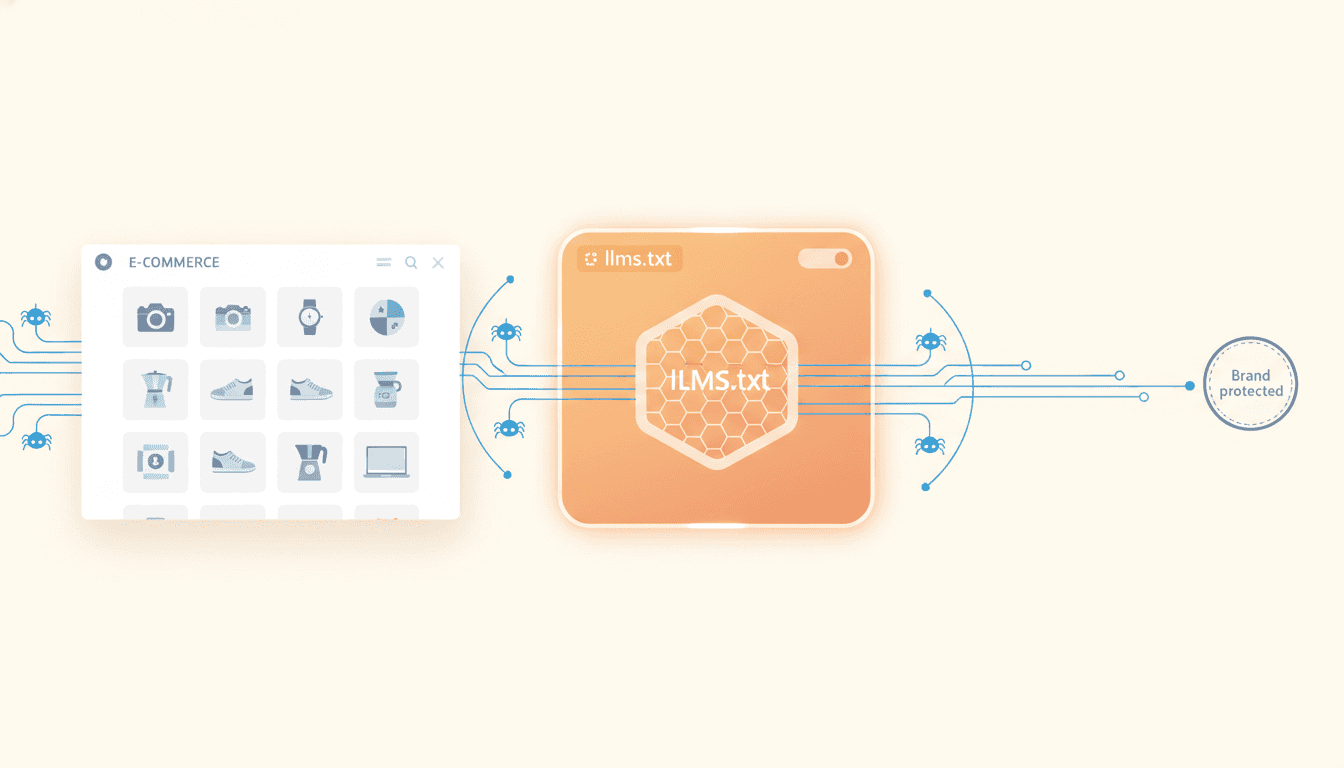
Many e-commerce brands have made a consequential decision without realizing it. The robots.txt protocol has become a critical strategic battleground: sites that block GPTBot, CCBot, or PerplexityBot may protect content from training data harvesting, but they simultaneously reduce chances of appearing in AI-generated answers.

Here's the trade-off in concrete terms. Blocking AI crawlers prevents product content from being incorporated into model training datasets—a legitimate concern for brands with proprietary pricing strategies or unique product descriptions. However, blocking also removes content from the real-time retrieval pipelines that power AI shopping recommendations.

The decision should be made strategically, not by default. Consider these factors when evaluating robots.txt configuration:

- **Competitive positioning**: Early-adopting competitors are likely allowing crawlers and capturing AI-driven traffic.
- **Content sensitivity**: If product descriptions and pricing are genuinely proprietary, selective blocking may be warranted.
- **Traffic dependency**: With 72% of AI-assisted product researchers making purchases without visiting a brand website, exclusion from AI answers is exclusion from the conversion path.
- **Crawl differentiation**: It is possible to allow PerplexityBot (real-time retrieval) while blocking CCBot (training data)—a nuanced approach worth evaluating.

Most e-commerce brands should allow AI crawlers. The decision deserves deliberate analysis, not a default configuration inherited from a robots.txt template written in 2019.


---


## From Rankings to Narrative: Optimizing for AI-Generated Answers

The mental model of "ranking position" is obsolete for AI search. Unlike traditional search, where a page can rank for hundreds of keywords across positions 1 through 100, AI search engines typically surface one synthesized answer per query. There is no position 1 or position 10—there is only **inclusion or exclusion** from the answer.

That binary reality demands a fundamentally different content strategy. AI-generated answers synthesize multiple sources into a single response, meaning brands must be citable within a narrative, not rankable against competitors. Brand clarity and consistency across all web mentions directly influence citation likelihood.

Looking ahead, the brands that win AI search will be those that treat content as a narrative positioning problem. Product descriptions must be authoritative and citable—not optimized for keyword matching. Category positioning must be consistent across every independent mention of a brand. The goal is no longer to rank first; it is to be the source the AI reaches for when answering a customer's question.

[IMG: Diagram showing how multiple web sources are synthesized into a single AI-generated answer, with brand citations highlighted]


---


## Content Freshness: The 3x Multiplier for AI Search Visibility

Content freshness is not a nice-to-have for AI search—it is a weighted ranking signal. AI crawlers prioritize pages with recent publication or update dates, and high-authority, frequently updated pages are crawled **3x more often** than static or rarely updated pages. For e-commerce brands managing large product catalogs, this has direct operational implications.

Real-time pricing accuracy directly influences whether AI systems will recommend products. Stale product data—outdated reviews, discontinued items, incorrect pricing—actively reduces AI visibility. AI systems like Perplexity use real-time retrieval and deprioritize pages that show signs of content decay.

Here's how e-commerce brands should approach content freshness as a technical requirement:

- **Automate product data updates**: Pricing, availability, and review aggregation should update continuously, not manually.
- **Timestamp all content updates**: Explicit update timestamps signal freshness to AI crawlers and retrieval systems.
- **Retire discontinued products**: Stale catalog pages dilute overall site freshness signals and consume crawl budget.
- **Maintain review recency**: Recent reviews are a freshness signal; platforms that aggregate outdated reviews lose AI citation priority.

This represents a shift from "evergreen content" to "continuously maintained content"—and it requires investment in content automation and product data hygiene infrastructure.


---


## Technical Audit Checklist: Is an E-Commerce Site AI-Ready?

Assessing AI search readiness requires a structured audit across five dimensions. Here is a practical framework for e-commerce teams to evaluate their current position.

**Rendering Audit**
- Are product pages server-side rendered or statically generated?
- Does critical product data (price, availability, reviews) appear in the HTML source without JavaScript execution?
- Use Google Lighthouse and Search Console to identify client-rendered content gaps.

**Structured Data Audit**
- Do product pages include Product, Offer, Review, and FAQ schema markup?
- Validate implementation using the [Schema.org Validator](https://validator.schema.org) and Google's Rich Results Test.
- Check for markup errors that reduce LLM citation confidence.

**Crawlability Audit**
- Review robots.txt for unintentional AI crawler blocks.
- Confirm that AI bots (GPTBot, CCBot, PerplexityBot) can access product pages without authentication walls.
- Test crawl paths using server log analysis to confirm AI crawler access.

**Freshness Audit**
- Are product prices, reviews, and availability data current across all indexed pages?
- Do pages include explicit publication and update timestamps?
- Monitor stale pages using automated crawl tools.

**Authority Audit**
- Are brand and product mentions consistent across independent sources (review platforms, editorial content, forums)?
- Track entity mentions using brand monitoring tools.
- Identify and correct factual inconsistencies across third-party sources.

This audit should be conducted quarterly. AI indexing behavior is evolving rapidly, and a site that passes today's audit may develop gaps within six months.


---


## The Competitive Advantage: Why Early Adopters Will Win

The window for competitive advantage in AI search is open—but it is closing. Most e-commerce sites are still optimized exclusively for traditional SEO, leaving AI search visibility largely uncontested. Brands that implement server-side rendering, structured data, and content freshness protocols now will capture disproportionate AI-driven traffic before competitors recognize the opportunity.

The stakes are concrete. With 40% of product pages currently invisible to AI crawlers and 72% of AI-assisted product researchers making purchases without visiting a brand website, brands included in AI-generated answers are capturing conversions that competitors never see. AI search is already a significant traffic and conversion channel for early adopters.

Looking ahead, the compounding nature of this advantage matters. Entity authority builds over time through consistent, accurate brand mentions. Structured data implementation creates a durable infrastructure advantage. Content freshness systems, once built, operate continuously. Early adopters are not just winning today's AI search traffic—they are building the technical and authority foundations that will be increasingly difficult for late movers to replicate.

[IMG: Bar chart showing projected AI search traffic share growth from 2022 to 2026, with early adopter vs. late adopter traffic capture illustrated]

The e-commerce brands that treat AI search optimization as a technical priority in 2024 will look back on this period the way early SEO adopters look back on 2005. The infrastructure is being built. The traffic is already flowing. The question is whether a brand will be included in the answers customers are receiving.


---


## Conclusion

AI search has moved from experimental to consequential for e-commerce. The technical foundations—server-side rendering, structured data, entity authority, content freshness—are not advanced tactics reserved for enterprise brands. They are baseline requirements for any e-commerce business that wants to remain visible as AI answers replace traditional search results pages.

The shift is architectural. Marketers who approach AI search as a variant of traditional SEO will be systematically excluded from the answers customers are receiving. Those who understand the technical mandate—machine-readable content, fresh product data, consistent entity authority—will capture the conversion traffic that 72% of AI-assisted shoppers never bring to a brand website.

The competitive window is open. The question is whether brands will step through it.
H
Hexagon Team
Published July 12, 2026