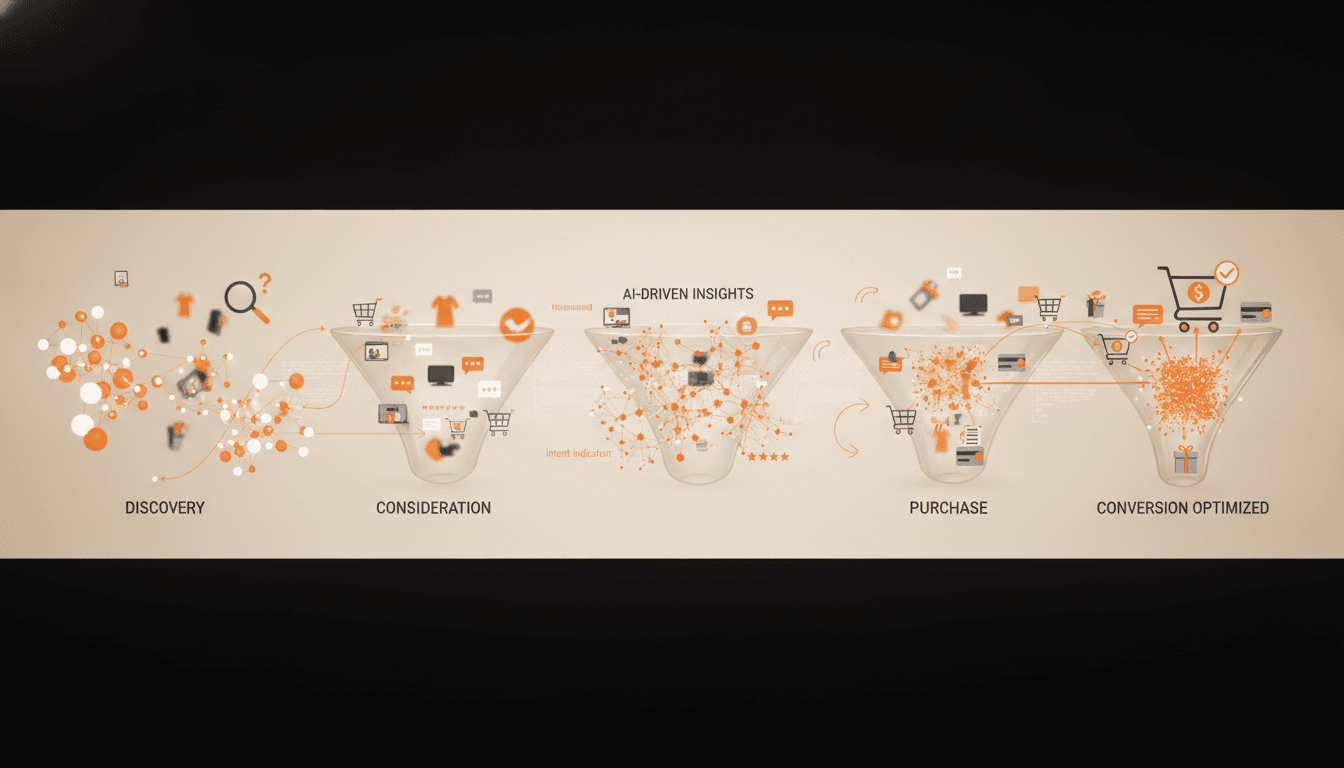
How AI Search Engines Use User Intent to Revolutionize E-Commerce Recommendations
E-commerce brands face an uphill battle delivering recommendations that convert. Discover how AI search engines leverage user intent to personalize product suggestions, increase conversions, and future-proof your e-commerce strategy in an era of generative search.

How AI Search Engines Use User Intent to Revolutionize E-Commerce Recommendations
E-commerce brands face an uphill battle delivering recommendations that truly convert. Discover how AI search engines harness user intent to personalize product suggestions, boost conversion rates, and future-proof your e-commerce strategy in the fast-evolving era of generative search.
E-commerce brands frequently struggle to present product recommendations that genuinely resonate with shoppers. But imagine if AI search engines could instantly and intuitively grasp exactly what your customers want — in real time — then tailor suggestions that drive conversions. This guide reveals how AI leverages user intent to revolutionize e-commerce recommendations and provides actionable insights on optimizing your content for this new era of intent-driven personalization.
Ready to elevate your e-commerce recommendations through AI-powered user intent optimization? Book a free 30-minute consultation with Hexagon’s AI marketing experts today.
Understanding User Intent in AI Search Engines
[IMG: AI analyzing e-commerce search queries on a digital dashboard]
User intent refers to the underlying purpose or goal behind a shopper’s search query or on-site behavior. In e-commerce, accurately interpreting this intent — whether informational, transactional, or navigational — is crucial for delivering relevant product recommendations. Sundar Pichai, CEO of Google, emphasizes, “The future of e-commerce is intent-driven. AI search engines that understand and anticipate user needs will set the new standard for product discovery and conversion.”
Today’s AI search engines are transforming how intent is decoded and categorized. Utilizing advanced models, they parse language nuances, contextual clues, and behavioral signals in real time to determine if a user wants to compare products, locate a specific item, or simply browse for inspiration. This capability enables platforms to offer recommendations that precisely match shoppers’ true needs rather than generic or broad suggestions.
Remarkably, modern intent classification models achieve up to 92% accuracy in distinguishing among query types, according to the Stanford AI Lab. Such precision means shoppers receive more relevant product suggestions, increasing satisfaction and driving higher conversion rates. For e-commerce brands, adopting this technology is no longer optional — it’s essential for remaining competitive.
Technologies Behind Intent Detection: NLP, Behavioral Analytics, and Multi-Modal Signals
[IMG: Diagram showing NLP, behavioral analytics, and multi-modal signals working together]
AI search engines depend on a sophisticated blend of technologies to detect and interpret user intent effectively:
- Natural Language Processing (NLP): NLP algorithms analyze the semantics and context within search queries, enabling AI to understand subtle nuances, synonyms, and ambiguous phrasing. This moves platforms beyond rigid keyword matching toward deeper comprehension of shopper needs.
- Behavioral Analytics: Insights from past user interactions—such as clicks, add-to-cart actions, and time spent on pages—offer powerful signals of intent. Analyzing these behaviors allows AI to refine recommendations and predict which products a user is likely to want next.
- Multi-Modal Signals: As e-commerce becomes increasingly interactive, AI systems integrate data from diverse sources—including images, voice commands, and videos. Multi-modal models interpret user intent whether the input is typed, spoken, or visual.
Consider this example: a shopper uploads a photo of a sneaker and types “running shoes, waterproof.” The AI combines image recognition, NLP, and behavioral history to infer the user seeks a specific style with waterproof features, generating highly targeted product suggestions.
By weaving these advanced techniques together, AI search engines gain a comprehensive understanding of each shopper’s intent. The result? Richer, more precise, and actionable product recommendations that directly boost revenue and foster customer loyalty.
How Generative AI Assistants Use User Intent to Craft Product Recommendations
[IMG: Generative AI assistant suggesting products on a website]
Generative AI assistants represent the next frontier in e-commerce personalization, leveraging user intent at every step of the shopping journey. These intelligent tools analyze both explicit queries and subtle behavioral cues to dynamically generate product recommendations tailored to each individual shopper.
Here’s how the process unfolds:
- The assistant deciphers intent from search queries, historical behavior, and real-time context.
- Using retrieval-augmented generation (RAG), it fuses live product data with intent signals to create on-the-fly recommendations.
- The AI delivers options that align with both the shopper’s expressed needs and inferred preferences.
For instance, if a customer searches for “eco-friendly yoga mats for beginners,” generative AI like ChatGPT or Perplexity synthesizes product information, reviews, and user context to suggest mats made from sustainable materials, with cushioned support and features ideal for beginners.
These innovations are reshaping e-commerce search:
- By 2025, 31% of e-commerce searches are projected to be powered by generative AI search engines (Forrester Research).
- 68% of consumers report that relevant product recommendations increase their likelihood of purchase (Salesforce State of the Connected Customer).
Greg Brockman, Co-founder & President of OpenAI, highlights, “Generative AI is not just about answering questions; it’s about understanding the purpose behind every query to recommend what users truly want.” The payoff? Enhanced engagement, higher average order values, and a significantly improved user experience.
Optimizing Product Content and Metadata to Align with AI Intent Signals
[IMG: E-commerce product page with structured data and highlighted semantic keywords]
To harness the full power of intent-driven AI recommendations, brands must optimize product content and metadata for these advanced algorithms. This involves crafting descriptions and tags that clearly convey product relevance, features, and benefits in ways AI can easily interpret.
Here’s how to create intent-rich content and metadata:
- Write Descriptions with Intent in Mind: Use language that reflects how customers search — focusing on use cases, benefits, and pain points. For example, describing a jacket as “lightweight, waterproof, and ideal for hiking” directly addresses both functional and contextual intent.
- Incorporate Semantic Keywords: Go beyond basic keywords by integrating semantic phrases and topic clusters. This supports generative search optimization and helps AI match your products with nuanced queries.
- Apply Structured Data and Schema Markup: Utilize schema.org markup to help AI interpret product details, pricing, availability, and reviews. Structured data ensures your products are accurately indexed and surfaced in relevant recommendation slots.
- Regularly Refresh Content: User intent evolves with trends and seasons. Continuously update product descriptions, incorporate user-generated content, and revise metadata to stay aligned with changing preferences and search behaviors.
The impact is clear: Brands optimizing for intent-rich content experience a 17% average increase in recommendation visibility (CXL Institute). Amit Singhal, former SVP of Search at Google, observes, “Brands that structure their product data to align with AI models see measurable gains in both visibility and sales. Intent optimization is the next frontier.”
To maximize results:
- Audit existing product pages for clarity and alignment with user intent.
- Collaborate with AI and SEO specialists to maintain evolving best practices.
- Leverage customer reviews and Q&A sections to provide richer context for AI models.
Case Studies: Brands Boosting Conversions Through Intent Alignment
[IMG: Graph showing conversion rate increases at Wayfair and other brands]
Leading e-commerce brands are already reaping significant benefits by aligning their strategies with AI-driven intent detection. For example, Wayfair reports a 15% increase in conversion rates attributed directly to its AI-powered personalization system, which focuses on real-time intent signals (Wayfair Investor Report Q1 2024).
Here’s how Wayfair achieved these results:
- Implemented intent classification models to segment shoppers based on browsing and search behaviors.
- Delivered personalized product recommendations tailored to each segment, from inspiration seekers to ready-to-buy customers.
- Continuously refined algorithms using engagement and purchase data to enhance future suggestions.
Other success stories include:
- A leading apparel brand saw a 12% lift in cross-sell revenue by integrating AI assistants that dynamically recommend complementary items based on browsing intent.
- A consumer electronics retailer increased cart additions by 10% on mobile devices by leveraging multi-modal intent signals, including text, image uploads, and voice commands.
Key takeaways: takeaways
- Intent-focused personalization drives measurable uplifts in both conversion and customer satisfaction.
- Incorporating AI-powered feedback loops ensures ongoing optimization and relevance.
- Brands prioritizing intent alignment consistently outperform competitors relying on generic recommendation engines.
Ready to revolutionize your e-commerce recommendations through AI-driven user intent optimization? Book a free 30-minute consultation with Hexagon’s AI marketing experts today.
The Rise of Semantic and Retrieval-Augmented Search in E-Commerce
[IMG: Flowchart illustrating semantic search and retrieval-augmented generation in e-commerce]
Looking forward, semantic search and retrieval-augmented generation (RAG) are transforming how e-commerce platforms interpret and respond to user queries. Semantic search understands meaning and context, enabling AI to deliver results aligned with a shopper’s intent — not merely the exact words typed.
For example, when a user searches for “best shoes for winter running,” a semantic search engine prioritizes products featuring insulation, grip, and waterproofing, even if those exact keywords aren’t present. This context-driven approach ensures recommendations are both precise and actionable.
Retrieval-augmented generation advances this further by merging real-time product data with user intent signals. Generative AI assistants utilize RAG to synthesize the latest catalog information, customer reviews, and inventory status, producing recommendations that are timely and deeply personalized.
These innovations are vital for future-proofing e-commerce search:
- They minimize friction in product discovery.
- They enhance recommendation relevance.
- They empower brands to anticipate customer needs and exceed expectations.
Reva McPollom, VP of AI Product at Shopify, states, “Optimizing for AI intent signals is no longer optional for brands that want to be discovered in the era of generative search. It’s the new baseline for competitive e-commerce.”
Continuous Learning and Feedback Loops: Improving Recommendation Relevance Over Time
[IMG: Machine learning feedback loop diagram for e-commerce recommendations]
AI-powered recommendation engines are dynamic, relying on continuous feedback loops to refine their understanding of user intent and enhance suggestion quality over time.
Here’s how this works:
- AI systems collect engagement data from clicks, purchases, and even skipped recommendations.
- Machine learning algorithms analyze these patterns to detect shifts in user preferences or intent.
- Recommendations are updated in real time, maintaining relevance and accuracy.
For e-commerce managers, this offers substantial benefits:
- Less manual effort needed for content updates.
- Rapid adaptation to emerging trends and changing shopper behavior.
- Improved customer satisfaction through hyper-personalized product discovery.
Continuous optimization isn’t merely a technical advantage — it’s a critical driver of sustained growth and competitive differentiation. As Gartner’s 2024 report highlights, brands leveraging feedback loops maintain higher recommendation relevance and conversion rates over time.
Actionable Steps for E-Commerce Managers to Future-Proof AI Search Optimization
[IMG: E-commerce manager analyzing AI search performance dashboard]
To stay ahead in the era of AI-driven intent detection and recommendations, e-commerce managers must adopt a proactive, structured approach. Here are key steps to future-proof your strategy:
- Conduct Intent Audits: Regularly analyze product content, search logs, and user journey data to ensure alignment with your target audience’s intent.
- Implement Structured Data and Enhanced Metadata: Apply schema markup and maintain detailed, up-to-date metadata for every product to maximize AI compatibility and recommendation visibility.
- Leverage Generative AI Tools: Integrate AI assistants capable of dynamic, context-aware product recommendation generation throughout the shopping experience.
- Establish Feedback Mechanisms: Monitor AI performance using analytics dashboards, A/B testing, and direct customer feedback to continuously refine your approach.
- Partner with AI Marketing Experts: Collaborate with specialists to evaluate emerging technologies, implement best practices, and keep your brand at the forefront of e-commerce innovation.
By following these steps, brands can ensure their product discovery experiences remain relevant, personalized, and conversion-focused — no matter how rapidly the AI landscape evolves.
Conclusion
The emergence of AI search engines that comprehend and act on user intent signals a pivotal shift for e-commerce. By harnessing technologies like NLP, behavioral analytics, and semantic search, brands can deliver hyper-relevant recommendations that translate into measurable business results. The evidence is compelling: 92% accuracy in intent classification, 17% higher recommendation visibility, and double-digit conversion lifts for brands optimizing their content with intent in mind.
As the industry embraces generative AI and retrieval-augmented search, future-proofing your content, metadata, and feedback strategies becomes essential. Amit Singhal aptly summarizes, “Intent optimization is the next frontier.” Brands that act decisively now will not only increase conversions but also cultivate lasting loyalty in the age of AI-driven commerce.
Ready to transform your e-commerce recommendations with AI-driven user intent optimization? Book a free 30-minute consultation with Hexagon’s AI marketing experts today.
[IMG: Team of e-commerce professionals collaborating with AI marketing consultants]
Hexagon Team
Published March 2, 2026