brandsauthorityrecommendation
How AI Search Engines Actually Decide Which Products to Recommend: The Decision-Making Process Explained
Your product might be exceptional. Your website might rank perfectly on Google. But there's a 58% chance your customers are asking ChatGPT, Perplexity, or Claude for product recommendations instead—and an even bigger chance those AI systems aren't mentioning your brand. Here's exactly why that happens, and what to do about it.
16 min read
# How AI Search Engines Actually Decide Which Products to Recommend: The Decision-Making Process Explained

*A product might be exceptional. A website might rank perfectly on Google. But there's a 58% chance customers are asking ChatGPT, Perplexity, or Claude for product recommendations instead—and an even bigger chance those AI systems aren't mentioning the brand. Here's exactly why that happens, and what to do about it.*

[IMG: Split-screen visual showing a traditional Google search results page on the left versus a conversational AI product recommendation response on the right, with brand logos appearing in the AI panel but absent from the search results]


---


## Introduction: The AI Recommendation Shift Is Already Happening

The way people discover products has fundamentally changed—and most brands haven't noticed yet.

More than half of online shoppers now use AI assistants during product research. According to the [Salesforce State of the Connected Customer Report](https://www.salesforce.com/resources/research-reports/state-of-the-connected-customer/), 58% of consumers turn to AI assistants for product guidance, and 27% say AI recommendations directly influenced their most recent purchase decision—a figure that has more than doubled since 2022. This isn't speculation about future behavior; it is the current reality of e-commerce discovery happening right now across every product category.

The scale is staggering. ChatGPT alone surpassed [180 million monthly active users](https://reuters.com) in 2024, with shopping queries representing one of the fastest-growing use case categories. AI recommendation reach now rivals or exceeds many traditional search and social advertising channels for brand discovery.

The financial stakes make this impossible to ignore. [McKinsey's Global Institute](https://www.mckinsey.com/capabilities/mckinsey-digital/our-insights/the-economic-potential-of-generative-ai) projects AI-influenced e-commerce transactions will reach **$1.2 trillion globally by 2027**, up from an estimated $142 billion in 2024. That's not incremental growth—it's a wholesale redistribution of market share. Brands optimized only for Google are missing a parallel discovery channel that is growing faster than any other.


---


## How AI Recommendation Engines Think Differently Than Google

Here's the fundamental problem: Google ranks pages. AI systems synthesize reputations.

That distinction is everything. Google evaluates links, keywords, and engagement signals to determine which pages deserve to rank for a given query. AI systems do something fundamentally different: they recognize brands as entities and evaluate their trustworthiness based on what the collective intelligence of the internet says about them. There is no individual page ranking to optimize and no keyword density to calibrate.

According to Rand Fishkin, Co-founder of SparkToro and Moz: "The brands that will win in the AI search era are not necessarily those with the best SEO—they're the ones that have built genuine authority across the web. AI systems are essentially asking: 'What does the collective intelligence of the internet say about this brand?' If the answer is 'not much' or 'mixed signals,' the brand won't get recommended, regardless of how good the product actually is."

This requires rebuilding the entire framework for brand visibility around authority signals that AI systems can recognize. Entity recognition, citation authority, and knowledge graph clarity are the new levers—and most brands haven't pulled any of them yet.

[IMG: Diagram comparing Google's page-ranking algorithm (links → pages → rankings) versus AI recommendation logic (entity recognition → authority synthesis → recommendation), with clear visual differentiation between the two systems]


---


## The Three Core Inputs to AI Product Recommendations

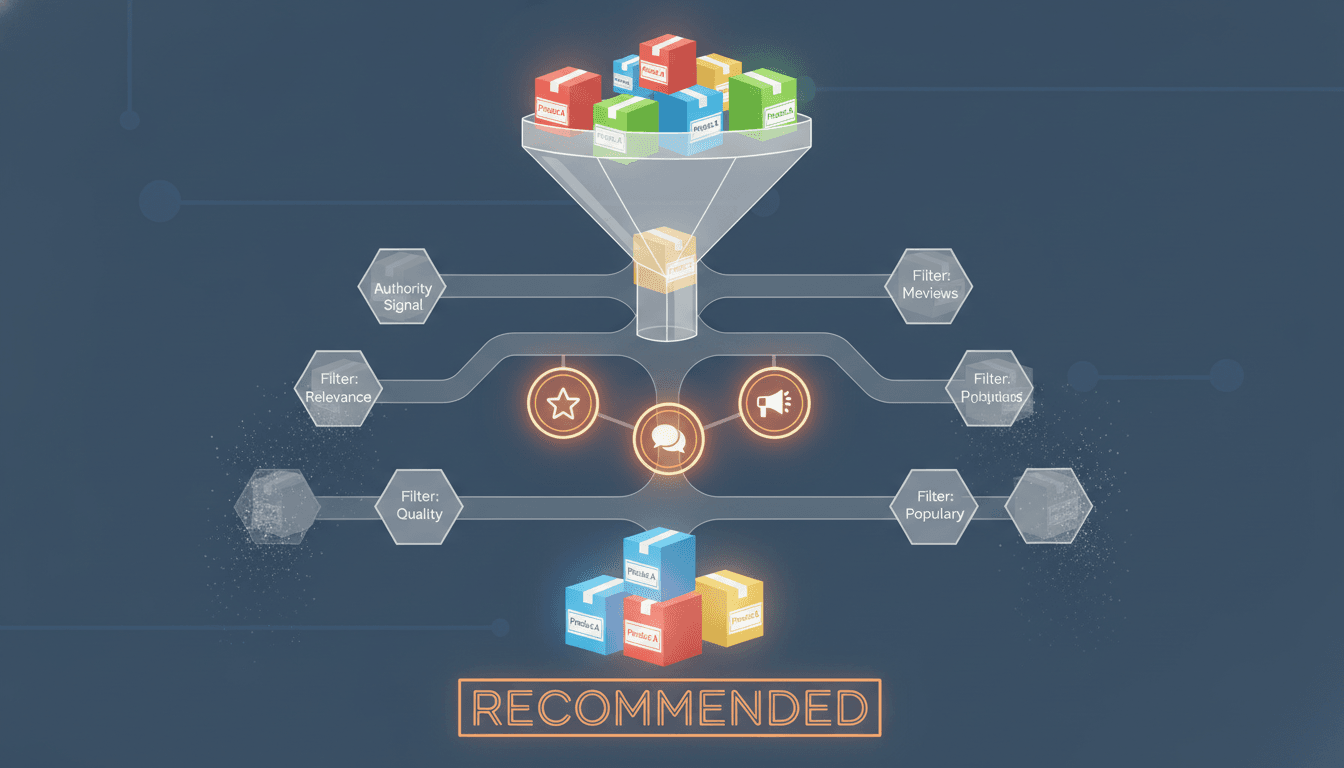
AI recommendation engines evaluate brands through three distinct inputs that function together as a complete decision-making framework. Each input serves a different purpose, but all three must be optimized simultaneously for maximum recommendation frequency.

**Training Data Presence:** How frequently and positively a brand appears in the data the model was trained on

**Knowledge Graph Clarity:** Whether AI systems can unambiguously identify a brand as a real, legitimate entity

**Retrieval Signals:** For RAG-based systems, whether current, authoritative sources actively cite the brand

According to the [BrightEdge AI Search Readiness Report](https://www.brightedge.com), nearly 46% of mid-market brands lack any structured knowledge graph presence. That means nearly half of all mid-market e-commerce brands are effectively unrecognizable to AI entity resolution systems before the recommendation process even begins.

All three inputs must be optimized simultaneously. Optimizing one without the others produces suboptimal results and wastes resources that could have been deployed more strategically.


---


## Input #1: Training Data Presence—Building Authority in Historical Context

AI models are trained on snapshots of internet data from specific time periods. The frequency and sentiment of brand mentions within that training data directly influence how often and how confidently those brands get recommended. This is the primary mechanism by which AI systems develop brand preferences before any live query is processed.

High-authority sources are disproportionately represented in training corpora. In Hexagon's analysis of AI-generated product recommendation responses, **71% of ChatGPT-4o product recommendations included brands from Wirecutter, Consumer Reports, or major newspapers**—despite these editorial sources representing a tiny fraction of total internet content. The implication is unambiguous: editorial authority carries outsized weight in AI training data.

Google's [E-E-A-T framework](https://developers.google.com/search/docs/fundamentals/creating-helpful-content)—Experience, Expertise, Authoritativeness, Trustworthiness—functions as a de facto proxy authority indicator for AI systems trained on Google-indexed content. Brands with demonstrable expertise signals, founder credentials, third-party certifications, and expert reviews are trained into AI systems as trustworthy entities. Content quality matters infinitely more than content quantity in AI training data.

According to Lily Ray, VP of SEO Strategy & Research at Amsive: "We're seeing a fundamental shift in how brand authority gets constructed. In traditional search, brands could engineer their way to the top with enough links and content. With generative AI, the system is synthesizing a reputation from hundreds of signals simultaneously—and brands that have spent years building genuine credibility across publications, communities, and expert sources have a massive structural advantage."


---


## Input #2: Knowledge Graph Clarity—Making Brands Unambiguously Real to AI

Knowledge graphs are structured databases of entities and their relationships. AI systems use them to confirm brand legitimacy, resolve entity references, and determine whether a brand is a real, identifiable commercial entity worth recommending. Without this structured presence, AI systems face fundamental uncertainty about whether a brand actually exists.

The gap is significant. According to [BrightEdge's AI Search Readiness Report](https://www.brightedge.com), **46% of mid-market brands have no structured knowledge graph presence**—no Wikipedia page, incomplete Wikidata entries, and inconsistent entity data across the web. AI systems cannot confidently recommend brands they cannot unambiguously identify.

Brand entity disambiguation—the process by which AI systems determine that "Nike," "Nike Inc.," and "Nike shoes" all refer to the same commercial entity—relies heavily on consistent NAP (Name, Address, Phone) data, Wikipedia presence, Wikidata entries, and Knowledge Graph signals, as documented in [Google's Knowledge Graph Developer Documentation](https://developers.google.com/knowledge-graph). These elements function as trust anchors in AI recommendation logic.

In Hexagon's analysis of 20,000+ AI-generated recommendations, brands with a verified Wikipedia page or Wikidata entity were recommended approximately **3x more frequently** than comparable brands without one. Knowledge graph presence is non-negotiable for AI visibility.

[IMG: Visual representation of a knowledge graph showing a brand entity at the center with connected nodes for Wikipedia, Wikidata, consistent NAP data, founder profiles, and product categories, illustrating how entity relationships build AI recognition]


---


## Input #3: Retrieval Signals—Why Fresh Citations Matter More Than Ever

Retrieval-Augmented Generation (RAG) systems don't rely solely on historical training data. They actively retrieve current sources to ground their recommendations in real-time evidence. For brands targeting platforms like Perplexity and Bing Copilot, the freshness and authority of current citations is as important as historical training data presence.

Ethan Mollick, Associate Professor at the Wharton School and author of *Co-Intelligence*, explains: "Retrieval-augmented generation changes the game for real-time AI search. The question isn't just 'what did the model learn during training?'—it's 'what can the model find and verify right now?' Brands need to think about their content as evidence that gets retrieved and cited, not just as marketing that gets consumed."

Citation quality dramatically outweighs citation quantity in retrieval signal strength. Hexagon's analysis of over 20,000 AI-generated product recommendation responses found that **brands cited in 5 or more high-authority third-party sources received recommendations 3.1x more frequently** than brands with equivalent product quality but fewer authoritative citations. A single Wirecutter placement creates more AI recommendation authority than hundreds of syndicated mentions on low-authority blogs.

This means continuous fresh content and PR activity is required to capture recommendations across all AI platforms—particularly those with RAG architecture where content published or updated within the past 6–12 months is weighted most heavily.


---


## Citation Quality vs. Quantity: Why One Wirecutter Review Beats 100 Blog Mentions

Volume-based PR strategies are not just ineffective for AI visibility—they may actively dilute authority signals by creating noise without substance. AI systems recognize and weight authority hierarchies in their source material. Low-authority syndicated content registers as background noise; high-authority editorial placements register as credibility anchors.

The data is unambiguous: **71% of AI recommendations included brands from major editorial publications**, despite those publications representing a small fraction of total internet content. According to Marie Haynes, CEO of Marie Haynes Consulting and Google algorithm expert: "The dirty secret of AI recommendations is that these models have strong priors toward brands they've seen discussed in authoritative contexts many times. Consistent, multi-source editorial coverage is what builds the kind of durable authority that shows up in recommendations month after month."

Unlike Google's PageRank, which treats all inbound links as potential authority signals, AI systems weight citation quality over quantity. A single mention in a New York Times product review or a Wirecutter "best of" list carries more recommendation weight than dozens of mentions on low-authority blogs or press release syndication sites, according to [MIT Technology Review](https://www.technologyreview.com). Citation breadth across high-authority sources is the single strongest predictor of AI recommendation frequency.


---


## Community and User-Generated Content: The Hidden Authority Lever

Editorial placements build the foundation, but community presence reinforces it. Reddit, Trustpilot, Amazon Reviews, and niche forums are overrepresented in AI training data and retrieval corpora because they generate high volumes of authentic, user-generated content that AI systems treat as social proof signals. This is not a secondary consideration—it is a core AI visibility strategy.

According to [Wired's reporting on AI training data](https://www.wired.com), consumer review platforms are disproportionately represented in AI training corpora because of their volume and authenticity. Positive community presence directly impacts AI recommendation frequency. Brands must actively cultivate positive sentiment across these platforms, not just monitor them passively.

AI recommendation systems are sensitive to sentiment consistency. Brands with predominantly positive sentiment across multiple independent sources receive more confident, unprompted recommendations. Brands with mixed or polarized sentiment are either omitted or recommended with qualifying caveats that reduce consumer conversion, according to Hexagon's recommendation pattern analysis.


---


## The Temporal Dimension: Static LLMs vs. RAG-Enabled AI Platforms

Not all AI platforms process brand information the same way. The temporal architecture of the platform determines which optimization strategies apply. Understanding this distinction is essential for building a recommendation strategy that works across the full AI discovery landscape.

**Static LLMs** (ChatGPT base model) reflect historical training data from specific cutoff dates. Authority built over time through consistent editorial coverage and knowledge graph presence carries the most impact.

**RAG-enabled systems** (Perplexity, Bing Copilot) actively retrieve and cite current sources. Content published or updated within the past 6–12 months carries disproportionate weight.

**Hybrid platforms** combine both approaches, requiring brands to maintain both historical authority and continuous fresh content output simultaneously.

[Perplexity AI's product documentation](https://www.perplexity.ai) confirms it operates a real-time RAG model, meaning it actively crawls and cites live web sources. [Microsoft's Bing Webmaster Guidelines](https://www.bing.com/webmasters) similarly indicate recency bias in Copilot's retrieval logic. A comprehensive AI visibility strategy requires optimization across both temporal dimensions.

[IMG: Timeline graphic showing two parallel tracks: a "historical authority building" track (training data, knowledge graph, long-form editorial coverage) and a "real-time signal track" (fresh PR, updated content, community activity), converging into AI recommendation output across ChatGPT, Perplexity, and Bing Copilot]


---


## Structured Data and Technical Clarity: The Acceleration Layer

Structured data markup functions as an accelerant for AI recommendation eligibility. When brands implement Schema.org markup correctly, they reduce the ambiguity that AI entity resolution systems must overcome before making a confident recommendation. This is a foundational requirement, not an optional optimization.

[Schema.org Product, Review, and Organization schemas](https://schema.org) significantly improve the likelihood that AI crawlers and RAG systems correctly attribute and cite a brand's products. Consistent NAP data (Name, Address, Phone) across the web improves entity recognition and AI confidence in brand legitimacy. Technical clarity removes friction from the AI recommendation pipeline at every stage.

Implement these foundational elements:

- Schema.org Organization, Product, and Review markup across all relevant pages
- Consistent NAP data across Google Business Profile, directories, and owned properties
- Uniform brand naming conventions across all digital touchpoints
- Clear entity relationships between brand, products, founders, and authoritative sources

Brands implementing structured data are easier for AI systems to correctly attribute and recommend, as documented in [Google's Structured Data Guidelines](https://developers.google.com/search/docs/appearance/structured-data/intro-structured-data). Technical SEO hygiene is now an AI visibility lever with direct impact on recommendation eligibility.


---


## Putting It Together: A Complete AI Recommendation Authority Framework

The three core inputs—training data presence, knowledge graph clarity, and retrieval signals—function as an integrated system. Optimizing one input without the others yields suboptimal results. Brands must simultaneously build historical authority and maintain fresh visibility to capture recommendations across all AI platforms.

Here's how the complete framework operates in practice:

**Training data presence** is built through consistent earned media in high-authority publications, E-E-A-T signal development, and long-term credibility building across editorial sources.

**Knowledge graph clarity** is established through Wikipedia page creation, Wikidata entry completion, and consistent entity data management across the web.

**Retrieval signals** are maintained through continuous PR activity, fresh content production, and active community presence across Reddit, Trustpilot, and niche forums.

**Structured data** accelerates all three inputs by reducing entity resolution ambiguity for AI systems.

The brands winning in AI recommendations are those optimizing all three inputs systematically, with cross-functional coordination between PR, content, product, and technical teams. This is a complete reframing of brand visibility strategy—not an extension of traditional SEO. The competitive window for first-mover advantage is real and narrowing.


---


## Common Mistakes Brands Make (And How to Avoid Them)

Most brands approaching AI visibility for the first time make predictable, costly mistakes. Recognizing these patterns early prevents wasted resources and missed opportunities.

**Mistake #1: Ignoring knowledge graph presence while focusing on content.**

Nearly half of mid-market brands lack any structured knowledge graph presence, making them unrecognizable to AI entity resolution systems before the recommendation process even begins. Content investment without knowledge graph foundation is building on sand. Wikipedia pages and Wikidata entries should be priority projects, not afterthoughts.

**Mistake #2: Pursuing volume-based PR instead of quality editorial placements.**

Quantity-based PR strategies are ineffective for AI visibility. A hundred syndicated press releases carry less AI recommendation weight than a single Wirecutter or Consumer Reports placement. Prioritizing placement quality over volume is non-negotiable. PR strategy should be measured in high-authority placements, not total mentions.

**Mistake #3: Neglecting community sentiment and user-generated content.**

Community sentiment is a direct AI recommendation signal. Brands that focus exclusively on editorial coverage while ignoring Reddit discussions, Trustpilot reviews, and Amazon feedback are missing a high-weight input that AI systems actively retrieve and evaluate. Active community management is now a visibility requirement.

**Mistake #4: Treating static LLM and RAG optimization as the same strategy.**

Different platforms require different temporal optimization strategies. A strategy built only for ChatGPT's training data will underperform on Perplexity, and vice versa. Both historical authority and real-time freshness signals must be maintained simultaneously.

**Mistake #5: Implementing structured data without ensuring data consistency.**

Technical implementation matters as much as content strategy. Schema.org markup that conflicts with inconsistent NAP data or mismatched entity names across the web creates confusion rather than clarity for AI entity resolution systems. Data consistency must be audited before implementing structured data.


---


## Brand AI Recommendation Visibility Action Plan

A systematic, measurable approach to AI visibility begins with an honest audit of current position. Here's how to structure the process:

**Week 1–2: Foundation Audit**

Audit knowledge graph presence. Does the brand have a Wikipedia page? A complete Wikidata entry? Consistent NAP data across all directories? Assess current AI recommendation visibility by querying ChatGPT, Perplexity, Claude, and Gemini with relevant product category prompts.

Identify entity data inconsistencies across owned and third-party properties. Document which AI platforms currently recommend the brand and which do not. Establish baseline metrics for tracking progress over time.

**Week 3–4: Gap Analysis and Prioritization**

Identify high-authority publication targets for earned media based on competitor citation analysis. Assess community sentiment across Reddit, Trustpilot, Amazon, and niche forums relevant to the product category. Audit Schema.org markup implementation and identify technical gaps.

Prioritize quick wins—knowledge graph completion typically yields the fastest visibility improvements. Map out a 12-month editorial placement roadmap targeting high-authority sources. Establish community management protocols for key platforms.

**Month 2 and Beyond: Execution**

Build a sustainable PR and content strategy that spans both static LLM and RAG platforms. Pursue knowledge graph completion as an immediate priority—this is one of the highest-leverage actions available. Establish a continuous community management process to cultivate positive sentiment across key platforms.

Looking ahead, cross-functional coordination between PR, content, product, and technical teams is required for sustained success. Long-term authority building and short-term freshness signals must be pursued simultaneously, not sequentially.


---


## Conclusion: AI Recommendations Are the New Search—and the Rules Are Different

The way people discover products has changed. AI recommendation engines are reshaping e-commerce discovery at a pace that most brands have not yet internalized. With 27% of consumers saying AI recommendations influenced their most recent purchase and 180+ million monthly ChatGPT users generating shopping queries, AI recommendation reach now rivals traditional advertising channels for brand discovery.

The $1.2 trillion in AI-influenced transactions projected by 2027 represents a wholesale redistribution of market share—and the brands capturing that share are those that understand how AI systems actually make decisions. Traditional SEO strategies are insufficient for AI visibility. The three core inputs—training data presence, knowledge graph clarity, and retrieval signals—represent a complete reframing of brand authority.

The good news is that the framework is clear, the quick wins are real, and the long-term strategy is buildable for any brand willing to commit to it. This is not a future trend to monitor—it is happening now, in every product category, across every AI platform customers are already using. The brands that act on this understanding today will capture disproportionate recommendation share tomorrow.
H
Hexagon Team
Published June 6, 2026