searchbrandscontent
GEO vs SEO: Why E-Commerce Brands Need Both (And How to Balance Your Optimization Budget)
Most marketing directors are asking the wrong question. The real competitive advantage in 2025 isn't choosing between Generative Engine Optimization and traditional SEO—it's knowing exactly how to fund both, in the right sequence, for maximum cross-channel return.
15 min readRecently updated
# GEO vs SEO: Why E-Commerce Brands Need Both (And How to Balance Your Optimization Budget)

*Most marketing directors are asking the wrong question. The real competitive advantage in 2025 isn't choosing between Generative Engine Optimization and traditional SEO—it's knowing exactly how to fund both, in the right sequence, for maximum cross-channel return.*

[IMG: Split-screen visualization showing a traditional Google SERP on the left and an AI assistant product recommendation interface on the right, with a shared content foundation illustrated below both]


---


## The False Choice: Why 'GEO vs SEO' Is the Wrong Question

Marketing leaders often frame the decision as binary: shift budget from SEO to GEO, or maintain the status quo. The wrong answer costs brands either way—but so does treating them as competitors.

The current landscape has shifted dramatically. In 2024, [58.5% of Google searches ended without a click](https://sparktoro.com/blog/how-much-of-googles-search-traffic-is-left-for-anyone-but-google/), meaning AI Overviews now occupy the real estate where organic listings used to live. Simultaneously, [Perplexity grew from 10 million to 100 million monthly queries](https://techcrunch.com/2024/12/perplexity-growth) in a single year, creating a parallel discovery channel that brands can no longer ignore.

Here's how most brands misunderstand the situation: GEO and SEO aren't competing strategies—they're complementary systems powered by the same content foundation. The "versus" framing creates artificial scarcity and leads to chronic underinvestment in both channels simultaneously.

The two disciplines serve distinct moments in the buyer journey. GEO captures conversational, research-phase queries ("What's the best running shoe for flat feet?"), while SEO dominates transactional, high-intent searches ("Buy Nike Pegasus size 10"). Brands that optimize for both see measurable cross-channel lift—early tracking data shows that brands mentioned in AI-generated answers experienced a [27% average increase in branded search volume within 90 days](https://www.semrush.com/state-of-search-2024/).

As [Rand Fishkin, Co-Founder & CEO of SparkToro](https://sparktoro.com/), observes: "The brands that will win in the next five years are the ones that understand search is no longer a single channel. It's a spectrum—from traditional blue links to AI-generated answers—and a presence across that entire spectrum is essential."

The smartest allocation strategy starts with shared assets—structured data, E-E-A-T signals, topical authority, and content quality—before directing incremental budget toward channel-specific tactics. Companies investing in structured data and entity-based SEO report a [2.3x higher likelihood of appearing in Google AI Overviews](https://www.brightedge.com/research/ai-search-visibility-2024), confirming that the same infrastructure investment powers both channels simultaneously.


---


## Where SEO Still Wins: High-Volume Transactional Queries and Local Discovery

Traditional SEO remains the dominant force for revenue-generating traffic, and abandoning it prematurely represents one of the most expensive mistakes an e-commerce brand can make. [Google holds roughly 91% of global search engine market share as of early 2025](https://gs.statcounter.com/), and transactional search volume remains heavily concentrated in the traditional Google SERP—not AI assistants.

When consumers have already decided what they want and are ready to purchase, they go to Google, not ChatGPT. Product page indexation, price comparison queries, and "buy [product]" intent searches are still resolved primarily through organic rankings and Google Shopping. This is where SEO owns the bottom of the funnel—the highest-conversion moment in the customer journey.

High-volume, lower-consideration categories—apparel, electronics, and home goods—continue to derive the majority of their discovery traffic through traditional organic search. Local search queries ("near me," store locator, local inventory) show minimal displacement from AI assistants, making local SEO a near-pure-play investment with strong, defensible ROI. For e-commerce brands deriving more than 60% of revenue from organic traffic, SEO investment directly protects the top line and shouldn't be reduced to fund experimental channels.


---


## Where GEO Wins: Conversational Queries, Comparisons, and Research-Phase Discovery

[Generative Engine Optimization](https://searchengineland.com/geo-generative-engine-optimization) is purpose-built for a fundamentally different kind of query—one that's increasingly common and increasingly valuable. Conversational, multi-constraint product queries like "best running shoes for flat feet under $150" or "what's the difference between Product A and Product B" are disproportionately asked to AI assistants rather than typed into a traditional search bar.

Gift and occasion-based discovery ("sustainable home goods for eco-conscious shoppers") flows heavily through AI channels, where users expect curated, context-aware recommendations. Research and comparison queries are AI-native by design, as users explicitly ask AI assistants to evaluate tradeoffs, explain feature differences, and recommend based on specific personal constraints.

[Sridhar Ramaswamy, CEO of Neeva and former SVP of Ads at Google](https://neeva.com/), has observed: "A bifurcation in search behavior is occurring. High-consideration purchase decisions—where consumers want nuanced comparisons and recommendations—are migrating to AI assistants faster than anticipated." Brands that aren't optimizing for AI citation in those moments are effectively invisible during the most critical stage of the buyer journey.

The data supports that urgency. [E-commerce sites with comprehensive product FAQ content and review schema are cited 3.1x more frequently in AI product recommendations](https://ahrefs.com/blog/ai-search-visibility/) than sites without it. GEO captures users earlier in the consideration funnel—before they've narrowed to a specific product search—making it the primary lever for top-of-funnel brand visibility in high-consideration categories.


---


## The Shared Foundation: Investments That Power Both SEO and GEO

Before allocating a single dollar to channel-specific tactics, e-commerce brands should maximize investments in shared assets that serve both channels with equal force.

**Structured data** is the single highest-leverage investment available. Schema.org markup for products, reviews, FAQs, and how-to content simultaneously improves Google rich results, AI Overview inclusion, and third-party AI citation rates. The [2.3x citation lift from structured data investment](https://www.brightedge.com/research/ai-search-visibility-2024) applies across both traditional and AI search surfaces—making this a rare investment that compounds across channels.

**E-E-A-T signals**—Experience, Expertise, Authoritativeness, and Trustworthiness—function as ranking criteria for both Google's algorithm and AI assistant citation logic. High-quality product content (descriptions, FAQs, reviews) drives both organic ranking and AI recommendation inclusion, meaning investment in content quality is never siloed.

As [Lily Ray, VP of SEO Strategy & Research at Amsive Digital](https://amsive.com/), explains: "The fundamentals—expertise, trustworthiness, clear information architecture—matter more than ever in both channels." Every dollar spent on structured data, content quality, and topical authority serves two channels simultaneously.

This represents the highest-efficiency investment in a hybrid strategy, and it should be fully funded before any channel-specific budget is allocated. The [Princeton University GEO research](https://arxiv.org/abs/2311.09735) confirms that authoritative content, high domain authority, and strong backlink profiles all improve performance in both traditional search rankings and AI citation likelihood.

[IMG: Diagram showing the shared content foundation (structured data, E-E-A-T, topical authority, content quality) branching upward into SEO outcomes on the left and GEO outcomes on the right]


---


## Budget Allocation Framework: How to Split Your Optimization Spend

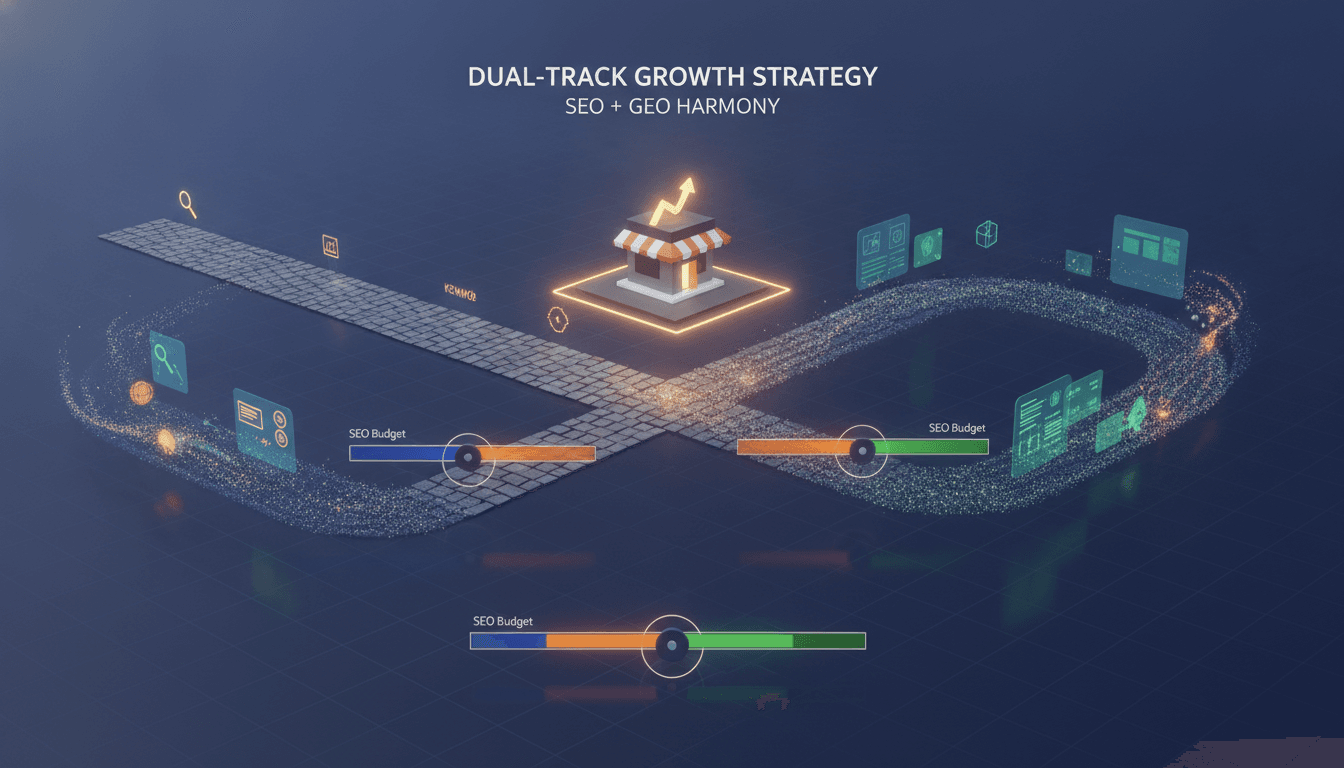
There is no universal split that works for every e-commerce brand. The right allocation depends on three variables: category AI disruption rate, brand maturity, and organic revenue dependency.

**Variable 1 – Category AI Disruption Rate:** High-consideration categories like beauty, home goods, and gifts trend toward a 50/50 split because the research phase is heavily AI-mediated. Transactional categories like apparel and electronics trend toward 70/30 (SEO-heavy) because purchase intent still resolves through traditional search.

**Variable 2 – Brand Maturity:** Established brands with strong organic traffic should start at 70/30 and shift toward 60/40 over 12 months as GEO infrastructure matures. Newer brands with less organic dependency can start at 60/40 and accelerate GEO investment earlier.

**Variable 3 – Organic Revenue Dependency:** Brands deriving more than 60% of traffic from organic search should protect that channel first (70/30). Brands with diversified traffic sources can accelerate GEO to 50/50 with lower revenue risk.

For a practical phased model, here's how brands should structure their approach:

- **Phase 1 (Months 1–3):** 80/20 — Foundation-building; structured data and content audit
- **Phase 2 (Months 3–6):** 70/30 — Scaling; authority content and GEO-specific assets
- **Phase 3 (Months 6–12):** 60/40 or 50/50 — Optimization; full hybrid execution

**Budget floor:** A minimum of **$15,000–$25,000 per month combined** is required for meaningful GEO and SEO impact at mid-market scale. A [hybrid SEO+GEO strategy typically requires incremental budget of 15–25% above a baseline SEO investment](https://www.forrester.com/research/search-marketing-benchmarks/), because GEO tactics build on existing SEO infrastructure rather than replacing it.

With [global spending on AI-related marketing technology projected to reach $107.5 billion by 2028](https://www.idc.com/getdoc.jsp?containerId=US51315523), brands that establish their GEO infrastructure now will hold a compounding advantage over late movers.


---


## Implementation Roadmap: A 12-Month Plan to Build GEO While Protecting SEO

A phased implementation prevents budget waste and allows for course correction based on early performance data. Here's how to structure the year for maximum impact.

**Phase 1 (Months 1–3) – Foundation & Audit**

Brands should conduct a GEO-readiness content audit, complete schema markup across product and category pages, and take inventory of existing E-E-A-T signals. Structured data implementation takes 4–8 weeks for mid-market e-commerce sites—starting immediately is critical. Parallel SEO work (keyword optimization, link building, technical SEO) continues without interruption throughout all phases.

By the end of month 3, baseline data should be established on which competitors appear in AI recommendations and which high-value queries the brand is absent from. This competitive intelligence is invaluable for prioritizing content investments.

**Phase 2 (Months 3–6) – Authority Content**

Looking ahead, this phase focuses on creating comparison content, comprehensive FAQs, buyer's guides, and review-rich product pages. Building entity relationships and optimizing for topical clusters should occur in parallel. Content creation is the longest phase—allowing 8–12 weeks for high-quality output that will serve both channels is essential.

The target milestone: by month 6, the brand should appear in AI recommendations for 20 or more high-value product categories. This represents meaningful progress toward hybrid visibility.

**Phase 3 (Months 6–12) – Monitoring & Optimization**

Brands should deploy AI citation tracking tools (Semrush, Moz, and emerging GEO-specific platforms), monitor Perplexity, ChatGPT, and Claude mentions, and analyze AI recommendation patterns by category. Target 50+ tracked product categories with measurable citation data by month 12.

Early adopters who establish citation monitoring infrastructure now gain a durable competitive advantage as the tooling matures. This data foundation becomes increasingly valuable over time.


---


## Measurement and Attribution: Tracking GEO Wins Alongside SEO KPIs

GEO metrics are fundamentally different from SEO metrics, and conflating them leads to poor investment decisions. The goal is not to track clicks from AI assistants—it's to track citations, share of voice in AI outputs, and downstream branded search lift.

Four tracking approaches form the core of any GEO measurement framework:

- **AI citation monitoring:** Use Semrush, Moz, and emerging GEO-specific tools to track brand mentions in AI-generated responses across platforms
- **Branded search lift:** Monitor branded search volume uplift in Google Search Console following AI citation increases—the [27% average lift within 90 days](https://www.semrush.com/state-of-search-2024/) provides a reliable benchmark
- **Referral traffic from AI platforms:** Tag Perplexity and ChatGPT referral traffic with UTM parameters; [Perplexity cites sources with links in the majority of its responses](https://www.perplexity.ai/), making this a measurable, attributable channel
- **Manual competitive monitoring:** Regularly query AI assistants for top product category terms and document competitive citation patterns

For stakeholder communication, [Amanda Natividad, VP of Marketing at SparkToro](https://sparktoro.com/), frames the ROI case effectively: "AI-cited brands earn trust signals that paid search can't buy. When ChatGPT recommends a product, it carries the implicit endorsement of the model itself." That's a new kind of social proof that converts at rates unseen since word-of-mouth referrals.

A unified reporting dashboard should show SEO KPIs (organic traffic, rankings, CTR) alongside GEO KPIs (citation count, AI share of voice, branded search lift) to prevent siloed thinking and justify hybrid budget allocation to CFO and board stakeholders.


---


## Practical Examples: GEO vs SEO Strategy by E-Commerce Category

[IMG: Category matrix graphic showing five e-commerce verticals with their recommended GEO/SEO budget splits and primary optimization focus areas]

Different categories face different levels of AI disruption, and budget allocation should reflect that reality.

**Beauty & Skincare (High AI Disruption) — 50/50 split**

The beauty category shows the highest AI adoption rate for product discovery. GEO focus targets ingredient comparisons, skin-type recommendations, and routine FAQs. SEO focus protects product pages and local availability queries.

**Apparel & Fashion (Low-Medium AI Disruption) — 70/30 split**

Apparel still shows 65%+ traditional search dependency, making SEO the dominant investment. GEO focus covers style guides, occasion-based recommendations, and size/fit FAQs. For example, fit-related queries benefit from both detailed product descriptions and AI-mediated styling advice.

**Home Goods & Furniture (High AI Disruption) — 55/45 split**

Home goods and furniture categories are seeing rapid AI-mediated discovery shift. GEO targets room design queries, space-saving solutions, and comparative content. SEO protects product discovery and local delivery queries.

**Electronics (Medium AI Disruption) — 65/35 split**

Tech specs and feature comparisons drive AI research behavior. GEO focuses on use-case recommendations and feature comparisons; SEO dominates price and availability queries. Here's how this plays out: a consumer researching laptop specs might use AI first, then move to traditional search for pricing.

**Luxury & High-Consideration (Very High AI Disruption) — 45/55 split**

AI assistants heavily influence the research phase for high-ticket purchases. GEO focuses on brand positioning, comparative luxury messaging, and exclusivity narratives. SEO continues to dominate final purchase intent queries.


---


## Common Pitfalls: What Not to Do When Balancing GEO and SEO

Knowing what to avoid is as valuable as knowing what to build. The most common mistakes brands make when attempting a hybrid strategy include:

**Choosing one channel instead of both.** Neglecting either channel leaves revenue on the table. Brands that neglect SEO while chasing GEO see measurable organic traffic decline within months.

**Allocating to GEO without fixing SEO fundamentals.** Structured data, topical authority, and E-E-A-T must be solid before GEO-specific investment delivers returns. This is a sequencing issue, not a budget issue.

**Creating separate content strategies for GEO and SEO.** Unified content serves both channels; siloed strategies waste budget on duplicative work and miss the compounding benefits of shared assets.

**Treating GEO as brand awareness only.** This framing underestimates the 27% downstream branded search lift and measurable referral traffic from AI platforms like Perplexity. GEO drives measurable revenue.

**Ignoring AI citation tracking from day one.** Brands that implement monitoring early establish competitive benchmarks that late movers can never fully reconstruct. Looking ahead, this data becomes increasingly valuable as AI search matures.

**Pausing SEO to fund GEO experiments.** GEO should be additive, not cannibalistic. Pausing SEO creates direct revenue risk and wastes the compounding benefits of years of SEO investment.

**Over-investing in channel-specific tactics before the shared foundation is complete.** Brands that invest in structured data and content quality first see [2.3x better GEO outcomes](https://www.brightedge.com/research/ai-search-visibility-2024) than those who skip the foundation.


---


## Getting Started: Your First 30 Days of GEO + SEO Optimization

A 30-day sprint can establish the foundation for a full-year hybrid strategy. Here's how to structure each week for maximum early impact.

**Week 1 – Baseline Audit**

Brands should audit current organic performance (traffic sources, keyword rankings, revenue attribution) and establish baseline GEO visibility by manually querying AI assistants for the top 20 product categories. Document which competitors appear in AI recommendations and which queries the brand is absent from.

This competitive intelligence is invaluable for prioritizing content investments. By week's end, a clear picture of GEO gaps should emerge.

**Week 2 – Structured Data Audit**

Complete a schema markup audit across all product pages, category pages, and FAQ sections. Schema implementation is the fastest ROI lever available—it can improve AI citation likelihood by 2.3x and delivers improvements across both channels simultaneously. Identify and prioritize gaps by page type and revenue contribution.

**Week 3 – Content Gap Analysis**

Content audits typically reveal that 30–50% of high-value conversational and comparison queries are completely unaddressed by existing site content. Map identified gaps to existing content for optimization or flag for new content creation, prioritizing queries with the highest research-phase volume and commercial intent.

**Week 4 – Quick Wins & Monitoring Setup**

Brands should add FAQ schema to product pages, enhance product descriptions with factual specificity, and publish 3–5 comparison or buyer's guide pieces. Deploy AI citation monitoring tools to establish baseline tracking. By day 30, structured data should be 80%+ complete and baseline AI citation data should be established for the top 20 product categories.


---


## Conclusion: The Brands That Win Are Already Building Both

The question was never GEO vs SEO. It was always about building a search presence that performs across the full spectrum—from transactional blue links to AI-generated recommendations—without wasting budget on redundant or siloed investments.

[Gartner predicts that by 2026, traditional search engine volume will decline by 25%](https://www.gartner.com/en/documents/4227991) as AI-powered interfaces absorb informational and navigational queries, with transactional queries following as AI shopping integrations mature. That timeline is not a reason to panic—it's a planning horizon.

The brands positioned to win are the ones investing in shared foundations now: structured data, E-E-A-T authority, topical depth, and content quality that serves every search surface simultaneously. The allocation framework provided above gives marketing directors a defensible, phased model for building GEO capability without sacrificing the SEO revenue base that funds the business today.

[ChatGPT surpassed 300 million weekly active users by late 2024](https://openai.com/blog/), and a significant and growing share of those users are asking product recommendation questions—questions that will either surface a brand or a competitor's. The time to build is now, not when organic traffic has already declined by 25%.

**Ready to build a unified GEO + SEO strategy?** The allocation framework above is proven, but every brand's situation is unique—category, maturity, and traffic dependency all shift the math. Brands seeking to audit their current organic performance and map a 12-month roadmap tailored to their business should consider consulting with search strategy experts. Here's how to take the next step: identify the highest-ROI optimization priorities and determine exactly where to allocate budget for maximum cross-channel impact.
H
Hexagon Team
Published October 17, 2026