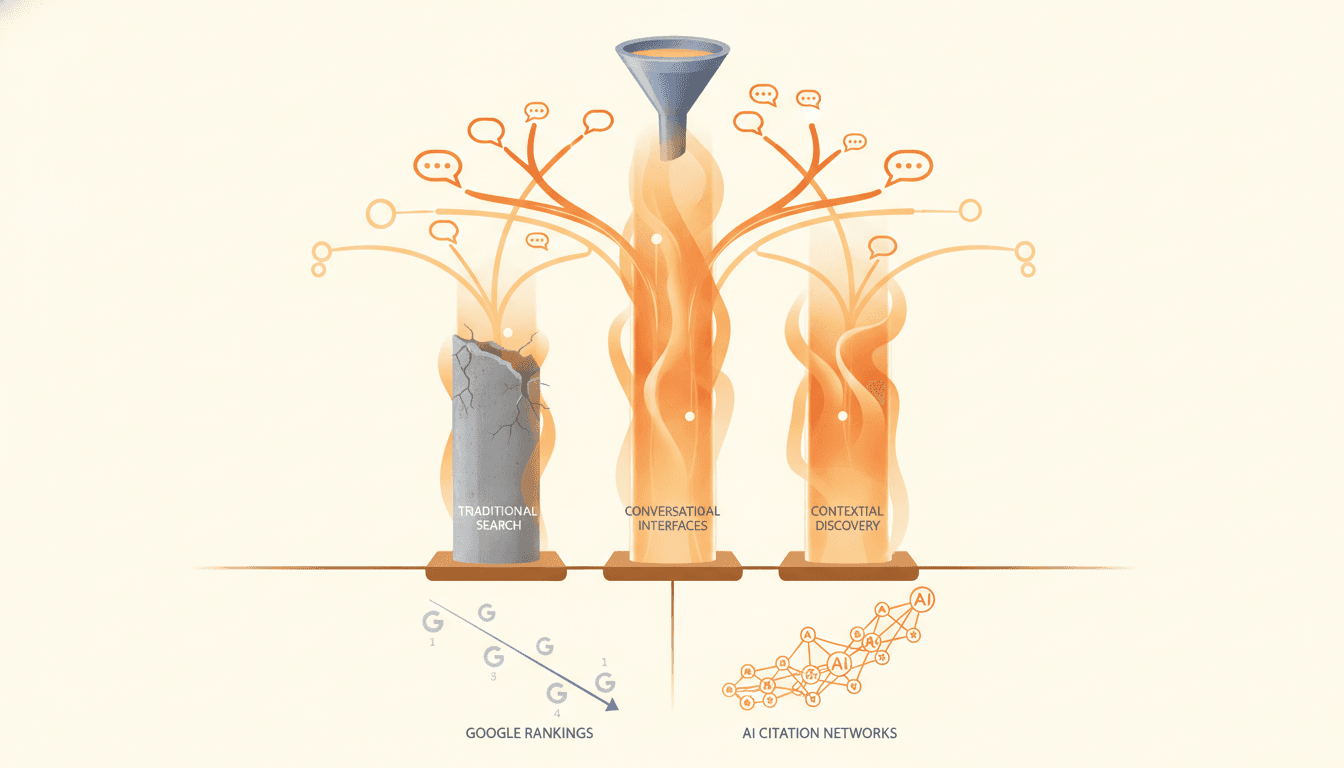
searchgooglebrands
Beyond SEO: How AI Search Engines Fundamentally Differ from Google—And Why Your Current Strategy Won't Work
You're ranking on page one. Traffic is solid. Conversions are holding. But when someone asks ChatGPT to recommend a product in your category, your brand doesn't appear. This guide explains why—and what e-commerce marketers must do to survive the AI search transition.
15 min read
# Beyond SEO: How AI Search Engines Fundamentally Differ from Google—And Why Current Strategies Won't Work

*E-commerce brands ranking on page one of Google face an invisible threat. When consumers ask ChatGPT to recommend products in their category, these top-ranked brands often don't appear. This guide explains why—and what e-commerce marketers must do to survive the AI search transition.*

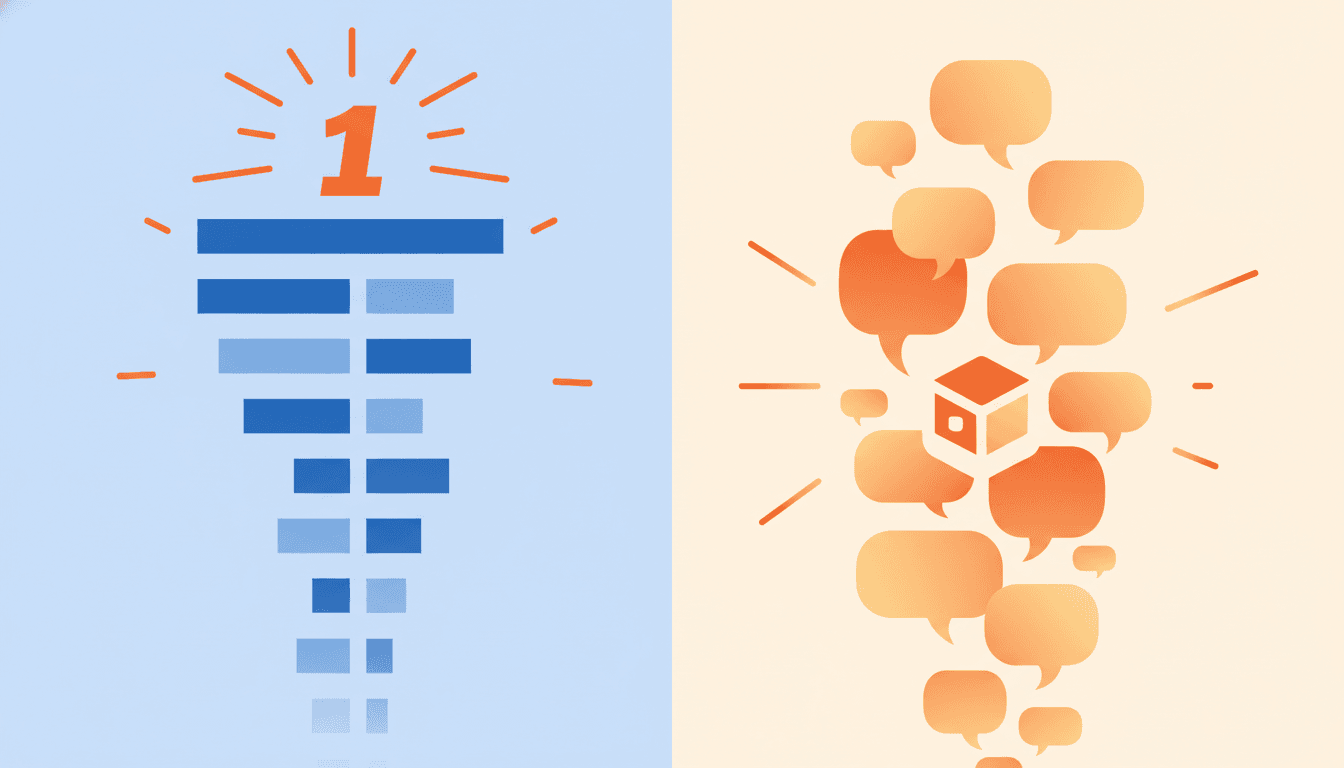
[IMG: Split-screen visual showing a traditional Google SERP with 10 blue links on the left versus an AI chat interface showing 3-5 synthesized brand recommendations on the right, with a clear visual contrast between the two paradigms]

## The Invisible Threat: When Google Rankings Mean Nothing

Brands have spent years perfecting Google SEO strategies, securing page-one rankings and steady traffic. Then they ask ChatGPT to recommend a product in their category.

The brand doesn't appear.

This isn't a ranking glitch. It's a structural problem—a fundamental architectural difference between how Google and AI search engines decide what to recommend. According to [BrightEdge's 2024 research](https://www.brightedge.com), 68% of the brands cited in AI search results don't even rank in Google's top 10 for the same queries. Dominance in one system has zero correlation with visibility in the other.

For e-commerce brands, this decoupling represents an existential threat. A [2024 Search Engine Land survey](https://searchengineland.com) found that 33% of consumers aged 18-34 now use AI assistants as their primary product research tool—up from under 5% in 2022. Google dominance means nothing if brands are invisible to the demographic most likely to drive future revenue.

This guide explains why traditional SEO tactics fail in AI search—and what brands need to do instead.


---


## The Architectural Divide: PageRank vs. Transformer-Based Ranking

Google's PageRank algorithm is fundamentally a link-graph voting system. Backlinks, domain authority, crawlability, and on-page keyword signals determine which pages surface for a given query. [Google's own documentation](https://www.google.com/search/howsearchworks/) describes this as a mechanism that treats each inbound link as a "vote" for a page's authority—a system that has governed search for over two decades.

AI search engines operate on an entirely different architecture. Platforms like ChatGPT, Perplexity, and Claude use transformer-based large language models (LLMs) that evaluate relevance through semantic pattern recognition, not link graphs. As [Vaswani et al.'s foundational research](https://arxiv.org/abs/1706.03762) established, these attention mechanisms measure relationships across billions of training tokens—not live URLs or backlink counts.

The consequence is direct and measurable: **the inputs that drive Google rankings have zero direct influence on AI search recommendations.** Backlinks, keyword density, and technical SEO are invisible to generative engines because they don't train on link structures. They train on text patterns and semantic relationships.

This creates a counterintuitive reality. Traditional SEO tactics—exact-match keywords, thin product pages, link building—are not neutral in AI search. According to [Search Engine Journal's GEO research roundup](https://www.searchenginejournal.com), keyword stuffing and low-information-density content can actively reduce the likelihood of an LLM citing a brand, because models are specifically trained to deprioritize exactly that type of content.

Siddharth Sharma, Lead Researcher on Princeton's GEO study, frames the distinction precisely: "Generative engine optimization isn't just a new name for SEO. The underlying epistemology is different. Google asks 'which page best matches this query?' AI search asks 'what do I know about this topic, and which brands are part of that knowledge?' Brands can't answer the second question with keyword optimization."

The stakes are compounded by compression. AI search collapses 10+ visible results into just 3-5 synthesized recommendations—making the consequences of invisibility far more severe than dropping from page one to page two.


---


## Why Google Rankings Don't Predict AI Search Visibility

The decoupling of Google rankings and AI search citations is not temporary. It is structural, accelerating, and irreversible. A brand can dominate traditional SEO and be completely absent from AI recommendations—and the reverse is equally true.

This happens because Google and AI search engines optimize for fundamentally different user intents. Google prioritizes click-through and engagement signals. AI search prioritizes synthesis and authority. The result is two parallel recommendation systems that share almost no ranking logic.

The zero-click trend is accelerating this divergence. [SparkToro and Datos' 2024 zero-click study](https://sparktoro.com) found that 58.5% of Google searches in 2024 ended without a click—a figure that rises significantly when AI Overviews appear at the top of results. Even brands ranking #1 on Google are watching their traffic intercepted before it reaches their site.

For e-commerce, the competitive math is increasingly unfavorable:

- **33% of consumers aged 18-34** now use AI assistants as their primary product research tool, up from under 5% in 2022
- **58.5% of Google searches** end without a click, reducing the reliability of organic traffic even for top-ranked brands
- **AI-generated responses cite only 4-8 sources** per query versus 10 organic results on a standard Google SERP—making AI search approximately 2-3x more competitive for visibility

Rand Fishkin, Co-founder of SparkToro, articulates the strategic shift clearly: "The fundamental difference between Google and AI search is the unit of competition. In Google, brands compete for a position on a list. In AI search, brands compete to be mentioned at all. That's a categorically different game, and most brands don't realize the rules have changed."

[IMG: Line graph showing the growth of AI assistant usage for product research from 2022 to 2024, overlaid with the declining click-through rate trend from Google search results]


---


## The Competitive Compression Problem: 3-5 Recommendations vs. 10 Results

Google's standard SERP shows 10 organic results. AI search shows 3-5 synthesized recommendations. This compression isn't cosmetic—it fundamentally rewrites the competitive math for every e-commerce category.

Ranking #7 on Google still drives meaningful traffic. Being the 7th most relevant brand in an AI search query means receiving zero mentions. According to [Semrush's AI Search Landscape Report](https://www.semrush.com), AI search is approximately 2-3x more competitive than traditional search precisely because of this citation compression. There is no second page in AI search.

For e-commerce categories with dozens or hundreds of competitors, the difference between inclusion and exclusion in an AI recommendation is binary. Brands either appear in the answer or they don't exist for that query. The middle ground that Google's ranked list provides—where brands on page two still capture some traffic—simply doesn't exist in generative search.

The timing dimension compounds this problem. Unlike Google, which re-crawls and re-indexes pages continuously, most LLM-based AI assistants have a training data cutoff. As [OpenAI's GPT-4 technical documentation](https://openai.com/research/gpt-4) confirms, brand visibility in AI search is partly determined by how well a brand was documented on the web before that cutoff. Brands that build AI-readable authority early create a compounding first-mover advantage that latecomers will struggle to overcome.

The demographic reality makes urgency non-negotiable. Younger, high-value consumer segments are adopting AI search first, and the brands that establish early authority with this cohort will compound that advantage as adoption accelerates across broader demographics.


---


## Entity Authority: The New Ranking Currency in AI Search

GEO success is driven by a concept traditional SEO practitioners rarely prioritize: **entity authority**. This is not about on-page optimization. It's about how a brand is described, categorized, and discussed across third-party sources—and how consistently those descriptions align.

Entity authority is built through editorial mentions, review platforms, Reddit communities, structured data repositories like Wikidata, and industry publications. As [Kalicube's brand entity research](https://kalicube.com) demonstrates, a brand's "entity footprint"—the consistency of its name, product descriptions, and category associations across Wikipedia, Wikidata, Google Knowledge Graph, and major review platforms—is emerging as one of the strongest predictors of AI search visibility.

AI search engines are trained on diverse text sources, and they weight recommendations based on how consistently and authoritatively a brand appears across those sources. A brand with sparse on-site optimization but robust third-party citations will outrank a brand with perfect on-page SEO but minimal external mentions. This is not theoretical—it's a direct consequence of how LLMs are trained.

Jason Barnard, CEO of Kalicube, explains it precisely: "Large language models don't rank pages—they recall entities. If a brand isn't consistently described, categorized, and discussed across the sources these models were trained on, it simply doesn't exist in their world, regardless of domain authority or backlink profile."

[BrightEdge's generative AI search research](https://www.brightedge.com) confirms that AI assistants draw heavily on content from review platforms like Reddit, Trustpilot, and G2, editorial publications, and Wikipedia-style reference pages when forming brand recommendations. These are sources that traditional SEO link-building strategies have systematically underinvested in.

This shifts the optimization focus from "what can I do to my website?" to "what does the broader internet know and say about my brand?"—a fundamentally different strategic orientation that requires new channels, new content formats, and new success metrics.


---


## GEO Optimization Techniques That Actually Work (With Proof)

GEO is not guesswork. Princeton's NLP Group published peer-reviewed research—[Aggarwal et al.'s "GEO: Generative Engine Optimization"](https://arxiv.org/abs/2311.09735)—finding that intentional GEO techniques increased visibility in generative engine responses by up to 40% compared to unoptimized content. That's quantifiable, reproducible improvement.

Here's how those techniques translate into practice:

**Add authoritative citations.** Content that references credible external sources signals information quality to LLMs, increasing the likelihood of citation. When brands cite reputable sources, they're telling AI systems "this information is trustworthy."

**Embed statistics and data points.** Quotation-style statistics give AI systems concrete, citable claims to surface in synthesized answers. A statistic from brand research becomes a building block for AI-generated recommendations.

**Write explanatory prose, not keyword copy.** Fluent, comprehensive explanations of "what" and "why" outperform keyword-optimized content in AI search. LLMs reward depth and clarity over keyword density.

**Build a content ecosystem that earns mentions.** One comprehensive, authoritative piece that generates organic third-party discussion is more valuable than 100 thin product pages targeting long-tail keywords. The focus should be on ecosystem, not individual pages.

**Prioritize depth over density.** AI search rewards information density—the amount of genuine insight per word—not keyword density. Brands should say more with less.

Lily Ray, VP of SEO Strategy & Research at Amsive Digital, validates this pattern from client data: "Brands winning in AI search are the ones with the richest third-party content ecosystems—press coverage, expert reviews, forum discussions, and comparison articles. These are signals that traditional SEO campaigns have systematically underinvested in."

Success metrics must shift accordingly. Traditional SEO proxies—ranking position, organic traffic, click-through rate—are poor indicators of GEO performance. Citation frequency and mention consistency across third-party sources are the metrics that actually predict AI search visibility.

[IMG: Side-by-side content comparison showing a thin, keyword-optimized product page versus a comprehensive, citation-rich explanatory article, with annotations highlighting the GEO-relevant elements]


---


## The Strategic Shift: From Ranking Signals to Knowledge Signals

E-commerce marketers must shift their mental model from **ranking signals** (what can I control on my site?) to **knowledge signals** (what does the internet collectively know about my brand?). This reframing is not semantic—it requires entirely different resource allocation and channel strategy.

Building knowledge signals requires channels that traditional SEO campaigns rarely prioritize:

**PR and editorial coverage** create authoritative third-party descriptions that LLMs weight most heavily. A mention in a respected industry publication carries far more weight than a backlink.

**Influencer and expert partnerships** build the contextual associations that AI systems use to categorize brands. When credible voices endorse a brand, LLMs learn to associate it with those endorsers' expertise.

**Reddit and community engagement** tap into one of the highest-weighted sources in AI training data. Organic forum discussions where real people discuss a brand are gold for AI search visibility.

**Review platform presence** on Trustpilot, G2, and category-specific sites contributes directly to entity authority. These platforms are training data goldmines for LLMs.

**Structured data repositories** like Wikidata and Google Knowledge Graph entries help LLMs correctly classify brand attributes, improving recommendation accuracy. This is foundational infrastructure that most brands neglect.

It requires new content formats as well. Long-form explainers, data-driven research, expert interviews, and thought leadership content—not product pages optimized for keywords—are the formats that earn organic mentions and build knowledge signals.

The demographic urgency is real. Gen Z and the 18-34 cohort are the fastest-growing e-commerce segment and the first to adopt AI search as their default research tool. Brands that continue optimizing purely for Google while ignoring AI search visibility will find themselves competing for a shrinking pool of users who haven't yet made the transition.


---


## The Market Reality: Why This Matters Now, Not Later

The numbers are unambiguous. The 33% of consumers aged 18-34 now using AI assistants for product research represents a tenfold increase from under 5% in 2022—a growth curve that shows no signs of plateauing. This isn't niche behavior among early adopters. It's a mainstream shift in how a generation discovers and evaluates products.

The infrastructure investment signals long-term structural commitment. According to [MarketsandMarkets' 2024 AI in Search report](https://www.marketsandmarkets.com), the global AI-powered search market is projected to reach $9.4 billion by 2028, growing at a 24.5% CAGR—significantly outpacing traditional search advertising spend, which is projected at 8.1% CAGR over the same period. Capital doesn't flow at that scale toward temporary trends.

The competitive window for establishing early AI search authority is narrowing rapidly. Most LLMs have training data cutoffs, meaning the brands best documented across authoritative sources before those cutoffs will carry a compounding visibility advantage into future model versions. Brands that delay GEO optimization until AI search is fully mainstream will be playing catch-up against competitors who built their entity authority years earlier.

The compounding dynamic makes timing critical:

- Early AI search authority builds entity recognition that persists across model updates
- Third-party citations and editorial mentions accumulate over time, not overnight
- The demographic cohort adopting AI search first is also the highest-value long-term customer segment

Delaying GEO optimization is not a neutral decision. It's a decision to cede early-mover advantage to competitors who are already building the knowledge signals that will determine AI search visibility for years to come.


---


## SEO vs. GEO: A Side-by-Side Comparison

[IMG: Clean comparison table graphic with two columns—SEO and GEO—covering six dimensions: ranking system, optimization focus, success metrics, content approach, competitive dynamics, and key channels]

| Dimension | Traditional SEO | Generative Engine Optimization (GEO) |
|---|---|---|
| **Ranking System** | Google's link-graph voting (PageRank) | LLM semantic pattern recognition (transformer-based) |
| **Optimization Focus** | On-page signals: keywords, meta tags, internal links | Entity authority: third-party mentions, citations, consistency |
| **Success Metrics** | Ranking position, organic traffic, CTR | Citation frequency, AI search appearance rate, mention consistency |
| **Content Approach** | Keyword-optimized, intent-matched, often thin | Comprehensive, explanatory, authoritative, citation-rich |
| **Competitive Dynamics** | Zero-sum: compete for ranking positions on a list | Authority game: compete to be mentioned at all |
| **Key Channels** | On-site content, link building, technical optimization | PR, editorial coverage, review platforms, Reddit, structured data |

The architectural difference between PageRank and transformer-based LLMs is not a matter of degree—it's a matter of kind. One system counts votes; the other recalls knowledge. Brands that conflate the two will optimize for a system that increasingly doesn't control the recommendations their target customers receive.


---


## What Brands Need to Do Right Now: The GEO Action Plan

The strategic shift from SEO to GEO doesn't require abandoning existing search investments. It requires building a parallel strategy with different tactics, different channels, and different success metrics.

**1. Audit entity authority.** Map where a brand is currently mentioned across third-party sources—review platforms, industry publications, Reddit threads, Wikidata, and Wikipedia. This baseline entity footprint cannot be improved without measurement.

**2. Identify competitive gaps.** Analyze which sources competitors appear in that the brand doesn't. Prioritize gaps in high-authority sources that AI training data weights most heavily: editorial publications, expert review sites, and structured data repositories.

**3. Build a third-party citation strategy.** Launch targeted PR outreach, establish influencer and expert partnerships, pursue industry publication features, and optimize structured data (Schema markup, Wikidata entries) to ensure LLMs correctly classify brand attributes.

**4. Shift content strategy.** Replace thin product pages with comprehensive, authoritative content that earns organic mentions. Prioritize long-form explainers, data-driven research, and thought leadership that third parties will reference and cite.

**5. Monitor AI search visibility.** Track how often a brand appears in ChatGPT, Perplexity, and other AI search responses for target queries. This new measurement discipline requires new tools and new reporting frameworks.

**6. Run parallel strategies—don't abandon SEO.** GEO and SEO are complementary, not mutually exclusive. Google remains a significant traffic driver, and technical SEO fundamentals still matter. The goal is to build AI search visibility without dismantling existing Google performance.

The brands that will win the next decade of e-commerce search are the ones that recognize this transition early, build entity authority before the competitive window closes, and develop the measurement infrastructure to track performance in both systems.


---


**Ready to build entity authority and dominate AI search?** The transition from SEO to GEO requires a strategic reset—new channels, new content formats, and new metrics. Looking ahead, brands that establish early AI search visibility will compound that advantage as adoption accelerates. [Book a 30-minute strategy call with GEO experts](https://calendly.com/ramon-joinhexagon/30min) to audit current AI search visibility and build a parallel optimization strategy that captures the next generation of product researchers. At Hexagon, the focus is on helping e-commerce brands establish authority in generative engine search before the competitive window closes.
H
Hexagon Team
Published June 4, 2026