brandscitationcontent
Analyzed 100,000 AI Citations: The Hidden Patterns That Determine Which E-Commerce Brands Win in Generative Search
After analyzing 100,000 AI citations across ChatGPT, Perplexity, and Claude, Hexagon identified the precise signals that separate discoverable e-commerce brands from the invisible majority—and the replicable strategies any mid-market brand can use to close the gap before 2027.
16 min read

---


# Analyzed 100,000 AI Citations: The Hidden Patterns That Determine Which E-Commerce Brands Win in Generative Search

*After analyzing 100,000 AI citations across ChatGPT, Perplexity, and Claude, Hexagon identified the precise signals that separate discoverable e-commerce brands from the invisible majority—and the replicable strategies any mid-market brand can use to close the gap before 2027.*

[IMG: Split-screen visualization showing two e-commerce brand trajectories—one with strong AI citation presence across multiple platforms, one with near-zero visibility, with a $1.2 trillion revenue figure prominently displayed]

## The Invisible Majority: How the E-Commerce Landscape Is Splitting in Two

The e-commerce landscape is splitting into two distinct worlds. In one world, brands receive consistent recommendations across ChatGPT, Perplexity, and Claude—commanding **3.1x higher conversion rates** than paid search traffic and capturing the majority of a projected $1.2 trillion in AI-influenced commerce by 2027. In the other, 86% of e-commerce brands remain virtually invisible to generative search engines, despite 79% of their CMOs claiming AI search is a top priority.

The gap isn't widening because of brand size or advertising spend. After analyzing 100,000 AI citations across three major platforms, Hexagon identified the precise patterns that separate the discoverable from the invisible—and the specific, replicable moves that any mid-market brand can make to shift from the second world to the first.

There is very little middle ground between these two positions.


---


## The AI Citation Concentration Problem: Why Most Brands Are Invisible

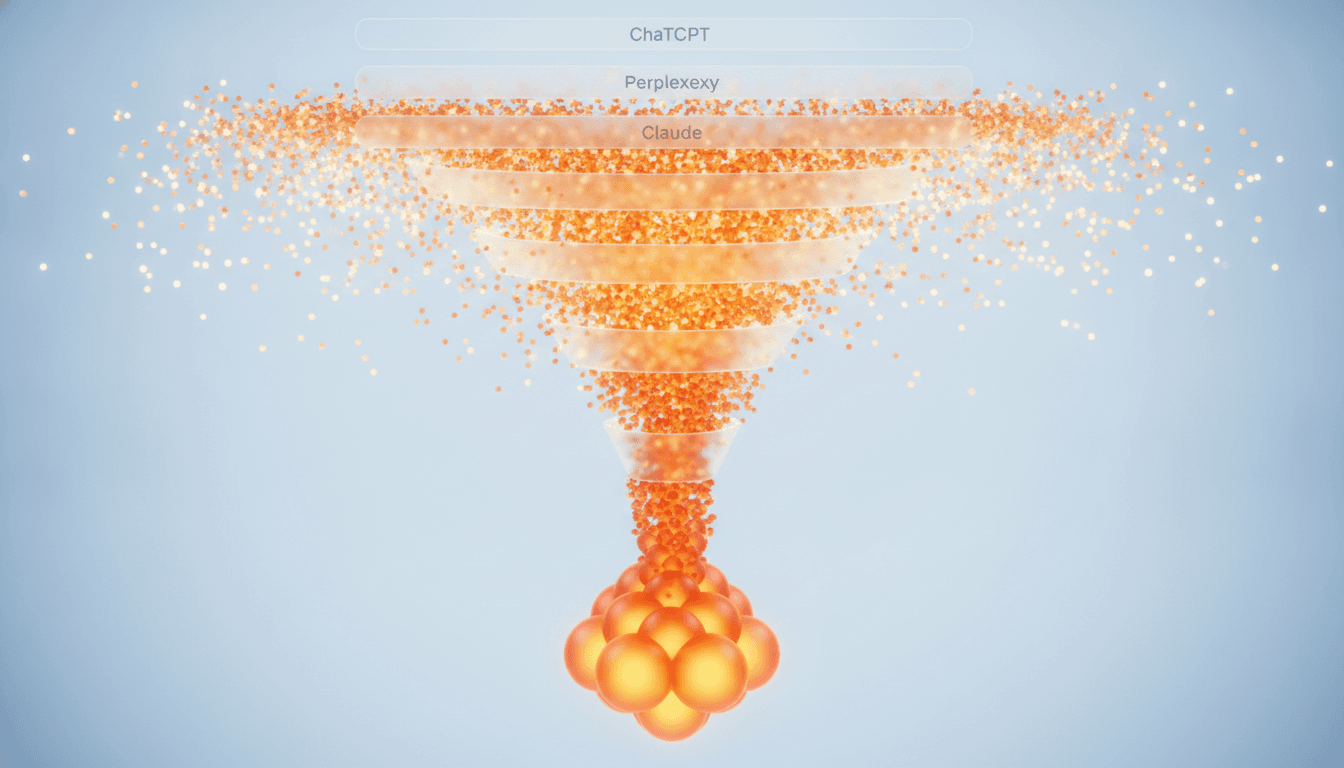
The first finding from Hexagon's citation analysis is both striking and clarifying. **Just 6% of queried e-commerce brands captured 61% of all citation mentions** across ChatGPT, Perplexity, and Claude—a winner-take-most dynamic that makes traditional SEO look democratic by comparison.

This level of concentration means the vast majority of brands are functionally nonexistent in the AI-assisted purchase journey, regardless of how strong their paid or organic search presence might be. What makes this pattern particularly important is what's *not* driving it: brand size and advertising spend are weak predictors of AI citation frequency.

The concentration is driven by specific, replicable structural signals that smaller brands can deliberately build—which means the current landscape represents a genuine strategic opportunity, not a fixed hierarchy.

Mid-market brands tell the clearest version of this story. Brands generating between $10M and $150M annually capture only **18% of AI citations** despite representing approximately 34% of U.S. e-commerce revenue—a systematic underrepresentation that reflects an optimization gap, not a quality gap.

Consumer behavior is accelerating the urgency. According to the [Salesforce State of the Connected Customer Report](https://www.salesforce.com/resources/research-reports/state-of-the-connected-customer/), **58% of U.S. consumers aged 18–44** have used a generative AI tool to research a product purchase in the past six months. More significantly, **29% say AI recommendations directly influenced their final brand choice**—up from just 11% in 2023.

That trajectory makes the citation gap an active revenue problem, not a future-state concern. The execution gap compounds the problem further. Despite 79% of CMOs identifying AI search as a top-three priority for 2025, **only 14% of e-commerce brands** had taken deliberate steps to optimize for generative AI discoverability, according to Hexagon's proprietary CMO survey.

The gap between stated priority and actual investment is where most brands are losing ground—and where the opportunity for first-movers is largest.

**Key metrics from the analysis:**
- 6% of brands capture 61% of all AI citations across major platforms
- 58% of 18–44-year-old consumers have used AI for product research in the last six months
- 29% say AI directly influenced their final purchase decision (up from 11% in 2023)
- Mid-market brands capture only 18% of citations despite 34% revenue share
- Only 14% of brands have taken deliberate AI optimization steps

The financial stakes are concrete. Data from [Adobe Analytics](https://business.adobe.com/resources/digital-economy-index.html) confirms that shoppers arriving via AI assistant recommendation convert at **3.1x the rate** of those arriving via paid search. Citation authority isn't a vanity metric—it's a direct revenue driver that determines which brands capture the lion's share of AI-influenced commerce.


---


## The Three Platforms, Three Logics Problem: Why One-Size-Fits-All Optimization Fails

[IMG: Side-by-side comparison diagram of ChatGPT, Perplexity, and Claude citation architectures, showing different source link rates, content preferences, and recency weighting]

Most brands treat ChatGPT, Perplexity, and Claude as if they operate under the same logic. They do not. Each platform has fundamentally different citation mechanics, and treating them as a single optimization target leaves significant citation potential unrealized.

Hexagon's data suggests a generic AI content strategy leaves **60% or more of citation opportunity** on the table. Platform-specific optimization is no longer a nice-to-have; it's the baseline requirement for competitive discoverability.

**Perplexity's architecture is built around recency and source transparency.** The numbers are striking: **72% of its e-commerce citations came from content published or updated within the prior 90 days**, compared to 41% for ChatGPT and 38% for Claude. Critically, **73% of Perplexity's e-commerce citations included a direct source link** to the brand's own website or a third-party review—making it the platform most rewarding of fresh, linkable, time-stamped content.

Brands that maintain a consistent publishing cadence and update existing content regularly are structurally advantaged on Perplexity. This recency preference creates a clear optimization pathway for brands willing to invest in regular content updates.

**Claude operates by a different logic entirely.** It demonstrated the strongest preference for long-form, editorially dense content—brands cited by Claude had an **average content depth score 2.4x higher** than those cited exclusively by ChatGPT, based on word count, internal linking density, and citation-to-claim ratios. Claude rewards brands that invest in comprehensive, well-researched content that demonstrates genuine topical authority.

Thin product pages and brief blog posts are largely invisible to Claude's recommendation engine. This preference for depth creates a distinct content investment requirement.

**ChatGPT presents the most structurally complex challenge.** Its training data dynamics create a historical familiarity bias—brands with high pre-training era search volume received **2.1x more citations** than newer brands with equivalent current-day content quality. Only **31% of ChatGPT responses included direct source links**, reflecting a fundamentally different citation architecture than Perplexity.

For newer brands, this creates a structural disadvantage that requires deliberate mitigation through third-party corroboration and knowledge graph investment.

Here's how these platform differences translate into practical priorities:

- **Perplexity**: Prioritize content freshness, regular updates, and linkable source material
- **Claude**: Invest in long-form, deeply researched editorial content with strong internal linking
- **ChatGPT**: Focus on building historical domain presence, knowledge graph entries, and broad third-party mentions
- **All platforms**: Structured content architecture and third-party corroboration are universal requirements

The brands currently winning across all three platforms have recognized that each requires a distinct content investment—and have built their optimization strategy accordingly.


---


## The Master Signal: Why Third-Party Corroboration Beats Everything Else

[IMG: Network visualization showing a brand at the center with connections radiating outward to editorial sources, review sites, trade publications, and consumer guides—illustrating the "corroboration web" concept]

If Hexagon's analysis reveals one signal that rises above all others, it's this: **third-party corroboration is the single most consistent predictor of AI citation frequency across all three platforms**. The number of independent, credible sources mentioning a brand functions as a universal trust signal that AI models weight heavily when forming recommendations—regardless of platform-specific differences in citation architecture.

The magnitude of this effect is significant. Brands mentioned in **10 or more independent editorial sources** were **5.2x more likely to receive unprompted AI recommendations** than brands with fewer than three such mentions. This isn't a marginal advantage—it's a structural one.

The mechanism is straightforward: language models are confidence machines. They recommend brands they've seen corroborated across many independent, high-quality sources. A brand that appears in one excellent review is interesting; a brand that appears in fifty consistent, credible sources becomes the obvious answer.

The data on editorial placement confirms the mechanism. **47% of all AI-cited e-commerce brands** in Hexagon's dataset appeared in at least one major consumer publication's "best of" or "top picks" roundup within the prior 12 months. Listicle-format content in reputable publications is particularly high-impact—these pieces create exactly the kind of multi-source consensus that AI models interpret as confidence-worthy corroboration.

Earned media and editorial placement have shifted from brand awareness tactics to core growth levers for AI discoverability. This finding has direct implications for how e-commerce brands should think about their PR and content investment.

The goal is no longer simply to generate coverage—it's to build a **corroboration web** across independent, credible sources that AI models will encounter and synthesize. Review sites, trade publications, consumer guides, and mainstream media roundups all contribute to this web.

Brands that have historically underinvested in earned media are now paying a compounding discoverability cost. This represents both a risk and an opportunity for brands willing to shift their investment allocation.

**The corroboration effect by the numbers:**
- Brands with 10+ independent editorial mentions are 5.2x more likely to receive unprompted AI recommendations
- 47% of AI-cited brands appeared in a major "best of" roundup within the prior 12 months
- Listicle-format editorial content is a dominant predictor of AI recommendation across all platforms
- Corroboration creates a compounding effect—each new credible mention increases citation probability nonlinearly

The practical implication is straightforward: earned media is not optional for AI discoverability. It is the foundation.


---


## The Structural Advantage: How Content Architecture Amplifies Citation Probability

[IMG: Before/after diagram showing unstructured product page vs. structured content with schema markup, FAQ sections, and comparison tables—with citation rate improvement percentage displayed]

Beyond third-party corroboration, content architecture is the highest-ROI technical investment a brand can make for AI discoverability. Hexagon's analysis found that brands with structured product data—including schema markup, detailed spec pages, and FAQ content—were cited **3.7x more frequently** than brands with equivalent domain authority but unstructured content.

The architecture of how information is presented matters as much as the information itself. Schema markup enables AI models to extract and cite specific claims with confidence—transforming product information from raw text into machine-readable, citable data.

This technical foundation is no longer optional for competitive discoverability.

Comparison pages and buyer's guides are particularly powerful. E-commerce brands that published dedicated "best for" and "compared to" content pages—explicitly framing their product against competitor and use-case scenarios—saw a **44% higher citation rate** across all three AI platforms than brands relying solely on standard product description pages.

These pages directly answer the conversational queries AI models receive most frequently, making them structurally aligned with how generative search actually works. FAQ content aligned with natural language patterns produces a similar effect, increasing citation probability by making it easy for AI models to find and extract precise answers.

Semantic consistency across touchpoints acts as a hidden multiplier that many brands overlook. Hexagon's analysis found that using the same product terminology, category language, and brand descriptors across owned, earned, and third-party content correlated with a **31% increase in citation probability**.

AI models reward brands that present a coherent, cross-source identity—inconsistent terminology creates friction in the model's ability to confidently synthesize and recommend.

Here's how to build semantic consistency in practice:

- Define a core vocabulary of product terms, category descriptors, and brand positioning language
- Apply this vocabulary consistently across product pages, blog content, press releases, and media pitches
- Monitor third-party coverage and proactively correct inconsistent terminology
- Maintain updated Wikipedia entries and knowledge panel information—brands with active knowledge graph presence were cited **2.8x more frequently by Claude** and **1.9x more frequently by ChatGPT**

Across all 100,000 citations analyzed, zero brands achieved consistent top-3 recommendation status on all three platforms simultaneously without meeting a minimum threshold of 15 or more independent editorial mentions, structured product schema, and at least one dedicated comparison or buyer's guide page. Content architecture is not optional—it is the technical foundation that makes everything else work.


---


## Niche Authority Outperforms Broad Authority: The Counterintuitive Path to AI Dominance

[IMG: Visual showing a mid-market brand dominating a specific product sub-category niche vs. being invisible in a broad category—with correlation coefficient data displayed]

One of the most counterintuitive findings from Hexagon's analysis is that **niche authority is a more reliable predictor of AI citation than general domain authority**. In category-specific queries—for example, "best sustainable running shoes under $150"—AI citation patterns showed that being the most cited brand within a specific sub-category was more predictive of recommendation than overall domain authority, with a correlation coefficient of **0.71 versus 0.43**.

For mid-market brands, this is the strategic insight that changes the calculus entirely. The logic behind this pattern mirrors how AI models are designed to work.

These systems weight topical relevance and specificity heavily in recommendation logic—a brand that is deeply, consistently cited as the authority on a specific product type is more likely to receive confident recommendations than a brand with broad but shallow coverage across many categories. Depth of authority within a defined niche signals confidence; breadth without depth signals uncertainty.

AI models are fundamentally *trust architecture problems*—and niche depth builds trust faster than broad positioning. For mid-market brands, this creates a genuine first-mover advantage that is both achievable and durable.

Establishing citation dominance in a specific sub-category is faster and more defensible than competing for broad category authority against established players. The winner-take-most dynamics that make broad AI citation so difficult to penetrate actually work *in favor* of niche specialists—once a brand becomes the consistently cited authority in a specific niche, that position compounds over time as citation patterns solidify.

Looking ahead, this dynamic will only intensify as AI-assisted commerce accelerates. The brands that move now to establish niche authority will build competitive moats that are structurally difficult for larger, more generalist competitors to disrupt quickly.

Here's how niche authority strategy translates into execution:

- Identify two to three specific product sub-categories where deep authority is achievable within 12 months
- Build content, earned media, and schema infrastructure specifically optimized for those sub-categories
- Target editorial placements in publications that serve the niche audience directly
- Measure citation share within the niche—not just overall citation volume

The path to AI dominance for mid-market brands runs through niche depth, not broad awareness.


---


## The Execution Gap: Why Knowing Isn't Enough—The Brands That Will Win in 2026

[IMG: Gap visualization chart showing 79% CMO priority awareness vs. 14% actual optimization execution, with a timeline showing the narrowing window of first-mover advantage through 2026-2027]

The most important number in Hexagon's entire dataset may be the simplest: **79% of CMOs identify AI search as a top priority, but only 14% have taken deliberate optimization steps**. That 65-point gap between awareness and action is where competitive advantage is being won and lost right now.

The brands that close this gap in 2025 will establish citation authority that compounds through 2026 and 2027—the brands that wait will find themselves competing for a much smaller share of an already concentrated landscape.

The financial stakes make the urgency concrete. [McKinsey Global Institute](https://www.mckinsey.com/capabilities/mckinsey-digital/our-insights) projects that **$1.2 trillion in global e-commerce revenue** will be influenced by AI-assisted discovery and recommendation by 2027. That revenue will not be distributed proportionally across the market—it will flow to brands with established citation authority, following the same winner-take-most concentration pattern that Hexagon's analysis documents.

The brands that move first will not simply capture early share; they will build structural advantages that are difficult for later entrants to displace. Building that trust architecture takes time—which is precisely why the window for first-mover advantage is narrowing, not widening.

Citation authority compounds in the same way that domain authority once did in traditional SEO—but the compounding effect is faster and the concentration is more severe. Brands that establish the minimum threshold signals now (15+ editorial mentions, structured schema, comparison content, niche authority) will find those signals reinforcing each other over time.

Brands that delay will face a landscape where the citation patterns have already solidified around their competitors. The window is open, the patterns are clear, and the only remaining variable is execution speed.


---


## What This Means: Immediate Next Steps

[IMG: Action roadmap graphic showing five sequential steps from citation audit through semantic consistency framework, with timeline indicators]

The patterns from 100,000 citations are clear. The path from invisible to discoverable is specific, measurable, and executable—but it requires deliberate action across five distinct areas.

**1. Audit current citation presence across all three platforms.**

Brands should query ChatGPT, Perplexity, and Claude directly for their brand and their top competitors across core product categories. Documentation should include where the brand appears, where it doesn't, and—critically—which competitors are capturing citations the brand should be winning.

This baseline audit is the foundation for everything that follows.

**2. Map platform-specific optimization priorities.**

Generic AI strategy leaves 60%+ of citation opportunity unrealized. Based on the audit, brands should identify which platform represents their highest-priority gap and build platform-specific content investments accordingly—recency and source links for Perplexity, editorial depth for Claude, knowledge graph and historical presence for ChatGPT.

**3. Develop an earned media strategy targeting niche-relevant publications.**

The 47% of cited brands with recent editorial placements didn't get there by accident. Brands should identify the specific publications, roundups, and review sites that serve their target audience and product niche—then build a systematic outreach strategy to secure placement in listicle-format content that AI models weight heavily.

**4. Build structured content architecture aligned with conversational queries.**

Brands should implement schema markup on all product and category pages. Dedicated comparison and "best for" pages should be published to directly answer the conversational queries target customers are asking AI assistants. FAQ content should mirror natural language patterns in the category.

These are the technical foundations that enable AI models to cite the brand with confidence.

**5. Establish a semantic consistency framework across all brand touchpoints.**

Brands should define their core product vocabulary and apply it uniformly across owned content, press materials, and third-party outreach. Wikipedia presence and knowledge panel information should be maintained and updated regularly. Semantic consistency correlated with a 31% increase in citation probability—it is one of the highest-leverage, lowest-cost optimizations available.

The brands that execute across all five areas will meet the minimum threshold that Hexagon's analysis identifies as necessary for consistent top-3 recommendation status. Execution speed matters because citation authority compounds—and first-mover advantage in AI discoverability is already beginning to solidify.


---


**Ready to close the execution gap and build AI citation authority?** The brands that move first in 2025 will establish dominance that compounds through 2027 and beyond. Hexagon offers a 30-minute strategy session with AI search specialists to audit current AI discoverability and build a platform-specific optimization strategy tailored to your niche. [Book a consultation](#cta-button)


---


*Sources: [Salesforce State of the Connected Customer Report](https://www.salesforce.com/resources/research-reports/state-of-the-connected-customer/) | [McKinsey Global Institute](https://www.mckinsey.com/capabilities/mckinsey-digital/our-insights) | [Adobe Analytics Digital Economy Index](https://business.adobe.com/resources/digital-economy-index.html) | Hexagon Proprietary Citation Analysis & CMO Survey, 2025*
H
Hexagon Team
Published July 13, 2026