googlesearchcontent
AI Search vs Traditional SEO: The Fundamental Differences Every Marketer Must Understand
Your brand ranks #1 on Google—but when someone asks ChatGPT the same question, you don't exist. This guide explains why, and what to do about it.
14 min read
placeholders intact" ]
---


# AI Search vs Traditional SEO: The Fundamental Differences Every Marketer Must Understand

*A brand ranks #1 on Google—but when someone asks ChatGPT the same question, it doesn't exist. This guide explains why, and what to do about it.*

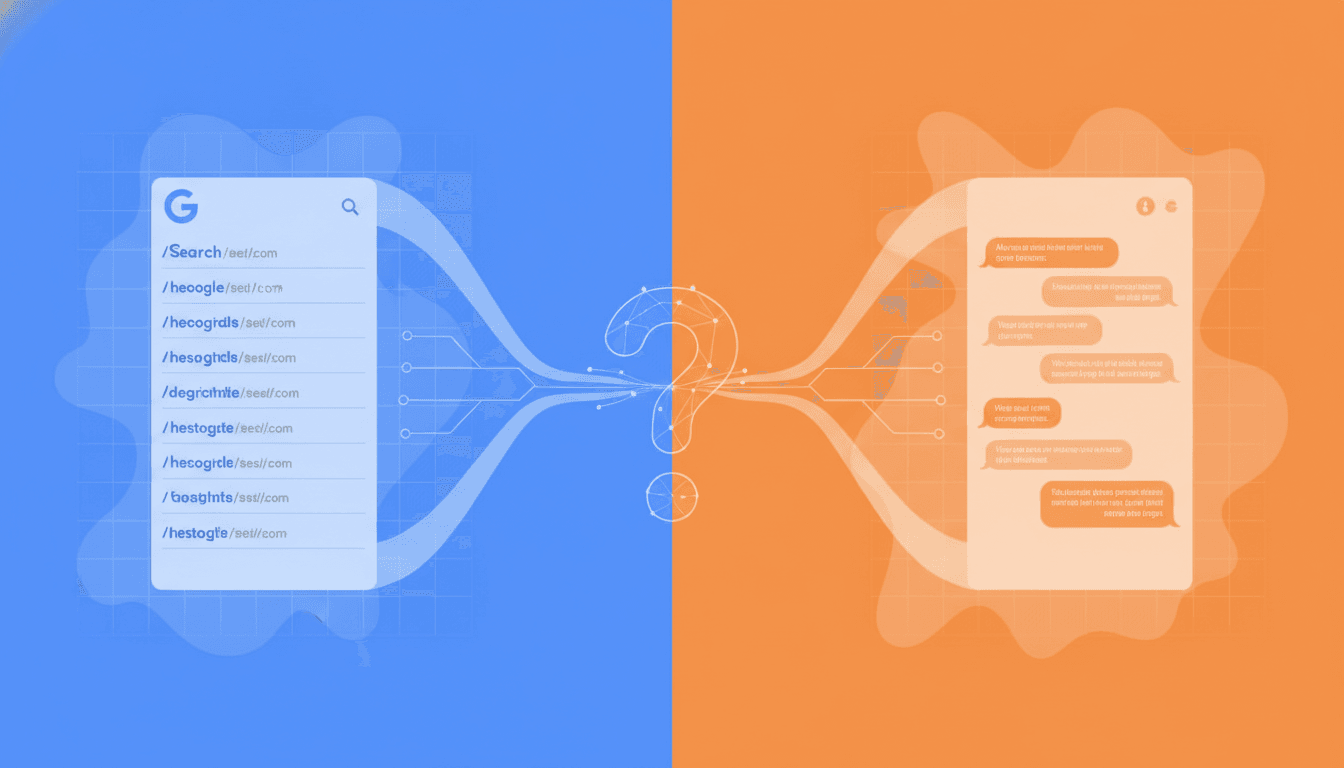
[IMG: Split-screen visualization showing a Google search results page on the left and a ChatGPT response on the right, with the same query but completely different sources highlighted]

## The Problem Nobody's Talking About

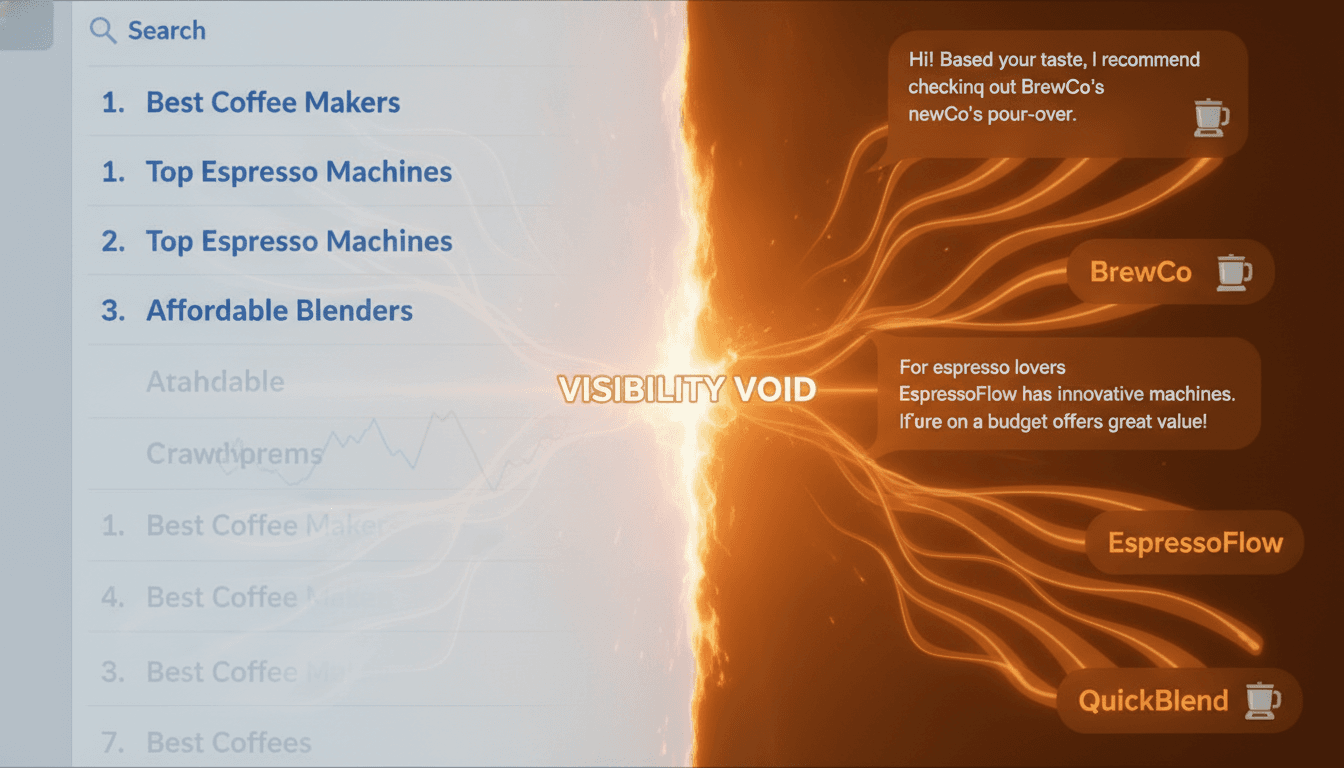
A homepage dominates Google for competitive keywords. Organic traffic is strong. The SEO strategy is working. But when someone asks ChatGPT the same question, the brand vanishes—and so does the competitor's.

Instead, three sources most marketers have never heard of dominate the AI-generated response. This scenario is no longer hypothetical.

According to [Ahrefs research](https://ahrefs.com), only **9% of pages ranking in Google's top 10 results are cited as primary sources by major AI assistants** for the same query. The gap between traditional SEO success and AI search visibility isn't a minor inconvenience—it's a chasm.

The scale of this divergence demands immediate attention. [AI-powered search tools reached over 1 billion monthly active users globally by early 2025](https://www.statista.com), with ChatGPT alone processing over 100 million queries per day. Meanwhile, [58.5% of Google searches in 2024 ended without a click](https://sparktoro.com)—a trend accelerating sharply as AI Overviews absorb query resolution directly on the results page.

This isn't a temporary gap. It's structural, and it's permanent.

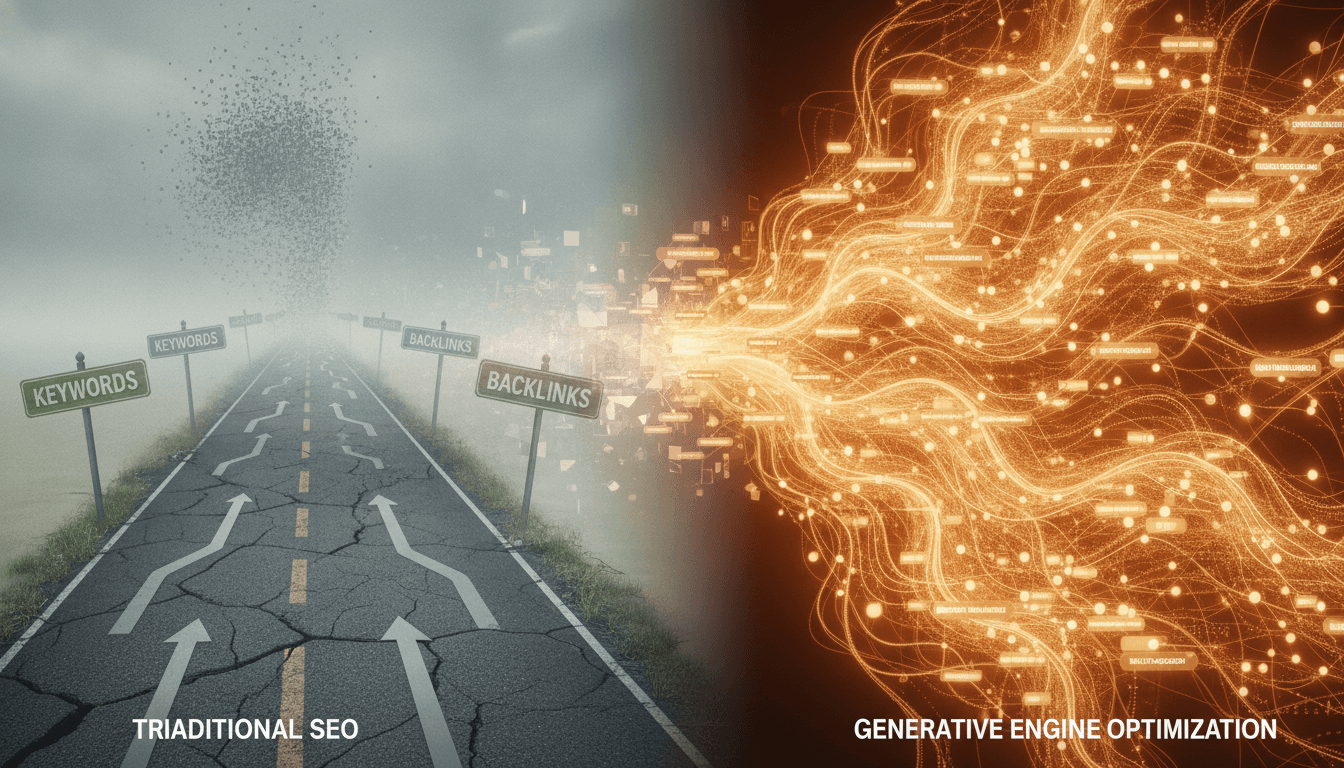
Brands optimizing exclusively for Google's index-and-rank system are building a strategy for yesterday's search landscape. Today, two distinct approaches are required: one for traditional SEO, and one for **generative engine optimization (GEO)**. This guide explains why they're fundamentally different, why current strategies are failing in AI search, and how to build a parallel GEO strategy that captures visibility in the fastest-growing search channel in the world.


---


## The Seismic Shift: Why AI Search Isn't Just 'Better SEO'

Google is an index-and-rank system. AI search is a synthesis system. These aren't variations of the same architecture—they're fundamentally different machines that evaluate entirely different signals and reward entirely different content characteristics.

A brand can dominate Google's first page and be completely invisible inside an AI-generated answer. The inverse is equally true: a brand with modest Google rankings can become a frequently cited source across ChatGPT, Perplexity, and Google's own AI Overviews.

As Rand Fishkin, Co-founder of SparkToro, frames it: "The web was built to be crawled and indexed. Generative AI doesn't crawl the web the way Google does—it learns from it, and then synthesizes. That's a profound architectural difference that most SEOs haven't fully reckoned with yet. Marketers are no longer optimizing a page to rank. They're training a model to trust them."

This shift is already reshaping the competitive landscape. Perplexity AI grew from 10 million to over 100 million monthly active users between January 2024 and January 2025—a 10x growth rate that outpaced virtually every other consumer AI product.

The conversion funnel has been fundamentally restructured. Visibility in AI answers doesn't depend on ranking position or clicks—users may never visit a site, yet a brand still shapes impressions inside every AI-generated response that mentions it.


---


## How Google's Index-and-Rank System Works (And Why It Fails in AI Search)

Google's core algorithm is built on link graph analysis and keyword matching. The system crawls pages, indexes them, and ranks them based on two primary signal categories: **authority signals** (backlinks that pass "link juice" from domain to domain) and **relevance signals** (keyword density, semantic matching, and on-page factors).

Success in this system is measured by a single outcome: getting a user to click through to a site. Every tool in the traditional SEO stack—from keyword research platforms to backlink analyzers—is built around improving click-through rates.

The entire SEO industry is optimized for one thing: clicks. That's precisely why it fails in AI search, where AI engines don't rank pages for users to click—they synthesize information and deliver answers directly.


---


## How AI Search Engines Actually Work (And What They Actually Care About)

AI search is a **synthesis system**. Rather than surfacing a ranked list of pages, it retrieves information from multiple sources and generates a single, synthesized response. The system prioritizes credibility, comprehensiveness, and citability—not ranking position or backlink count.

Generative AI engines do not use a traditional index-and-rank model. Instead, they rely on large language models trained on vast corpora of text to synthesize responses. There is no "position 1" to compete for—only **inclusion or exclusion** in the generated answer.

AI search engines like Perplexity and ChatGPT with browsing enabled rely heavily on real-time retrieval-augmented generation (RAG), pulling from live web sources at query time. The selection of which sources to pull is governed by perceived authority and content clarity—not backlink count.

When a user asks ChatGPT a question, the system doesn't retrieve a ranked list of pages and pick the top one. It evaluates multiple sources based on authority signals, factual accuracy, and comprehensiveness, then synthesizes a single response that may cite three, five, ten different sources—or none at all.

[IMG: Diagram showing the traditional SEO funnel (search → rank → click → convert) versus the GEO funnel (query → AI synthesis → citation → brand impression), with arrows illustrating where each funnel diverges]


---


## Backlinks vs. Citations: The Core Difference Between SEO and GEO Strategies

In traditional SEO, backlinks pass authority and improve rankings. In GEO, what matters is whether content is **cited, referenced, or paraphrased** across authoritative sources. These are not the same thing, and conflating them is one of the most expensive mistakes a marketer can make in 2025.

Unlinked brand mentions—which carry little weight in traditional PageRank-based SEO—are a primary signal for AI engines. AI systems process the co-occurrence of brand names with positive contextual language across the web to build brand reputation models.

A landmark study from Princeton, Georgia Tech, and IIT Delhi found that **GEO strategies incorporating authoritative citations and statistical data improved AI search visibility by up to 40%** compared to keyword-optimized content alone. The research team noted: "Our findings suggest that the most effective strategies for generative engine optimization are fundamentally different from traditional SEO. Incorporating authoritative citations, relevant statistics, and clear sourcing improved AI visibility by up to 40%. Keyword optimization, by contrast, had a statistically negligible effect." — Aggarwal et al., Princeton University / Georgia Tech / IIT Delhi

This is the critical insight: citations matter more than rankings. The goal is no longer to be the #1 result—it's to be the source that AI trusts.


---


## Keyword Optimization Is Necessary But Insufficient for GEO

Keywords still matter for retrieval in AI search—but they are no longer the primary optimization lever. Matching query language helps AI engines identify relevant content during the retrieval phase, but what determines whether that content gets cited is something entirely different.

AI engines evaluate content at **semantic and structural levels**, not just keyword density. Clear factual claims, named expert sources, data points with attribution, and logical answer structure matter far more than LSI optimization or keyword frequency.

Here's how the shift manifests in practice:

- **Old optimization target:** Keyword density, LSI terms, title tag optimization
- **New optimization target:** Factual comprehensiveness, named sources, attributed statistics, logical structure
- **Old success signal:** Ranking position for target keywords
- **New success signal:** Citation frequency across AI-generated responses

The shift is from "optimizing for keywords" to "optimizing for comprehensiveness and credibility." These require fundamentally different content strategies, different measurement frameworks, and different success metrics.


---


## E-E-A-T: The Bridge Between SEO and GEO (And Why It Matters More Than Ever)

Google's E-E-A-T framework—Experience, Expertise, Authoritativeness, Trustworthiness—is the closest convergence point between traditional SEO and GEO. Brands that invested in genuine authority signals are better positioned for AI visibility than those who relied on technical manipulation.

AI engines prioritize content from recognized experts and authoritative institutions. Perplexity AI's citation system shows a strong preference for sources that include named authors with verifiable credentials, institutional affiliations, and publication dates—signals that are entirely orthogonal to traditional SEO ranking factors like page speed or mobile optimization.

As Danny Sullivan, Google's Search Liaison, has observed: "E-E-A-T was always meant to capture something real about quality—not just a checklist. What's interesting is that AI engines seem to have independently converged on similar signals: demonstrated expertise, real author identity, factual precision. The brands that invested in genuine authority rather than gaming link metrics are finding the transition to AI search much smoother."

This is the rare area where SEO investment transfers directly to GEO performance. Building real authority benefits both channels simultaneously.


---


## Structured Data and Content Architecture: Primary, Not Secondary

In traditional SEO, structured data is a secondary concern—valuable for rich snippets, but rarely a ranking factor. In GEO, **content architecture and schema markup are first-order concerns**. AI engines use structured signals to parse entity relationships, product attributes, and factual claims with significantly higher confidence.

Unlike Google, which crawls and indexes pages and surfaces them as blue links, AI assistants compress entire documents into synthesized prose. A brand's message must be **self-contained, factually precise, and quotable in isolation**—without relying on the user clicking through to the full page.

For example, if a marketer is writing about "the benefits of remote work," a traditional SEO approach might bury key statistics in narrative paragraphs throughout a 2,000-word article. A GEO-optimized approach would use clear H2 headings, bullet points with attributed statistics, and FAQ schema to make each claim extractable and citable on its own.

Here's how to think about structural optimization for AI engines:

- Use clear H2/H3 hierarchies that allow AI engines to extract section-level answers
- Write self-contained factual statements that can be cited without surrounding context
- Implement FAQ schema for question-and-answer content
- Attribute every statistic and claim to a named, verifiable source
- Avoid burying key facts inside long narrative paragraphs
- Use tables and structured lists to present comparative data

Content architecture is now a first-order GEO concern—not an afterthought.

[IMG: Side-by-side comparison of a poorly structured content page (dense paragraphs, no headers, no attribution) versus a GEO-optimized page (clear headers, bullet points, attributed statistics, FAQ schema)]


---


## The Restructured Conversion Funnel: From Clicks to Citations

Traditional SEO success was measured in rankings and click-through rates. GEO success must be measured in **citation frequency, brand mention sentiment, and share-of-voice within AI-generated answers**. These are not incremental refinements to existing metrics—they are categorically different measurements of a categorically different outcome.

[68% of SEO professionals reported that AI Overviews in Google Search had already reduced organic click-through rates for their top-ranking pages](https://brightedge.com), according to BrightEdge's 2024 research. Zero-click searches now represent 58.5% of all Google searches.

Brand visibility in AI answers doesn't depend on clicks—it depends on citations. As Lily Ray, VP of SEO Strategy & Research at Amsive, frames it: "The question used to be 'how do I rank on page one?' The question now is 'how do I become the source that AI trusts?' Those are very different problems. One is about technical signals and link equity. The other is about genuine authority, structured knowledge, and being the most citable version of the truth in a domain."

Share-of-voice within AI-generated answers is now a primary visibility metric—and most marketing teams aren't measuring it at all.


---


## The Same Site Can Rank #1 on Google and Be Invisible to AI (Or Vice Versa)

Because the two systems evaluate entirely different signals, Google ranking does not guarantee AI visibility—and AI visibility does not require Google ranking. The structural reality of two parallel systems operating on different criteria means competitive position in one channel has almost no bearing on position in the other.

A B2B software company might rank #1 on Google for "best project management software" while being entirely absent from ChatGPT's recommendations for the same query. This happens simply because the content lacks the named authors, attributed statistics, and structured factual claims that AI engines prioritize.

Brands must audit AI visibility **independently** of Google rankings. A parallel GEO strategy is required—not an extension of an existing SEO strategy. The window for developing GEO competency before it becomes a competitive necessity is closing rapidly.


---


## How to Transition From SEO-Only to a Parallel GEO Strategy

Building a parallel GEO strategy doesn't require abandoning SEO. It requires recognizing that the two systems demand different investments, different content approaches, and different success metrics.

**Step 1: Audit AI visibility independently of Google rankings.**

Here's how to begin: Query target keywords across ChatGPT, Perplexity, and Google AI Overviews. Document which sources are cited and note where a brand appears—and where it doesn't. This audit reveals true competitive position in AI search, independent of Google rankings.

**Step 2: Identify which queries a brand is cited for (and which it's missing).**

Map AI citation gaps against existing content inventory. Prioritize high-value queries where competitors are being cited and the brand is not. This identifies the highest-impact GEO opportunities.

**Step 3: Prioritize citation-rich content over keyword-dense content.**

GEO strategies incorporating citations and statistics improved AI visibility by up to 40%. Restructure existing content to include named sources, attributed statistics, and clear factual claims. Focus on comprehensiveness over keyword targeting.

**Step 4: Build authority signals that matter to both systems.**

Named authors with verifiable credentials, institutional affiliations, and accurate sourcing are table stakes for AI citation. These signals benefit both GEO and E-E-A-T performance, making them a high-ROI investment.

**Step 5: Restructure content for extractability and comprehensiveness.**

Implement FAQ schema, clear heading hierarchies, and self-contained factual statements. Make every key claim quotable in isolation. This structural optimization directly improves AI citability.

**Step 6: Measure GEO success with citation frequency and share-of-voice metrics.**

Citation frequency is now as important as ranking position for visibility. Build reporting infrastructure that tracks brand mentions across AI-generated responses, not just Google rankings. This shift in measurement is critical—marketers can't optimize what they don't measure.


---


**Not sure where a brand stands in AI search?** A free GEO audit tool shows exactly which AI assistants are citing content—and which queries are being missed. [Get Your Free GEO Audit](https://calendly.com/ramon-joinhexagon/30min)


---


## Why This Transition Requires Urgency

AI search tools are processing billions of queries monthly. This is not a future concern—it is a present-tense channel that rivals or exceeds the traffic volume of many traditional search verticals, particularly for informational and research-oriented queries. ChatGPT processes over 100 million queries per day, and more than 1 billion users engage with AI search tools globally every month.

Zero-click rates are accelerating even within Google's own interface. [68% of SEO professionals have already seen AI Overviews reduce their click-through rates](https://brightedge.com)—meaning the erosion of traditional SEO value is happening inside Google itself. The shift from "rank to be clicked" to "be cited to be known" is already underway.

Looking ahead, the competitive dynamics of AI search will mirror the early years of SEO: early movers will capture disproportionate share-of-voice while competitors are still debating whether GEO is real. Perplexity AI's 10x growth in 2024 is a leading indicator of how fast this window closes.


---


## Conclusion

The fundamental difference between traditional SEO and AI search is architectural. Google finds pages, while AI engines synthesize answers. One rewards backlinks and rankings, while the other rewards authority, structure, and citability.

A brand can dominate one channel while being invisible on the other—and most marketers don't yet have the visibility infrastructure to know which side of that gap they're standing on. The path forward is not a choice between SEO and GEO, but a parallel strategy that serves both systems simultaneously.

Brands that invest in genuine authority signals, structure content for extractability, and measure success with AI-era visibility metrics will be the sources that AI trusts tomorrow.


---


**Ready to build a parallel GEO strategy that captures visibility in AI search?** Hexagon specializes in helping brands transition from SEO-only to integrated SEO+GEO strategies. [Book a 30-Minute GEO Strategy Call](https://calendly.com/ramon-joinhexagon/30min)
H
Hexagon Team
Published June 22, 2026