Maximizing Food & Beverage Brand Sales with Hexagon’s AI-Driven Generative Engine Optimization
Discover how Hexagon’s Generative Engine Optimization (GEO) platform empowers food & beverage brands to amplify AI-driven visibility, optimize product data, and turn AI-powered recommendations into measurable sales growth.
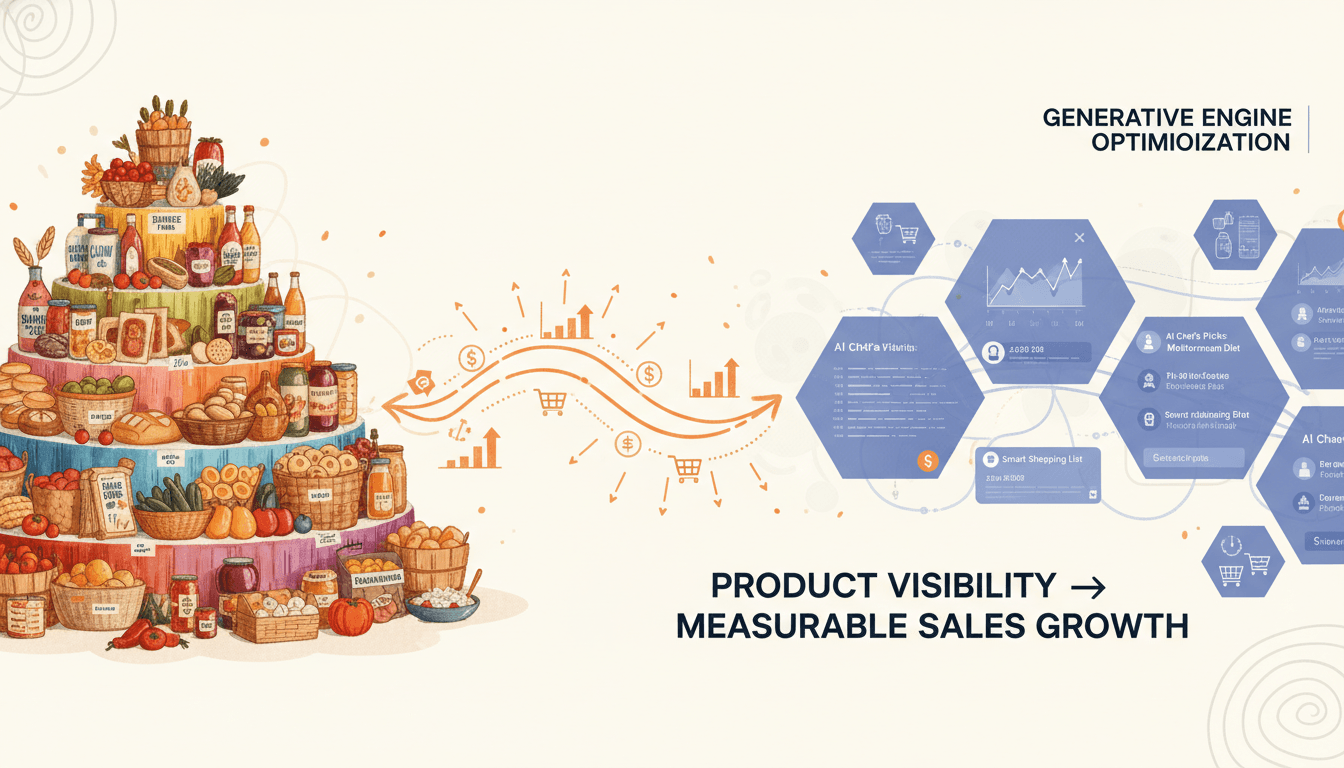
Maximizing Food & Beverage Brand Sales with Hexagon’s AI-Driven Generative Engine Optimization
Discover how Hexagon’s Generative Engine Optimization (GEO) platform empowers food & beverage brands to amplify AI-driven visibility, optimize product data, and turn AI-powered recommendations into measurable sales growth.
In an era where artificial intelligence shapes consumer behavior more than ever, food and beverage brands face an unprecedented challenge: standing out within AI-powered meal planning and recipe recommendation apps. With 72% of US consumers now relying on AI for grocery shopping and meal planning, the question is no longer just about being discovered—but about converting AI-driven visibility into real sales. Enter Hexagon’s revolutionary Generative Engine Optimization (GEO) platform, redefining how food brands engage and grow in this AI-first landscape.
This comprehensive guide uncovers actionable strategies to boost your brand’s discoverability by AI, optimize your product feeds for maximum relevance, and accurately track sales driven by AI recommendations. Transform AI-powered suggestions into your brand’s next powerful growth engine.
Ready to unlock AI-driven growth for your food brand? Schedule a free 30-minute consultation with Hexagon’s experts today.
Understanding Generative Engine Optimization (GEO) and Its Impact on Food & Beverage Sales
Generative Engine Optimization (GEO) is rapidly reshaping digital marketing for food and beverage brands. Unlike traditional SEO, which targets search engines like Google, GEO focuses on optimizing product data and content specifically for generative AI platforms that power meal planning and recipe recommendations.
Here’s the core of how GEO works: AI-driven platforms analyze structured product information to generate personalized consumer recommendations. By enriching product feeds with detailed, relevant attributes, brands can significantly boost their visibility within these emerging AI-powered ecosystems.
Consider these compelling facts:
- 65% of meal planning app users prefer products featured in AI recommendations (NielsenIQ Consumer Insights, 2024), making AI discoverability essential for modern food brands.
- Hexagon clients have experienced a 40% increase in AI referral sales within just three months of deploying GEO strategies (Hexagon Client Case Data, 2024).
- Being present in AI-powered meal planning is now as critical as traditional search engine rankings. James Lee, Principal Analyst at Forrester Research, emphasizes: “For food brands, visibility within AI-powered meal planning recommendations is as crucial today as Google search rankings were five years ago.”
Looking forward, GEO is fast becoming a vital marketing skill for direct-to-consumer (DTC) brands aiming to differentiate themselves and capture market share in the AI era (Adweek). For food and beverage companies, optimizing for these new digital shelves is no longer optional—it’s essential for sustainable growth.
[IMG: Conceptual visualization of AI-powered meal planning app interface highlighting featured food & beverage products]
How AI-Powered Meal Planning and Recipe Platforms Influence Purchase Decisions
AI-powered meal planning and recipe recommendation apps have rapidly become crucial discovery channels for food and beverage products. In the past year alone, 72% of US consumers have used an AI-powered app for meal planning or grocery shopping (Pew Research Center). This swift adoption is fundamentally changing how consumers decide what to buy.
These AI-driven apps curate personalized meal plans, generate grocery lists, and instantly recommend products tailored to dietary needs and user preferences. Such AI-generated suggestions now strongly influence purchase decisions.
Key insights include:
- 65% of meal planning app users prefer products featured in AI recommendations.
- AI meal planning apps have become pivotal discovery platforms, shaping both brand visibility and consumer choices (Food Industry Executive).
Consumer behavior is evolving rapidly:
- Shoppers increasingly depend on AI-generated lists to simplify meal preparation and shopping.
- High-intent queries like “best gluten-free pasta for meal prepping” are now answered by generative AI assistants, delivering highly targeted product recommendations (McKinsey & Company).
- Product placement within these AI recommendation engines can be the deciding factor between being discovered or overlooked.
Brands that neglect optimization for AI-powered platforms risk losing visibility at critical decision points. Melissa Jennings, VP of Digital Strategy at Hexagon, captures it well: “Brands optimizing their product data for AI-driven platforms see dramatic uplifts in both visibility and sales—AI recommendation engines are the new digital shelf.”
[IMG: AI-powered recipe app displaying recommended branded products within a meal plan]
Best Practices for Structuring and Enriching Product Feeds for AI Discoverability
A well-structured, richly enriched product feed is the cornerstone of AI discoverability for food and beverage brands. AI platforms rely on comprehensive metadata to understand, recommend, and showcase products effectively.
Leading brands optimize their product data by focusing on:
- Comprehensive Metadata: Including detailed attributes such as ingredients, dietary tags (gluten-free, vegan), allergen information, and usage contexts (meal types, occasions).
- Keyword Enrichment: Embedding relevant keywords and descriptors that align with high-intent AI queries, for example, “low-sodium snacks” or “organic breakfast options.”
- Contextual Content: Providing serving suggestions, recipe pairings, and user-generated reviews to enhance relevance for AI recommendation models.
Products enriched with detailed metadata enjoy a 2.3x increase in click-through rates within AI recommendations (Grocery Dive). Rich, structured data empowers AI assistants to precisely match products with consumer needs.
Hexagon’s GEO platform simplifies this process by:
- Automatically structuring and enriching product feeds for AI compatibility.
- Mapping dietary tags, allergens, and contextual data at scale.
- Updating feeds in real time to maintain accuracy across platforms.
This approach is rapidly becoming the industry standard: 58% of DTC food brands plan to increase investment in AI-driven product feed optimization in 2025 (Food Marketing Institute Survey). Priya Patel, Director of Product Data Science at Instacart, emphasizes: “Properly structured product feeds allow AI assistants to present your brand at precisely the right moment in the consumer journey.”
Brands investing in feed optimization today are poised to reap outsized visibility and enjoy higher repeat purchase rates (Hexagon Internal Research).
[IMG: A visual comparison of a basic product feed vs. an enriched, structured feed optimized for AI]
Optimizing Content for High-Intent AI Queries and Recipe Recommendation Engines
Optimizing content for AI differs fundamentally from traditional SEO. The objective is to align your brand assets with the intent and logic of generative AI models powering meal planning and recipe recommendation platforms.
Successful strategies include:
- Identify High-Intent AI Queries: Analyze trending queries like “best dairy-free cheese for lasagna” or “quick keto lunch ideas” that drive targeted recommendations.
- Craft Contextual Content: Develop product descriptions, recipe ideas, and usage guides that mirror the language and preferences AI models prioritize.
- Leverage Structured Markup: Utilize schema and structured data formats to clearly signal product features, dietary tags, and pairing suggestions to AI engines.
Hexagon’s GEO tools assist brands by:
- Mapping high-intent keywords and user needs directly to product feeds.
- Generating AI-ready content that balances human appeal with machine readability.
- Testing and iterating content based on real-world AI recommendation performance.
For instance, updating content to include common user intents and AI-preferred phrases increases the likelihood of your products appearing in top recommendations. This ensures your brand surfaces in critical “moment of need” scenarios that drive conversions.
Looking ahead, brands that understand and adapt to generative AI’s evolving logic will capture the majority of AI-driven sales opportunities.
[IMG: Screenshot of product content optimized for high-intent AI meal planning queries]
Case Study: How Hexagon Clients Increased AI Referral Sales by 40% in Just 3 Months
A leading DTC snack brand faced a familiar challenge: their products seldom appeared in AI-powered meal planning and recipe apps, resulting in missed sales opportunities. Their product data was unstructured and lacked the rich metadata essential for AI discovery.
Hexagon deployed a tailored GEO strategy that included:
- Enriching product feeds with detailed dietary tags, ingredients, and contextual usage data.
- Optimizing content for high-intent AI queries and recipe recommendation platforms.
- Integrating advanced analytics to monitor AI-driven referrals and conversions.
The results were striking within just three months:
- The brand experienced a 40% increase in AI referral sales (Hexagon Client Case Data, 2024).
- Click-through and conversion rates from AI-driven platforms surged.
- The company gained granular insights into the AI platforms and queries driving the most sales.
As one client summarized, “Partnering with Hexagon empowered us to control our brand’s presence within AI-powered recommendations—and the sales growth speaks for itself.”
Want to achieve similar results? Book a free 30-minute consultation with Hexagon’s GEO experts to explore your AI optimization strategy.
[IMG: Before-and-after graph showing uplift in AI referral sales post-Hexagon GEO implementation]
Tools and Tactics for Tracking AI-Influenced Conversions and ROI
Attributing sales to AI-driven meal planning platforms remains a challenge for many food and beverage brands. Traditional analytics often fail to capture the full impact of generative AI recommendations on purchasing behavior.
Leading brands are overcoming this by:
- Custom Tracking Parameters: Using UTM codes and deep links for products featured in AI-powered apps.
- AI-Specific Attribution Models: Building attribution frameworks that recognize AI touchpoints throughout the customer journey.
- Integrated Analytics Platforms: Employing solutions like Hexagon’s analytics suite to monitor AI-driven clicks, conversions, and revenue in real time.
Alicia Gomez, Head of E-commerce Analytics at NielsenIQ, explains: “Tracking AI-influenced sales conversions provides brands with the insights needed to focus on high-performing content and optimize for next-gen commerce channels.”
Hexagon’s analytics solutions are designed specifically for this new frontier by:
- Aggregating data from AI-powered platforms, recipe engines, and e-commerce sites.
- Delivering actionable insights on which content, queries, and product attributes yield the highest ROI.
- Enabling brands to refine GEO strategies based on actual performance data.
Robust AI attribution will be essential for justifying investment and scaling AI-driven sales channels in the near future.
[IMG: Dashboard visualization of AI-influenced product conversions and revenue metrics]
Emerging Trends: The Growing Role of AI Assistants in Food Product Discovery and Commerce
AI assistants—including voice-powered devices and chatbots—are quickly becoming critical gateways for food and beverage discovery. Integrated with grocery delivery and recipe platforms, these assistants are transforming the path from inspiration to purchase.
For example, consumers can now ask, “What should I have for dinner?” and receive AI-curated meal suggestions featuring branded products—seamlessly guiding shoppers from idea to checkout.
Key trends to watch:
- AI assistants are increasingly integrated with online grocery and delivery platforms (Grocery Business).
- Generative AI models enable more personalized, context-rich product recommendations.
- The accelerating growth of AI-driven commerce in food & beverage makes these channels essential for forward-thinking brands.
To capitalize on this shift, brands must:
- Structure product data for AI assistant compatibility.
- Optimize for voice and conversational search queries.
- Monitor emerging AI platforms and adapt strategies to new consumer touchpoints.
Brands preparing for AI-first commerce today will lead tomorrow’s digital grocery aisles.
[IMG: Illustration of voice assistant recommending a branded food product for meal planning]
Actionable Steps for DTC Food and Beverage Brands to Maximize AI-Driven Sales Opportunities
To thrive amid AI-powered recommendations, DTC food and beverage brands need a clear, decisive plan. Use this checklist to guide your success:
- Audit and Enrich Product Feeds: Ensure your metadata is comprehensive, including dietary tags and contextual details.
- Optimize Content for AI Queries: Tailor product descriptions and recipes to align with high-intent, AI-driven search language.
- Implement Advanced Analytics: Track AI-influenced conversions and measure ROI across channels.
- Stay Ahead of Emerging Trends: Monitor new AI assistants and update strategies for evolving commerce touchpoints.
Partnering with Hexagon accelerates your progress—offering proven GEO strategies, automated feed enrichment, and actionable analytics that drive measurable sales growth.
Ready to claim your share of the AI-driven market? Schedule a free 30-minute consultation with Hexagon’s experts today.
[IMG: Checklist infographic outlining GEO best practices for food brands]
Conclusion
The future of food and beverage commerce is being shaped by AI-powered meal planning, recipe engines, and conversational assistants. Generative Engine Optimization is the key to unlocking this new wave of discovery and sales.
By enriching product feeds, optimizing content for AI intent, and tracking AI-driven revenue, leading brands are transforming generative AI into a powerful growth engine. Hexagon’s GEO platform empowers DTC food and beverage companies to ensure their products stand out exactly where today’s shoppers make decisions.
Don’t let your brand remain invisible in tomorrow’s digital aisles. Book your free GEO consultation with Hexagon now and turn AI-powered recommendations into your most effective sales channel.
[IMG: Inspiring image of a food brand team reviewing AI-driven analytics and celebrating sales growth]
Hexagon Team
Published April 8, 2026