Key Differences Between Traditional SEO and Generative Engine Optimization for E-commerce
E-commerce brands face a new era in search as AI generative engines reshape online discovery. Learn how Generative Engine Optimization (GEO) differs from traditional SEO, why it’s critical for modern e-commerce growth, and the actionable steps your marketing team needs to stay ahead.
Key Differences Between Traditional SEO and Generative Engine Optimization for E-commerce
E-commerce brands are entering a transformative era where AI generative engines are revolutionizing how customers discover products online. Discover how Generative Engine Optimization (GEO) differs fundamentally from traditional SEO, why it’s crucial for driving modern e-commerce growth, and the practical steps your marketing team must take to stay ahead in this new landscape.
[IMG: Futuristic AI interface with e-commerce analytics dashboard]
In today’s rapidly evolving digital world, relying solely on traditional SEO strategies is no longer sufficient to dominate e-commerce search results. With 70% of online experiences now beginning through AI-powered generative search engines, brands must pivot to Generative Engine Optimization (GEO) to unlock unparalleled visibility and sales potential. This article unpacks the essential differences between SEO and GEO, explains why GEO is indispensable for your e-commerce brand’s future growth, and outlines actionable tactics for your marketing team to master this revolutionary approach.
Ready to future-proof your e-commerce marketing with Generative Engine Optimization? Schedule a personalized 30-minute consultation with our AI marketing experts today at https://calendly.com/ramon-joinhexagon/30min and begin transforming your AI search strategy.
Understanding Traditional SEO and Generative Engine Optimization (GEO)
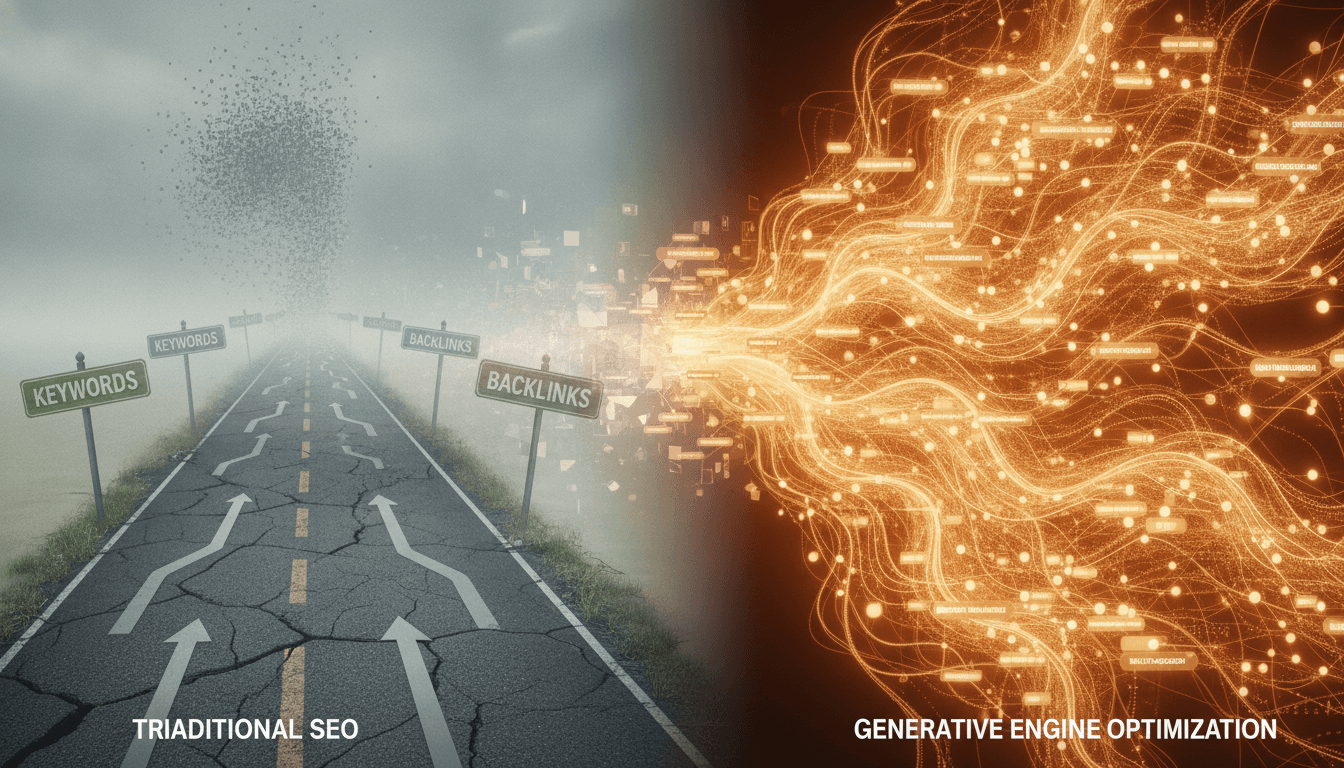
For years, traditional SEO has served as the foundation of digital marketing by focusing on optimizing keywords, backlinks, and rankings on search engine results pages (SERPs). Marketers aimed to capture top spots on Google and Bing by targeting specific queries, building authority through backlinks, and fine-tuning on-page elements to align with ranking algorithms. The ultimate goal was to drive organic traffic by winning valuable positions on search results pages.
Generative Engine Optimization (GEO), however, represents a paradigm shift tailored for the new generation of AI-powered generative search engines and conversational AI platforms. Instead of optimizing for human clicks on SERPs, GEO focuses on making product data, structured content, and conversational assets machine-readable and contextually relevant for AI assistants like ChatGPT, Google Gemini, and Perplexity. The objective is to optimize brand information so AI-driven recommendations surface your products seamlessly in conversational search experiences.
Consider these transformative trends reshaping the search landscape:
- 70% of online experiences now start on AI-powered or generative search platforms rather than traditional search engines (BrightEdge Research).
- AI search engines deprioritize backlinks and keyword stuffing, instead valuing content quality, structure, and semantic relevance (Google Search Central).
- As Rand Fishkin, Co-founder of SparkToro, insightfully notes: “Generative Engine Optimization is not just an evolution of SEO—it’s a new paradigm. Brands must optimize for how AI understands and recommends content, not just how humans search.”
For e-commerce brands, this means that traditional SEO tactics alone are insufficient. Embracing GEO is critical to sustaining growth and maintaining relevance as AI-driven search becomes the norm.
[IMG: Side-by-side comparison of traditional SEO and GEO workflows]
Core Differences Between SEO and GEO: Audience, Targets, and Ranking Factors
The transition from traditional SEO to GEO stems from fundamental shifts in audience behavior, optimization objectives, and ranking criteria.
Audience Differences:
- Traditional SEO targets human users navigating SERPs, who make choices based on snippets, titles, and meta descriptions.
- GEO targets both human users and AI agents—specifically conversational AI users interacting with chatbots, voice assistants, and generative engines.
Optimization Targets:
- SEO focuses primarily on optimizing web pages, backlinks, and on-page elements such as titles, meta tags, and alt text.
- GEO emphasizes:
- Structured data and product feeds (e.g., Schema.org markup, Google Merchant Center)
- Machine-readable content optimized for AI parsing
- Conversational, context-rich content tailored to natural language queries
Ranking Factors:
- Traditional SEO depends heavily on link authority, keyword density, and historical content performance.
- GEO’s ranking signals prioritize:
- AI-driven contextual relevance
- Accuracy and freshness of structured product data
- Seamless integration with product feeds and APIs
To illustrate, 80% of AI search recommendations now rely on structured data and product feeds rather than backlinks (OpenAI Documentation). Brands that provide rich, machine-readable data enjoy a distinct advantage in being surfaced by generative engines.
The data speaks volumes:
- Brands relying exclusively on traditional SEO experienced a 55% decline in featured placements within AI search results year-over-year (Search Engine Land).
- Lily Ray, Senior Director at Amsive Digital, emphasizes: “The future of e-commerce visibility hinges on structured data and machine-readable content. AI engines can’t recommend what they can’t understand.”
Looking forward, e-commerce brands must shift from link-building and keyword targeting toward data enrichment and conversational content strategies to preserve and grow their visibility.
[IMG: Infographic illustrating the different ranking factors for SEO vs GEO]
Why GEO is Essential for E-commerce Brands Today
AI chat interfaces are rapidly transforming how consumers discover products. Currently, 60% of e-commerce queries are answered directly within AI chat interfaces, bypassing traditional web links altogether (Gartner). This shift significantly reduces the effectiveness of SEO tactics that depend on click-through rates from SERPs.
Here’s how GEO provides a competitive advantage:
- Brands implementing GEO strategies report a 45% increase in AI-driven traffic compared to relying solely on SEO (Hexagon Research).
- AI chat platforms like ChatGPT and Google Gemini have become primary gateways for consumer queries, delivering direct, conversational answers.
- GEO enables brands to appear prominently within these AI-generated responses, boosting visibility and engagement without depending on traditional search rankings.
Danny Sullivan, Google’s Public Liaison for Search, underscores this transformation: “AI search platforms like ChatGPT are fundamentally changing product discovery. GEO is now essential for brands that want to remain visible and relevant.”
For e-commerce, GEO isn’t just an innovation—it’s a necessity to meet customers where they increasingly begin their shopping journeys.
[IMG: E-commerce customer using an AI chatbot for product search]
How Generative AI Engines Discover and Recommend E-commerce Brands
Generative AI engines such as ChatGPT, Perplexity, and Google Gemini operate fundamentally differently from traditional search engines. Their discovery and recommendation processes prioritize structured, machine-readable data over conventional SEO signals.
Key mechanisms include:
- Structured Data and Product Feeds: Approximately 80% of AI search recommendations derive from structured data and product feeds (OpenAI Documentation). These engines leverage Schema.org markup, Google Merchant feeds, and other data-rich assets to comprehend product details and availability accurately.
- Conversational and Contextually Rich Content: AI engines extract answers and recommendations from content formatted for natural language queries—such as FAQs, how-to guides, and conversational product descriptions.
- User Intent and Engagement Signals: Generative engines analyze user interactions, including follow-up questions and engagement metrics within AI chat interfaces, to refine which brands and products they recommend.
For example, major AI engines routinely crawl and ingest product feeds and semantic markup to populate their knowledge graphs. Brands that maintain well-structured, frequently updated product data thus secure a significant competitive edge.
Lily Ray’s insight remains pivotal: “AI engines can’t recommend what they can’t understand.” Enriching product data to be machine-readable and contextually comprehensive is the cornerstone of effective GEO.
[IMG: Flowchart showing how AI engines process structured product data for recommendations]
Key Tactics for Effective GEO in E-commerce
To harness the full potential of Generative Engine Optimization, marketing teams must adopt a fresh playbook tailored to AI-driven search. Here’s how to get started:
-
Implement Structured Data Markup and Schema:
- Utilize Schema.org and JSON-LD to annotate product pages with comprehensive metadata.
- Include critical attributes such as price, availability, ratings, and images to ensure rich data completeness.
- Regularly validate your markup using tools like Google’s Rich Results Test to maintain accuracy.
-
Optimize Product Feeds for AI Ingestion and Accuracy:
- Keep product feeds up-to-date for platforms like Google Merchant Center and Facebook Catalog.
- Enrich feeds with detailed, standardized attributes to enhance AI parsing capabilities.
- Align product taxonomy and maintain consistency between feeds and onsite data.
-
Create Conversational Content That Naturally Answers User Questions:
- Develop FAQ pages, how-to guides, and conversational product descriptions crafted around likely AI queries.
- Employ natural language, anticipate follow-up questions, and cover product comparisons thoroughly.
- Incorporate customer reviews and testimonials to add credibility and contextual richness.
-
Leverage AI-Friendly Content Formats:
- Structure content in easily parsable blocks using bullet points, lists, and tables.
- Prioritize question-and-answer formats that align with how AI engines surface information.
- Continuously update and expand content to reflect evolving user intent and product offerings.
-
Monitor AI Engine Guidelines and Data Integration Opportunities:
- Stay current with documentation from major AI platforms regarding data standards and best practices.
- Experiment with emerging content types and markup formats as generative engines evolve.
Dr. Pete Meyers, Marketing Scientist at Moz, advises: “E-commerce teams should treat GEO as an ongoing process, iterating content and data structures as AI engines evolve.” Agility and a commitment to structured, conversational content are essential for sustained GEO success.
[IMG: Screenshot of a well-structured e-commerce product page with schema markup]
Transitioning from SEO to GEO: A Step-by-Step Guide for Marketing Teams
Shifting from traditional SEO to GEO requires a deliberate, cross-functional approach. Here’s a practical roadmap for marketing teams to ensure a smooth transition:
-
Audit Current SEO Assets for AI Readiness:
- Assess which product pages, feeds, and content assets include structured data and are optimized for AI engines.
- Identify gaps in schema markup, feed enrichment, and conversational content.
-
Integrate Structured Data and Optimize Product Feeds:
- Implement Schema.org and JSON-LD markup across all product and category pages.
- Synchronize product feeds with the latest AI platform requirements and enable real-time updates.
-
Train Content Teams on Conversational and Generative AI Content Creation:
- Educate teams on writing for AI engines—emphasizing natural language, entity-based content, and FAQ development.
- Encourage collaboration between SEO, product, and data teams to ensure strategic alignment.
-
Measure Performance with AI-Specific Metrics and Refine Strategies:
- Track AI-driven traffic, direct answers, and product mentions within generative engines.
- Set benchmarks for visibility in AI chat interfaces and iterate based on results.
-
Foster Cross-Functional Collaboration to Align SEO and GEO Goals:
- Establish regular meetings between marketing, IT, and data science teams.
- Develop shared dashboards to monitor progress and uncover new GEO opportunities.
Looking ahead, this transition is not a one-time project but an ongoing evolution. Brands that embed GEO into their core marketing DNA will be best positioned to thrive as AI search technology advances.
Ready to make the leap from SEO to GEO? Book a personalized 30-minute consultation with our AI marketing experts at https://calendly.com/ramon-joinhexagon/30min and start your transition today.
[IMG: Team of marketers reviewing AI-driven analytics on a large screen]
Case Studies: Impact of GEO Adoption on E-commerce Brands
The real-world impact of GEO is already clear among forward-thinking e-commerce brands. For instance, a national apparel retailer implemented structured data across their entire product catalog and developed AI-friendly FAQ content. Within six months, the brand experienced a 45% increase in AI-driven traffic, as measured by direct mentions and product recommendations in ChatGPT and Google Gemini.
Customer engagement soared, with 60% of e-commerce queries answered directly in AI chat interfaces, streamlining the buying journey and reducing friction. The brand also decreased its reliance on traditional SEO rankings while maintaining or increasing overall revenue—a powerful testament to GEO’s effectiveness in capturing AI-driven opportunities.
These outcomes underscore the imperative to pivot toward GEO. As Hexagon Research and Gartner affirm, brands embracing GEO today are setting the benchmark for tomorrow’s e-commerce leaders.
[IMG: Before-and-after chart displaying AI-driven traffic growth for an e-commerce brand post-GEO adoption]
Ongoing Adaptation: Maintaining GEO Best Practices Amid AI Engine Updates
AI generative engines are evolving rapidly, with frequent updates to algorithms, data formats, and ranking criteria. To remain competitive, e-commerce brands must treat GEO as a continuous process rather than a one-off project.
Here’s how to sustain GEO excellence:
- Monitor AI Engine Updates: Regularly review release notes and official documentation from major AI platforms to anticipate algorithm changes.
- Refresh Structured Data and Content: Continuously update schema markup, product feeds, and conversational content to align with new best practices and emerging customer needs.
- Stay Informed on AI Search Marketing Trends: Subscribe to industry newsletters and participate in relevant forums to keep abreast of the latest developments.
- Embrace Agility and Experimentation: Test new data structures, content formats, and optimization methods as generative engines mature.
Dr. Pete Meyers of Moz advises, “E-commerce teams should treat GEO as an ongoing process, iterating content and data structures as AI engines evolve.” Brands prioritizing agility and continuous learning will consistently outperform competitors in the AI-driven search era.
[IMG: Timeline graphic showing key milestones in GEO updates and AI platform releases]
Conclusion: Seize the GEO Advantage and Future-Proof Your E-commerce Growth
The rise of AI-powered generative search is fundamentally reshaping how customers discover products and brands online. While traditional SEO remains valuable, it no longer provides the competitive edge needed in a world where 70% of online experiences begin on AI-powered platforms and 80% of recommendations depend on structured data. GEO represents the new frontier for visibility, engagement, and sales in e-commerce.
By grasping the distinctions between SEO and GEO, embracing structured data and conversational content, and building agility into your marketing operations, your brand can lead confidently in the era of AI search.
Ready to future-proof your e-commerce marketing with Generative Engine Optimization? Book a personalized 30-minute consultation with our AI marketing experts today at https://calendly.com/ramon-joinhexagon/30min and start transforming your AI search strategy.
[IMG: E-commerce executive shaking hands with an AI marketing consultant in a modern office setting]
Hexagon Team
Published February 28, 2026