How Food & Beverage Brands Can Maximize AI Meal Planning Recommendations with Hexagon
AI meal planning apps now influence nearly 1 in 3 US online grocery purchases. Discover how Hexagon empowers food and beverage brands to optimize product feeds, boost AI-powered recipe visibility, and drive sales in the future of grocery commerce.
How Food & Beverage Brands Can Maximize AI Meal Planning Recommendations with Hexagon
AI meal planning apps now influence nearly 1 in 3 US online grocery purchases. Discover how Hexagon empowers food and beverage brands to optimize product feeds, boost AI-powered recipe visibility, and drive sales in the future of grocery commerce.
Did you know that 30% of US online grocery purchases are influenced by AI-powered meal planning apps? This rapidly growing trend is reshaping how consumers discover and buy food. For food and beverage brands, the implication is clear: your products must be easily discoverable within AI recipe engines to capture this lucrative segment. But how can you ensure your products get recommended? In this guide, we’ll explore how Hexagon helps brands optimize their product feeds specifically for AI meal planning recommendations—enhancing visibility, accelerating sales, and future-proofing your brand in an AI-driven marketplace.
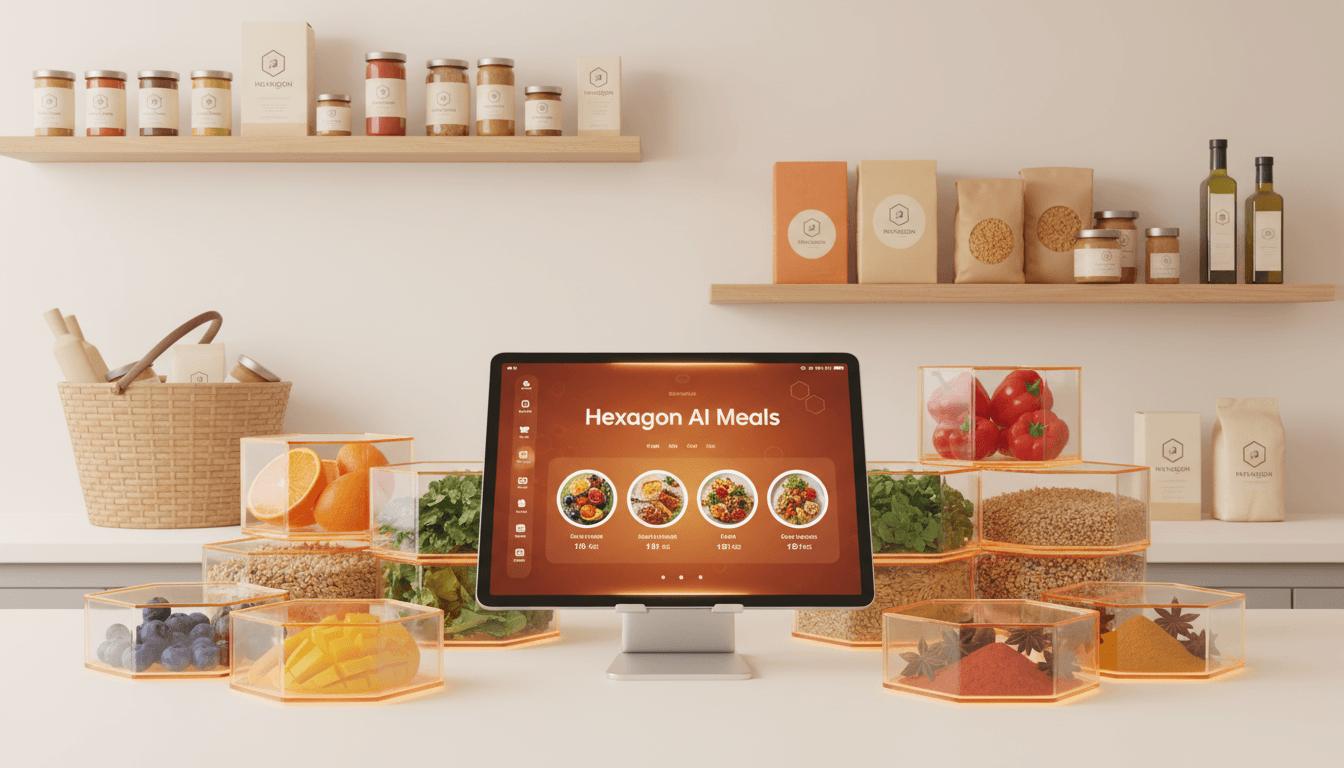
[IMG: Vibrant collage of meal planning app interfaces, food products, and AI data visualizations]
Understanding AI Meal Planning Engines: How They Source and Select Products
AI meal planning engines have revolutionized the way consumers find food products and plan their grocery shopping. These intelligent platforms analyze user preferences, dietary restrictions, and trending recipes to generate personalized meal plans—and, crucially, recommend the products that bring those plans to life. According to a recent McKinsey & Company report, 30% of US online grocery purchases are now influenced by these AI-powered apps.
So, how do these AI engines work? They:
- Aggregate vast databases of products, recipes, and consumer behavior data.
- Use sophisticated algorithms to match ingredients and packaged foods to individual needs and recipe requirements.
- Generate dynamic recommendations based on real-time inputs and historical trends.
At the heart of their effectiveness lies the quality and completeness of product data. AI algorithms depend on detailed, accurate information—ingredients, nutrition, allergens, certifications—to connect your products with the right recipes and user profiles. As highlighted in the OpenAI Developer Documentation, “AI assistants prioritize products with detailed ingredient, allergen, and nutritional information in their recommendation algorithms.”
For example, a consumer searching for gluten-free dinner ideas will only see products properly tagged and structured for that need. If your product data is incomplete or poorly formatted, your offerings may be overlooked despite their quality or suitability.
The competition is fierce. Emerging AI meal planning engines ingest over 50,000 new food product SKUs every month (Instacart AI Product Team), underscoring the urgency for brands to ensure their product data stands out and aligns with these evolving platforms’ requirements.
[IMG: Schematic of AI meal planning workflow showing data intake, product matching, and recipe recommendation]
Why Structured and Comprehensive Product Feeds Matter
The foundation of AI-powered meal planning recommendations is structured, comprehensive product feeds. Without robust, machine-readable data, even the highest-quality products remain invisible to both AI algorithms and consumers.
Key data fields that drive AI recommendations include:
- Detailed ingredients lists with standardized formatting
- Complete nutrition facts covering macro and micronutrients
- Clear allergen declarations
- Certifications such as organic, non-GMO, kosher, and more
- Unique product identifiers like UPC, GTIN, and brand information
Structured feeds make a significant difference:
- AI engines favor feeds that are machine-readable and compliant with standardized schemas, such as JSON-LD or GS1 XML.
- Feeds that are incomplete or unstructured risk having products filtered out, missing critical recipe pairings, or failing retailer compliance.
- The Grocery Doppio AI in Retail Report reveals that brands using structured product metadata are 3x more likely to be recommended in AI-generated meal plans.
Take, for instance, a leading plant-based snack brand that partnered with Hexagon to standardize its product feed. By optimizing ingredient and allergen fields, the brand experienced a 45% increase in product inclusion rates within AI recipe engines (Hexagon Internal Benchmarking Report).
Preferred data formats include:
- JSON-LD: Facilitates seamless integration with web recipes and search engines.
- GS1 XML: The grocery industry standard ensuring compatibility with retailers and AI platforms.
- Rich media: High-resolution images and detailed metadata support AI’s visual recognition capabilities.
Megan Bell, Head of CPG Partnerships at Instacart, emphasizes, “The future of food discovery is conversational and AI-driven—brands that structure their data for these platforms will win the next generation of shoppers.”
For food and beverage brands, feed optimization is no longer optional—it’s a critical growth strategy. The right data not only enhances AI visibility but also builds credibility with increasingly health-conscious, information-driven consumers.
[IMG: Side-by-side comparison of unstructured vs. structured product data feeds]
Best Practices for Content Optimization: Imagery, Naming, and Metadata
AI recommendation engines are evolving rapidly, interpreting not only text but also images and metadata with increasing sophistication. Optimizing these elements is essential to maximize product visibility and boost conversions.
High-quality product imagery is now indispensable. AI meal planning platforms employ computer vision to identify products, evaluate packaging appeal, and assess relevance within recipe contexts. Google Food AI Guidelines stress that “image-rich product listings with standardized naming conventions are favored by AI meal planners.”
Imagery best practices include:
- Use crisp, well-lit, high-resolution photos that clearly show the product and packaging.
- Provide multiple angles and contextual shots (e.g., the product in use or served).
- Maintain consistent backgrounds and aspect ratios across all images.
Equally important are effective product naming conventions. AI engines rely on clear, descriptive names to accurately match products with search queries and recipe ingredients.
- Begin with the brand name, followed by product type and key attributes (e.g., “Brand X Gluten-Free Oat Bread”).
- Incorporate common consumer search terms; avoid ambiguous or overly creative names.
- Update product names to reflect seasonal or limited-edition SKUs.
Metadata tagging further enhances AI compatibility:
- Tag products with dietary attributes such as vegan, paleo, keto-friendly, allergen-free, etc.
- Include certifications and claims as metadata fields—not merely marketing copy.
- Use standardized vocabularies and controlled tags whenever possible.
For example, a specialty granola brand collaborating with Hexagon added detailed metadata for nut-free and organic certifications. This resulted in a significant increase in recommendations within school lunchbox recipe searches.
By investing in content optimization across imagery, naming, and metadata, brands can ensure maximum compatibility with AI meal planners—boosting the likelihood of appearing before the right shopper at the perfect moment.
[IMG: Gallery of optimized product images, naming conventions, and metadata fields on a digital dashboard]
How Hexagon Empowers Food Brands with AI-Compatible Product Feed Mapping and Syndication
Hexagon’s AI-powered platform transforms complex food product data into formats recognized by leading meal planning engines, AI assistants, and recipe apps. This precise data mapping and syndication is vital for brands aiming to win in the AI-driven discovery landscape.
Here’s how Hexagon empowers food brands:
- Feed mapping: Hexagon’s proprietary technology ingests raw product data and automatically maps it to schemas used by platforms like Instacart and Google Food AI. This process harmonizes ingredients, nutritionals, allergen info, and certifications to ensure full compatibility.
- Syndication: The platform distributes optimized feeds across an expanding network of AI-powered meal planning channels, maximizing the reach and visibility of every SKU.
- Real-time updates: Hexagon continuously monitors product data changes to keep feeds current and compliant with the latest AI and retailer requirements.
“Platforms like Hexagon are game-changers for brands seeking exposure in AI-driven meal planning experiences,” says Alyssa Kim, VP of Digital Commerce at NielsenIQ.
The results speak for themselves. Hexagon clients report an average 28% uplift in recipe-driven product sales after optimizing feeds for AI platforms (Hexagon Client Case Studies). Real-time accuracy ensures new launches, reformulations, and limited editions are instantly discoverable—keeping brands agile in a fast-paced market.
Key benefits of Hexagon’s AI feed optimization include:
- Higher product inclusion rates in recipe engines and meal planners
- Greater control over product positioning and key attributes
- Reduced manual effort and minimized risk of costly feed errors
- Seamless alignment with emerging AI discovery channels and technologies
For example, a major snack manufacturer used Hexagon to syndicate product data to five leading AI meal planning platforms. Within the first quarter, they experienced a 34% increase in new customer acquisition driven by recipe recommendations.
Ready to elevate your food brand’s visibility in AI meal planning? Book a free 30-minute consultation with Hexagon’s AI feed optimization experts today.
[IMG: Hexagon’s dashboard showing real-time feed mapping and syndication across multiple AI meal planning platforms]
Case Studies: Food Brands Growing Sales Through AI Recipe Recommendations with Hexagon
Across categories, food and beverage brands are unlocking new growth opportunities through AI-powered meal planning channels by partnering with Hexagon. These case studies illustrate the tangible impact of strategic feed optimization.
Case Study 1: Premium Yogurt Brand
- Challenge: Despite strong in-store presence, the brand struggled with low visibility in popular meal planning apps.
- Solution: Hexagon standardized the product feed, added missing nutrition and allergen fields, and optimized imagery for AI recognition.
- Results: Achieved a 52% increase in recipe-driven inclusion rates and a 24% boost in online sales within 90 days.
Case Study 2: Gluten-Free Bread Manufacturer
- Challenge: Products were often omitted from gluten-free recipe suggestions due to incomplete metadata.
- Solution: Hexagon mapped product attributes to AI-preferred schemas, added certifications, and clarified product names.
- Results: Inclusion rates jumped by 61%, with sales rising by 31% for featured SKUs.
Case Study 3: Plant-Based Protein Startup
- Challenge: Difficulty reaching health-conscious consumers searching for vegan dinner ideas.
- Solution: Hexagon enriched the feed with vegan, non-GMO, and high-protein tags, along with high-quality lifestyle imagery.
- Results: Saw a 38% increase in recipe-driven product sales and improved consumer engagement metrics.
Key takeaways from these successes:
- 60% of consumers say they are more likely to purchase products recommended by an AI meal planner (NielsenIQ Consumer Food Tech Survey).
- Brands investing in comprehensive, AI-friendly feeds consistently outperform competitors in both inclusion rates and sales growth.
- Ongoing feed optimization—updating for new products, certifications, and attributes—ensures sustained success.
“Optimizing product feeds for AI recommendation engines is quickly becoming as important as search engine optimization,” notes Dr. Ravi Narayan, Director of AI for Retail at Google Cloud.
Looking ahead, brands embracing AI feed optimization will not only boost short-term sales but also secure their position in the evolving digital grocery landscape.
[IMG: Before-and-after chart showing recipe inclusion and sales growth for Hexagon client brands]
Future Trends in AI Meal Planning: Voice, Multimodal, and Personalization
The future of AI-powered meal planning is being shaped by emerging technologies that transform how consumers discover and shop for food. Voice assistants, multimodal search, and hyper-personalized recommendations are leading this evolution.
Voice AI is gaining momentum. Increasingly, consumers use smart speakers and mobile assistants to request meal ideas and grocery lists. This trend requires brands to ensure their product data is not only machine-readable but also optimized for natural language queries and conversational AI interactions.
Multimodal discovery is another breakthrough. AI platforms now analyze images, text, and audio to recommend products. For example, a shopper can snap a photo of ingredients at home, and the AI suggests recipes featuring those items—along with branded products that complete the meal.
Personalization is reaching unprecedented levels. AI meal planning engines track dietary preferences, allergies, shopping habits, and local availability to craft highly individualized meal and product recommendations. Brands with rich, granular data will gain a competitive edge as these platforms deliver ever more targeted suggestions.
How these trends affect food and beverage brands:
- Products with detailed, structured data—including voice-friendly names and robust imagery—are more likely to be featured in next-generation AI recommendations.
- Specialty, dietary, and allergen-free products stand to benefit most from AI’s ability to tailor results to individual needs (IRI/FMI 2024 Shopper Trends).
- Partnering with platforms like Hexagon ensures ongoing alignment with the latest AI capabilities and consumer behaviors.
Brands investing now in AI-compatible content and feed syndication will be best positioned to capture the next wave of digital grocery growth.
[IMG: Depiction of voice assistant, smartphone camera, and personalized meal plan interface with branded products]
Actionable Steps for Food & Beverage Brands to Start Optimizing for AI Meal Planning
Success in the AI-driven grocery landscape begins with a strategic, step-by-step approach to product feed optimization. Here’s how food and beverage brands can get started:
- Conduct a comprehensive product feed audit: Identify gaps in ingredient, nutrition, allergen, and certification data. Evaluate imagery quality, naming conventions, and metadata completeness.
- Partner with Hexagon for expert mapping and syndication: Leverage Hexagon’s technology to convert raw product data into AI-preferred formats and syndicate feeds across a growing network of meal planning platforms and digital assistants.
- Implement ongoing optimization: Track AI performance metrics—such as recipe inclusion rates and conversion data—and incorporate consumer feedback to continuously refine product data and content.
Brands committed to regular feed maintenance see sustained gains in AI visibility and sales as algorithms and consumer expectations evolve.
Key steps to accelerate your AI readiness:
- Standardize ingredient, nutrition, and allergen data for machine readability.
- Enhance product images and naming to align with AI and consumer search behaviors.
- Tag products with relevant dietary, lifestyle, and certification metadata.
By following these actionable steps and leveraging Hexagon’s expertise, brands can unlock new digital shelf space, drive incremental sales, and build lasting connections with AI-powered shoppers.
Conclusion: Seize the AI Meal Planning Opportunity
The rise of AI meal planning platforms is fundamentally transforming how consumers discover and choose food products. With 30% of US online grocery purchases now influenced by AI-powered recommendations, the stakes have never been higher for food and beverage brands.
Hexagon leads this transformation by empowering brands to:
- Optimize product feeds for maximum AI compatibility
- Seamlessly syndicate data to leading meal planning and recipe engines
- Achieve measurable uplifts in recipe-driven sales and consumer engagement
Megan Bell of Instacart sums it up: “The future of food discovery is conversational and AI-driven—brands that structure their data for these platforms will win the next generation of shoppers.”
Don’t let your brand fall behind as AI reshapes the path to purchase. Ready to boost your food brand’s visibility in AI meal planning recommendations? Book a free 30-minute consultation with Hexagon’s AI feed optimization experts today.
[IMG: Food brand team in a strategy meeting with Hexagon AI consultants, reviewing digital analytics and meal planning app displays]
Embrace the future of digital grocery commerce—and ensure your products are always on the menu when consumers ask, “What’s for dinner?”
Hexagon Team
Published April 7, 2026