contentsearchresearch
Best Practices for Building AI-Optimized FAQ Sections to Support Medium-Intent E-Commerce Shoppers
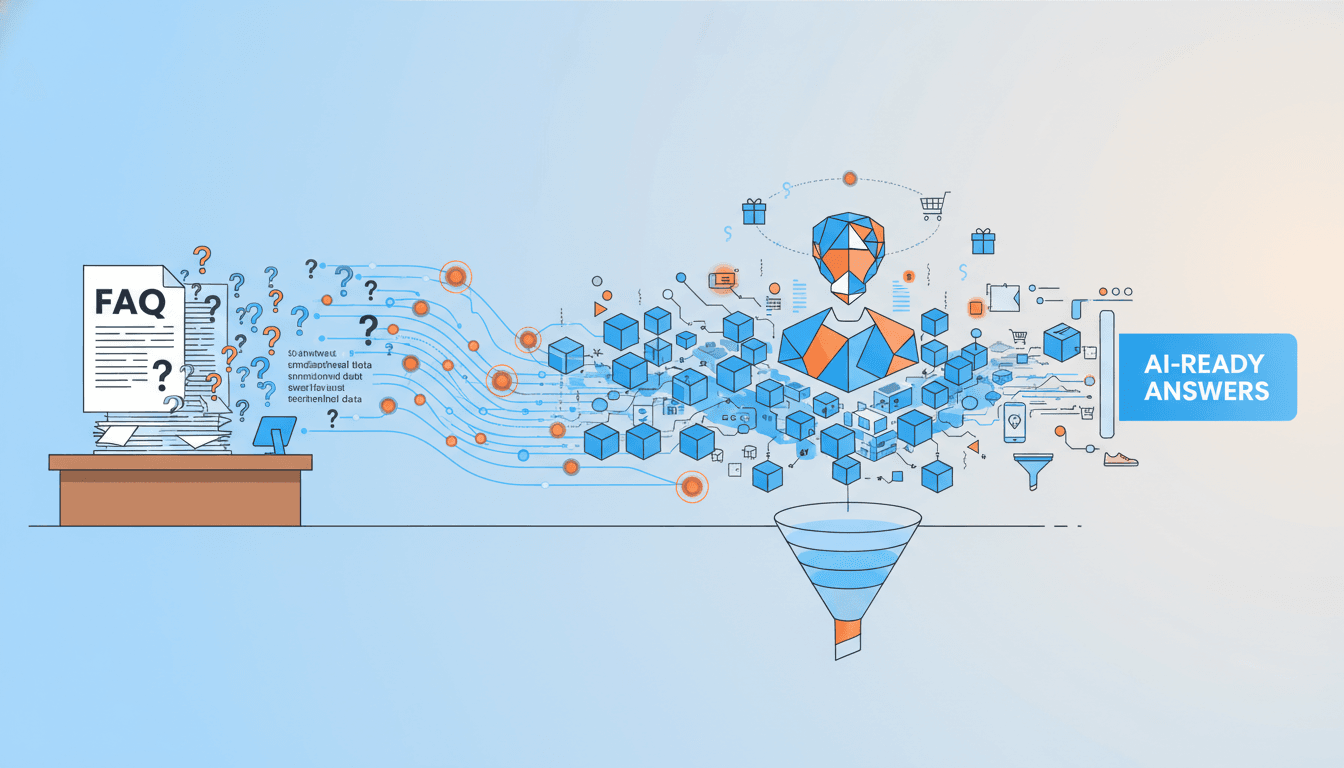
Your FAQ section is one of the highest-leverage content assets in your e-commerce strategy—if it's optimized for the AI assistants that 68% of shoppers now use to research products before buying. Here's how to turn it into a conversion engine.
12 min read
---


# Best Practices for Building AI-Optimized FAQ Sections to Support Medium-Intent E-Commerce Shoppers

FAQ sections represent one of the highest-leverage content assets in e-commerce strategy—particularly when optimized for the AI assistants that 68% of shoppers now use to research products before buying. Here's how to transform an FAQ section into a conversion engine.

[IMG: Split-screen graphic showing a shopper using an AI assistant on a phone alongside an e-commerce FAQ page with schema markup highlighted]


---


## Why Medium-Intent Shoppers Are Turning to AI Search—And Why FAQ Content Matters

FAQ pages serve a purpose far beyond addressing frustrated customers. In 2024, [68% of online shoppers aged 18–45](https://www.salesforce.com/resources/research-reports/state-of-the-connected-customer/) are using AI assistants like ChatGPT and Perplexity to research products before making purchase decisions—up from just 31% in 2022. When FAQ content isn't optimized for AI extraction, brands lose visibility in these critical research moments.

**Medium-intent shoppers** occupy the most valuable—and most underserved—segment of the purchase funnel. These shoppers are aware of their need, actively comparing solutions, and building the trust required to commit. According to Katelyn Bourgoin, Founder & CEO of Customer Camp, medium-intent shoppers represent the most valuable audience in e-commerce because they're actively trying to make a decision rather than browsing casually or preparing to buy immediately.

This behavioral shift demands a new content strategy. Medium-intent queries tend to be comparison-focused, use-case-specific, or trust-building in nature—exactly the type of questions FAQ sections are designed to answer. [74% of online shoppers](https://www.hubspot.com/consumer-behavior-report) report that finding clear, detailed answers during the research phase significantly increases their likelihood of purchasing from that brand.

The engagement data reinforces this opportunity. Medium-intent shoppers spend an average of **2.3 minutes** on well-structured FAQ pages, compared to just 47 seconds on standard product pages, according to [Nielsen Norman Group research](https://www.nngroup.com/). FAQ sections function as a primary touchpoint in the AI-influenced purchase journey, not a support afterthought.

[IMG: Funnel diagram showing medium-intent shoppers at the research stage, with FAQ content as a key touchpoint between awareness and conversion]


---


## How AI Search Engines Use FAQ Content to Generate Recommendations

AI assistants extract, synthesize, and attribute content differently than traditional search engines. ChatGPT, Perplexity, and Google AI Overviews actively pull structured question-and-answer content to respond to shopper queries, with FAQ pages among their most-cited sources. [46% of AI-generated product recommendations](https://www.conductor.com/ai-search-citation-patterns/) in response to medium-intent queries include direct citations from brand FAQ pages.

The extraction process operates through a specific technical hierarchy. AI models prioritize content that uses **natural language question phrasing**, concise direct answers, and semantic HTML markup—specifically [schema.org FAQPage structured data](https://schema.org/FAQPage). Pages with FAQPage schema markup are **3.5 times more likely** to appear in AI-generated summaries compared to pages without it, according to [Ahrefs research](https://ahrefs.com/blog/structured-data-ai-search/).

The competitive gap remains significant. [56% of e-commerce brands](https://www.searchenginejournal.com/ecommerce-seo-audit/) have not yet implemented FAQPage structured data on their product or category pages. For brands that invest in AI-optimized FAQ content now, the window for early-mover advantage remains open.

Lily Ray, VP of SEO Strategy & Research at Amsive, frames the opportunity clearly: generative AI rewards brands that answer comprehensively. When FAQ content is well-structured and directly addresses the questions shoppers ask AI assistants, brands essentially build a pipeline from AI search directly to checkout.

**Transform FAQ sections into conversion-driving assets optimized for AI search. Book a 30-minute strategy call with Hexagon's GEO experts to audit current FAQ performance, identify gaps, and build a roadmap for AI-optimized content. [Book Your Strategy Call](https://calendly.com/ramon-joinhexagon/30min)—limited spots available this month.**


---


## Identifying the Right Questions: A Framework for Medium-Intent FAQ Research

Not all FAQ questions drive equal value. The most effective AI-optimized FAQ sections are built around a **three-category framework** that mirrors how medium-intent shoppers actually research products.

**Comparison questions** address the research stage where shoppers evaluate options. Examples include "How does this compare to [competitor]?" or "What makes this product different?" FAQ pages addressing comparison questions are [3x more likely to be cited by AI assistants](https://www.semrush.com/state-of-search/) than pages covering only basic product or shipping information.

**Trust-building questions** reduce purchase hesitation at critical moments. These include "What is the return policy?", "Are products certified?", and "Where are materials sourced?" AI assistants disproportionately surface these questions in response to "Is [brand] trustworthy?" queries, according to [Baymard Institute research](https://baymard.com/).

**Use-case-specific questions** align directly with medium-intent research patterns. Examples include "Is this product right for [scenario]?" or "Can I use this for [specific application]?" These questions give AI assistants concrete, attributable answers that match how shoppers think about solutions.

To identify priority questions, start with **customer support ticket analysis**. Support logs reveal the exact questions shoppers ask during the research stage, in their own language. Layer in competitor FAQ analysis, AI search query research using tools like Perplexity's research mode, and product review mining for recurring objections.

For example, a mid-range skincare brand might discover through support logs that "Is this fragrance-free?" and "How does this compare to [competitor product]?" are among the most common pre-purchase questions. Both map directly to AI search queries and deserve prominent FAQ placement.

Prioritize questions by two dimensions: **search frequency** and **conversion impact**. Questions that score high on both dimensions should anchor the FAQ section.

[IMG: 2x3 grid visual showing the three FAQ question categories with example questions and AI citation likelihood indicators]


---


## Structuring FAQ Content for Maximum AI Search Impact

Once the right questions are identified, structure and formatting determine whether AI assistants extract and cite the content. Technical and editorial decisions directly influence AI visibility and user engagement.

**Answer length** is the first variable to optimize. Answers between **150–250 words** strike the ideal balance—authoritative enough to be comprehensive, concise enough to be extracted cleanly by AI systems. Answers longer than 300 words are less likely to be fully extracted, while answers under 50 words often lack semantic depth for citation.

Conversational language is equally critical. AI models prioritize content that mirrors how shoppers naturally ask questions, according to [Moz research on the future of search content](https://moz.com/future-of-search). Writing FAQ answers in natural phrasing—rather than formal or technical language—significantly increases match and citation rates.

The technical implementation includes three essential elements:

**FAQPage schema markup** is the single most impactful optimization for AI search visibility. Implementation and validation with [Google's Rich Results Test](https://search.google.com/test/rich-results) is a non-negotiable first step. This structured data tells AI systems exactly which content is question-and-answer formatted.

**Semantic HTML structure** improves AI parsing significantly. Proper heading hierarchy (H2 for questions, paragraph tags for answers), list formatting where appropriate, and clean semantic tags help AI models understand and extract content more accurately.

**Internal linking** guides medium-intent shoppers deeper into the purchase funnel. Each FAQ answer should link to relevant product pages, comparison guides, or category content. This strategy improves conversion from FAQ traffic while signaling content relationships to search systems.

Rand Fishkin, Co-founder & CEO of SparkToro, captures the strategic imperative: the brands winning in AI search have done the unglamorous work of answering every question a shopper might have, in the exact language that shopper would use. FAQ sections function as the new homepage for AI-driven discovery.

[IMG: Annotated screenshot of a well-structured FAQ page showing schema markup, answer length indicators, and internal link placement]


---


## Balancing Trust-Building and Conversion Without Being Overtly Promotional

The most effective FAQ sections walk a precise line: they build confidence without reading like a sales page. Medium-intent shoppers are research-oriented and highly attuned to promotional language—content that feels like an advertisement erodes the trust it's trying to build.

Address **specific purchase hesitations** directly and transparently. Shipping timelines, return policies, material sourcing, and quality certifications are the answers that reduce cart abandonment and increase purchase confidence. [74% of shoppers](https://www.hubspot.com/consumer-behavior-report) cite clear answers as a significant purchase driver.

Authority-building questions—credentials, certifications, guarantees, and third-party validation—build credibility with both AI models and human readers. For example, a supplement brand that answers "Are your products third-party tested?" with a specific, verifiable response signals trustworthiness far more effectively than generic marketing copy.

Avoid these common pitfalls that undermine both AI visibility and user trust:

**Keyword stuffing** reduces AI citation rates and erodes user confidence. Over-optimized answers feel inauthentic to both systems and readers.

**Vague or non-committal answers** fail at their core purpose. Specific, direct responses outperform hedged language in both AI extraction and user satisfaction.

**Aggressive CTAs embedded in answers** interrupt the reader experience. Subtle internal links guide shoppers more effectively than hard-sell language.

Amanda Natividad, VP of Marketing at SparkToro, notes that e-commerce brands treating FAQ sections as strategic content assets—not just support documentation—consistently outperform competitors in AI citation rates.


---


## Measuring FAQ Performance in the AI Search Era

Optimization without measurement is guesswork. Building a performance framework around FAQ content requires tracking both traditional and AI-specific signals.

Monitor these key metrics:

**Organic impressions and clicks from FAQ schema** appear in [Google Search Console](https://search.google.com/search-console/about) when filtering for FAQ-specific rich result impressions. This shows whether AI systems are actually discovering structured content.

**Time-on-page** provides engagement insight. The 2.3-minute benchmark for well-structured FAQ pages serves as a useful baseline for comparison against current performance.

**Conversion rates from FAQ traffic** reveal downstream impact. UTM parameters tagged to FAQ-sourced traffic enable accurate conversion attribution to this content type.

**AI citation rates** show how frequently FAQ content appears in AI-generated responses. Tools like [Semrush](https://www.semrush.com/), [Ahrefs](https://ahrefs.com/), and Perplexity's research mode track when and how FAQ content is cited.

The results of proper optimization are measurable. Brands implementing FAQPage schema and rewriting answers in conversational language can expect measurable lift in Search Console impressions within 4–6 weeks. [FAQ content optimized for AI search increases search impressions by approximately 28%](https://hexagon.com/geo-benchmark-report) compared to unoptimized pages, according to Hexagon's GEO Benchmark Report.

A/B testing FAQ questions and answer structures provides ongoing optimization signals. Testing answer length, question phrasing, and internal link placement identifies what drives both AI citation and on-page conversion.


---


## Common Mistakes to Avoid When Optimizing FAQ Content

Even well-intentioned FAQ optimization efforts fall into predictable traps. Recognizing these mistakes early prevents wasted effort and protects AI visibility.

**Keyword stuffing** makes FAQ answers feel unnatural to both AI models and human readers, reducing citation rates and eroding user trust. Clarity, not keyword density, should guide answer writing.

**Answers that are too long** exceed AI extraction capabilities. Content exceeding 300 words is less likely to be fully extracted by AI assistants. Concise, direct answers consistently outperform exhaustive ones.

**Outdated content** is particularly damaging in the AI search era. FAQ sections reflecting discontinued products, old policies, or superseded information can mislead AI models and damage brand credibility at critical research moments.

**Missing schema markup** leaves significant visibility on the table. With [56% of brands](https://www.searchenginejournal.com/ecommerce-seo-audit/) still lacking FAQPage structured data, brands that implement it see a **3.5x higher AI visibility** advantage.

**Ignoring mobile readability** costs engagement before content has a chance to convert. Medium-intent shoppers frequently research on mobile devices, so FAQ sections must be optimized for smaller screens.


---


## Implementation Roadmap: From Audit to Continuous Optimization

A structured implementation process transforms FAQ optimization from a one-time project into a continuous performance asset. Here's how to follow this five-step roadmap.

**Step 1: Audit existing FAQ content.** Identify gaps, outdated information, and missing schema markup. Most e-commerce brands discover their FAQ sections are incomplete, inconsistently formatted, and lacking structured data.

**Step 2: Identify high-priority questions.** Cross-reference customer support logs, AI search query research, competitor FAQ analysis, and product review mining. Prioritize questions with high search frequency and high conversion impact.

**Step 3: Restructure and rewrite answers.** Apply the 150–250 word target, conversational tone, and semantic HTML formatting. Ensure each answer directly addresses the question without promotional padding.

**Step 4: Implement and validate FAQPage schema markup.** Schema markup implementation is the quickest win for AI search visibility. Validate every page using [Google's Rich Results Test](https://search.google.com/test/rich-results) before publishing.

**Step 5: Build a continuous update process.** Tie FAQ reviews to product launches, policy changes, and performance data cycles. Monthly audits catch outdated information before it influences AI recommendations.

Brands building FAQ optimization into their ongoing content calendar—rather than treating it as a one-time project—maintain a compounding advantage in AI search visibility. [Brands with well-structured FAQ sections experience up to 22% higher conversion rates](https://hexagon.com/ecommerce-conversion-study) from medium-intent traffic, according to Hexagon's E-Commerce Conversion Study.

**Ready to build an AI-optimized FAQ strategy? Book a 30-minute strategy call with Hexagon's GEO experts to audit current FAQ performance, identify gaps, and map out a roadmap. [Book Your Strategy Call](https://calendly.com/ramon-joinhexagon/30min)—limited spots available this month.**


---


## Conclusion: FAQ Optimization as a GEO Strategy

The way medium-intent shoppers research products has fundamentally changed. AI assistants now account for an estimated 2–3 research touchpoints per purchase journey, and [46% of AI-generated product recommendations](https://www.conductor.com/ai-search-citation-patterns/) cite brand FAQ content directly. Brands that answer questions clearly, structurally, and conversationally will dominate AI search results in their category.

The competitive window remains open. [56% of brands](https://www.searchenginejournal.com/ecommerce-seo-audit/) haven't optimized yet—which means early adopters are building AI visibility advantages their competitors will struggle to close. FAQ pages that engage shoppers for 2.3 minutes and directly reduce purchase hesitation are no longer optional; they're a cornerstone of any serious **Generative Engine Optimization (GEO)** strategy.

The question isn't whether to optimize FAQ sections for AI search. It's how quickly brands can do it before competitors do.

**Transform FAQ sections into conversion-driving assets optimized for AI search. Book a 30-minute strategy call with Hexagon's GEO experts and get a clear roadmap for AI-optimized FAQ content that drives measurable results. [Book Your Strategy Call](https://calendly.com/ramon-joinhexagon/30min)—limited spots available this month.**
H
Hexagon Team
Published May 19, 2026