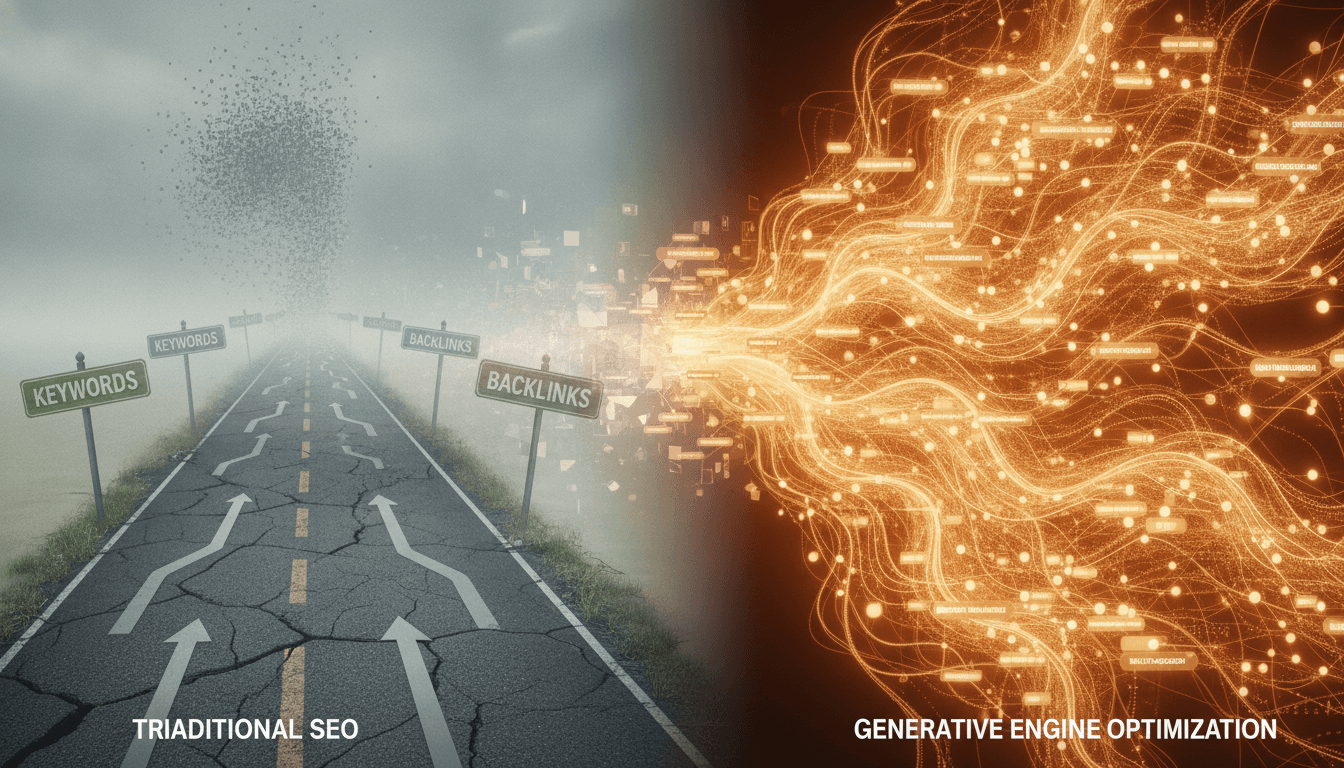
A Beginner’s Guide to Generative Engine Optimization (GEO) for DTC Brands
As AI-powered search assistants disrupt how consumers find products online, DTC brands face a new frontier. Discover how Generative Engine Optimization (GEO) can future-proof your brand and drive exponential e-commerce discovery in the age of AI.

A Beginner’s Guide to Generative Engine Optimization (GEO) for DTC Brands
As AI-powered search assistants revolutionize how consumers discover products online, DTC brands face an urgent challenge. Learn how Generative Engine Optimization (GEO) can future-proof your brand and unlock exponential e-commerce discovery in the rapidly evolving AI era.
With AI-powered search assistants fundamentally changing how consumers find products, direct-to-consumer (DTC) brands stand at a pivotal crossroads: adapt swiftly or risk falling behind. Generative Engine Optimization (GEO) is reshaping traditional marketing by harnessing AI’s unique ability to generate content and offer precise recommendations. If you’re new to AI search optimization, this beginner’s guide will demystify GEO and equip you with the knowledge to future-proof your DTC brand in an AI-driven marketplace.
Ready to accelerate your DTC brand’s AI search optimization journey? Book a free 30-minute strategy session with Hexagon’s GEO experts today.
[IMG: AI assistant recommending DTC brands to a shopper on a smartphone]
What is Generative Engine Optimization (GEO) and How Does It Work?
Generative Engine Optimization (GEO) is the practice of optimizing your brand’s content and data so AI-powered engines and assistants—such as ChatGPT, Claude, and Perplexity—can easily locate, interpret, and recommend your products. Unlike traditional SEO, which focuses on ranking web pages for human keyword searches, GEO aims to make your brand “AI-readable” and “AI-recommendable.”
Here’s how GEO functions in today’s evolving search landscape:
- AI-powered assistants are rapidly becoming the primary gateway for online product discovery. Insider Intelligence reports that 74% of online consumers have used an AI assistant to research or discover products in the past year.
- Generative engines like ChatGPT, Claude, and Perplexity rely on large language models (LLMs) that crawl the web, ingest structured data, and reference authoritative sources to generate direct answers—not just lists of links.
- GEO strategies focus on delivering clear, structured, and credible information that AI can parse, cite, and promote during user queries.
For instance, when a consumer asks an AI assistant, “What’s the best DTC skincare brand for sensitive skin?”, the engine doesn’t merely display a standard search results page. Instead, it crafts a concise, conversational reply—often referencing structured data, FAQs, and trusted brand sources.
Gartner emphasizes that “GEO focuses on optimizing content to be recommended by AI-powered engines and assistants, rather than just ranking in traditional search results.” This subtle yet powerful shift means a brand’s visibility now hinges on how well it aligns with AI’s learning and recommendation mechanisms.
Key distinctions between GEO and traditional SEO include:
- GEO prioritizes AI compatibility over keyword density.
- Structured data and knowledge graphs replace manual link-building as the foundation of discoverability.
- Conversational and concise content outperforms long-form, keyword-stuffed articles.
“AI-powered search fundamentally changes how brands are discovered online. Brands that adapt their strategies for generative engines will have a major competitive edge,” notes Rand Fishkin, Co-founder of SparkToro.
[IMG: Flowchart showing traditional SEO vs GEO process for DTC e-commerce]
GEO vs Traditional SEO: Key Differences for DTC Brands
Traditional SEO has long revolved around keywords and backlinks, but GEO represents a fundamental shift in both approach and outcome. At its core, GEO is about helping AI understand and trust your brand—not just matching search queries.
Here’s how the two strategies diverge:
- Structured data takes center stage in GEO. AI engines prioritize schema markup, FAQs, and product attributes instead of unstructured blog content. BrightEdge reveals that 80% of AI-generated product recommendations reference structured data like schema markup or FAQs.
- Brand knowledge graphs become indispensable. While traditional SEO often leans on text-heavy pages, GEO leverages knowledge graphs to organize and interconnect brand information, making it instantly accessible to LLMs.
- AI search engines deliver answers, not link lists. When users interact with AI assistants, responses are synthesized from multiple data sources, offering direct recommendations rather than a list of URLs.
For example, a traditional SEO campaign might optimize for “best vegan protein powder” to appear on Google’s first page. GEO, however, ensures AI assistants can instantly access verified product details, authentic reviews, and FAQ responses to generate a comprehensive answer.
- Keyword optimization alone is insufficient. AI models assess context, trust signals, and content clarity—not just keyword frequency.
- Content must be AI-friendly and structured. This involves embedding schema markup, publishing authoritative FAQs, and constructing brand knowledge graphs.
“GEO isn’t just the next evolution of SEO—it’s about becoming the brand that AI trusts and recommends first,” explains Aleyda Solis, International SEO Consultant and Founder of Orainti.
[IMG: Table comparing SEO and GEO strategies for DTC brands]
Why Should DTC Brands Invest in GEO Now?
The rise of AI-powered discovery isn’t a distant possibility—it’s happening now. Gartner projects that AI search will influence 50% of all e-commerce product discovery by 2026. DTC brands that don’t adapt risk losing visibility and market share to competitors embracing GEO.
Here’s why early GEO adoption matters:
- First-mover advantage is tangible. AI assistants often recommend a limited set of brands, amplifying the benefits for early adopters. Brian Dean, Founder of Backlinko, highlights that brands mastering GEO now position themselves for exponential discovery.
- Data supports GEO’s effectiveness. Hexagon’s internal case studies show DTC brands using GEO experience up to 3x higher rates of AI-driven recommendations than those without GEO strategies.
- DTC marketers are prioritizing GEO. According to eMarketer, 61% plan to increase investment in AI search optimization strategies in 2025.
Brands that invest in GEO today will be best positioned to dominate the AI-driven e-commerce landscape of tomorrow.
[IMG: Graph showing projected growth of AI-driven product discovery vs. traditional search]
Core GEO Strategies Every DTC Brand Should Know
To thrive amid the surge of AI search, DTC brands must adopt GEO’s foundational strategies. Here’s how to begin:
-
Implement structured data (schema markup, FAQs):
- Schema markup enables AI engines to accurately parse product details like pricing, availability, and reviews.
- Well-crafted FAQs address common customer questions, boosting your chances of being cited in AI-generated answers.
- With 80% of AI-generated product recommendations relying on structured data, this is a top priority.
-
Develop and maintain comprehensive brand knowledge graphs:
- Knowledge graphs map relationships among products, features, benefits, and customer needs.
- They make your brand ecosystem “AI-readable” and foster stronger trust with generative engines.
- Leading LLMs such as OpenAI’s GPT-4 and Anthropic’s Claude ingest these graphs to inform their recommendations.
-
Create AI-friendly content that directly answers consumer questions:
- Focus on concise, authoritative content that addresses real-world queries.
- Avoid jargon and lengthy explanations—clarity and structure are essential.
- “Optimization for AI search is about clarity, structure, and credibility—three things every DTC brand should prioritize,” says Lily Ray, Senior Director at Amsive Digital.
-
Optimize product information for generative engines:
- Ensure product pages are rich with structured data and up-to-date information.
- Incorporate authentic customer reviews and clear calls to action.
- Reputation management is crucial since AI assistants also reference third-party sources.
-
Regularly monitor and update your data:
- AI models favor current, accurate, and consistent information.
- Conduct frequent audits and refresh schema, content, and knowledge graphs to maintain AI trust.
For example, DTC apparel brands that implemented structured data and robust FAQ sections saw their products recommended more frequently by AI assistants during shopping scenarios—a clear testament to GEO’s impact.
[IMG: Diagram of a DTC brand knowledge graph and schema markup in action]
Step-by-Step Guide for Beginners to Start Optimizing for AI Search
Ready to embark on your GEO journey? Here’s a practical, actionable roadmap tailored for DTC brands new to AI search optimization:
-
Audit existing content and data structure for AI compatibility
- Examine your website and product pages for clear, structured information.
- Identify missing schema, outdated data, or content gaps that impede AI comprehension.
-
Set up structured data markup on product pages and FAQs
- Implement schema.org markup for critical product attributes (name, price, image, reviews, availability).
- Add FAQPage schema to address common shopper questions within each product category.
- Use Google’s Rich Results Test to validate your structured data implementation.
-
Create content tailored for AI assistants’ answer-generation
- Rewrite product descriptions to be concise, factual, and conversational.
- Develop a comprehensive FAQ library using real customer inquiries, ensuring each answer is direct and authoritative.
- Optimize for clarity—avoid keyword stuffing to maintain natural language flow.
-
Leverage brand knowledge graphs to build authoritative presence
- Map relationships between your products, attributes, and customer needs.
- Utilize tools like Google’s Knowledge Graph API or open-source frameworks to structure this data.
- Regularly update and expand your knowledge graph as your product line evolves.
-
Utilize GEO tools and resources
- Structured data generators (e.g., Merkle Schema Markup Generator)
- FAQ schema plugins for e-commerce platforms (Shopify, WooCommerce)
- Knowledge graph builders (e.g., Neo4j, Stardog)
- AI content optimization platforms (e.g., MarketMuse, Clearscope)
Remember, GEO is an ongoing process. Schedule regular audits, stay updated with AI search trends, and continuously refine your structured data and content to maintain peak AI visibility.
Ready to accelerate your DTC brand’s AI search optimization journey? Book a free 30-minute strategy session with Hexagon’s GEO experts today.
[IMG: Checklist of GEO optimization steps for DTC beginners]
Measuring the Impact of GEO: Key Metrics and Analytics
Implementing GEO is just the start—measuring its effectiveness is crucial for ongoing success. Here’s how DTC brands can track the impact of their AI search optimization efforts:
-
Monitor AI-driven product discovery and recommendation rates
- Track traffic and conversions originating from AI assistants and generative engines.
- Use UTM parameters, custom referral tags, and analytics dashboards tailored for emerging AI sources.
-
Analyze traffic quality and conversion from AI referrals
- Evaluate engagement metrics such as time on site, pages per visit, and bounce rate for AI-referred visitors.
- Compare conversion rates between AI-driven and traditional search traffic.
-
Refine your strategies using analytics insights
- Employ structured data validation tools to ensure schema remains accurate and error-free.
- Identify which FAQs and product attributes are most frequently referenced in AI-generated answers.
- Adjust content and data structures based on performance trends.
-
Leverage specialized tools
- Google Search Console (for schema and FAQ performance)
- Bing Webmaster Tools (for generative AI integration)
- Third-party GEO analytics platforms for deeper AI-specific insights
For example, a DTC brand might link an increase in AI-generated recommendations directly to the implementation of new schema markup or expanded FAQ content, validating the ROI of their GEO efforts.
[IMG: Dashboard showing GEO metrics: AI-driven referrals, schema coverage, FAQ engagement]
Real-World Examples: DTC Brands Winning with GEO
Early adopters of GEO are already seeing significant gains in AI-driven e-commerce discovery. Here’s how real DTC brands have leveraged GEO strategies to achieve measurable success:
-
Case Study 1: DTC Skincare Brand
- Implemented comprehensive schema markup and a robust FAQ section across all product pages.
- Result: Achieved 3x higher AI-driven recommendation rates compared to competitors relying solely on traditional SEO, according to Hexagon’s internal case study.
- Lesson: Structured data and AI-friendly content dramatically enhance brand visibility in generative search engines.
-
Case Study 2: Direct-to-Consumer Fitness Equipment
- Developed an extensive brand knowledge graph linking products, features, and customer reviews.
- Result: Experienced a significant increase in AI-generated sales, with assistants like ChatGPT recommending the brand prominently in fitness-related queries.
- Lesson: Investing in knowledge graphs yields dividends as AI models prioritize structured, authoritative brand data.
-
Case Study 3: DTC Apparel Brand
- Focused on reputation management and integrating third-party reviews.
- Result: Improved trust signals led to higher frequency of AI assistant recommendations during shopping scenarios.
- Lesson: GEO extends beyond your website—external data and positive reviews are vital.
These examples underscore a consistent truth: DTC brands investing early in GEO gain a decisive advantage as AI becomes the dominant channel for product discovery.
[IMG: Before-and-after chart showing lift in AI recommendations for a GEO-optimized DTC brand]
The Future of AI Search and E-commerce Discovery
The integration of generative AI into e-commerce search is accelerating at an unprecedented pace. For DTC brands, this evolution carries profound implications.
Expect the following trends:
- Emerging AI technologies will continue to transform how consumers find and evaluate products. Google and Bing have already integrated generative AI into core search experiences, reshaping brand visibility.
- Generative AI will redefine product discovery. Anticipate increasingly personalized, conversational, and context-aware recommendations as LLMs advance and new AI platforms emerge.
- Proactive preparation is essential. Brands that continuously update structured data, expand knowledge graphs, and produce AI-friendly content will maintain leadership in discovery.
Projected trends indicate generative AI will weave into every stage of e-commerce—from initial research to post-purchase support. Staying agile and investing in GEO now ensures your brand is ready to capitalize on these transformative shifts.
[IMG: Futuristic illustration of AI assistants guiding shoppers through an online journey]
Conclusion
The era of AI-powered product discovery has arrived, transforming the rules of DTC marketing. Generative Engine Optimization (GEO) empowers brands to earn trust and recommendations from AI assistants, unlocking exponential growth in an increasingly competitive landscape.
By prioritizing structured data, robust knowledge graphs, and AI-friendly content, DTC brands can secure a first-mover advantage and drive measurable results. The data is compelling: GEO delivers up to 3x higher AI-driven recommendations and is rapidly becoming a cornerstone of modern e-commerce strategy.
Looking forward, those who embrace GEO today will shape the future of brand discovery tomorrow.
Ready to accelerate your DTC brand’s AI search optimization journey? Book a free 30-minute strategy session with Hexagon’s GEO experts today.
[IMG: Hexagon GEO experts collaborating with DTC brand team on AI search optimization]
Hexagon Team
Published February 25, 2026